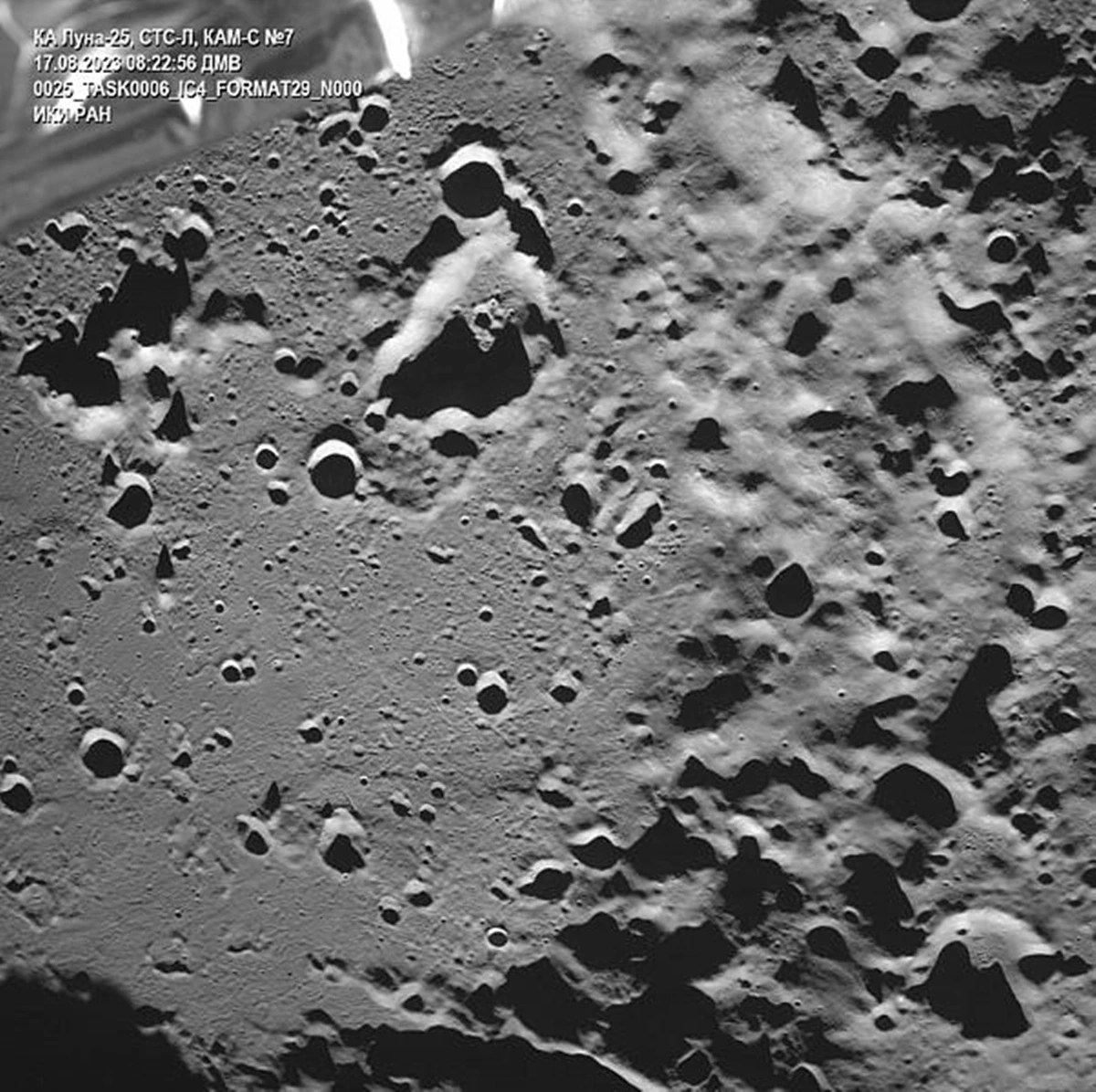
Image (Credit): The Zeeman crater as captured by Luna-25. (IKI RAS)
The first images from Russia’s Luna-25 mission have arrived. They show the far side of the Moon permanently hidden from those of us here on Earth.
The spacecraft is now orbiting the Moon, which was last done by the Russians back in 1976. The lander is expected to be on the lunar surface this Monday if all goes well.
For the sake of science (leaving politics out of it), let’s hope for a successful landing.
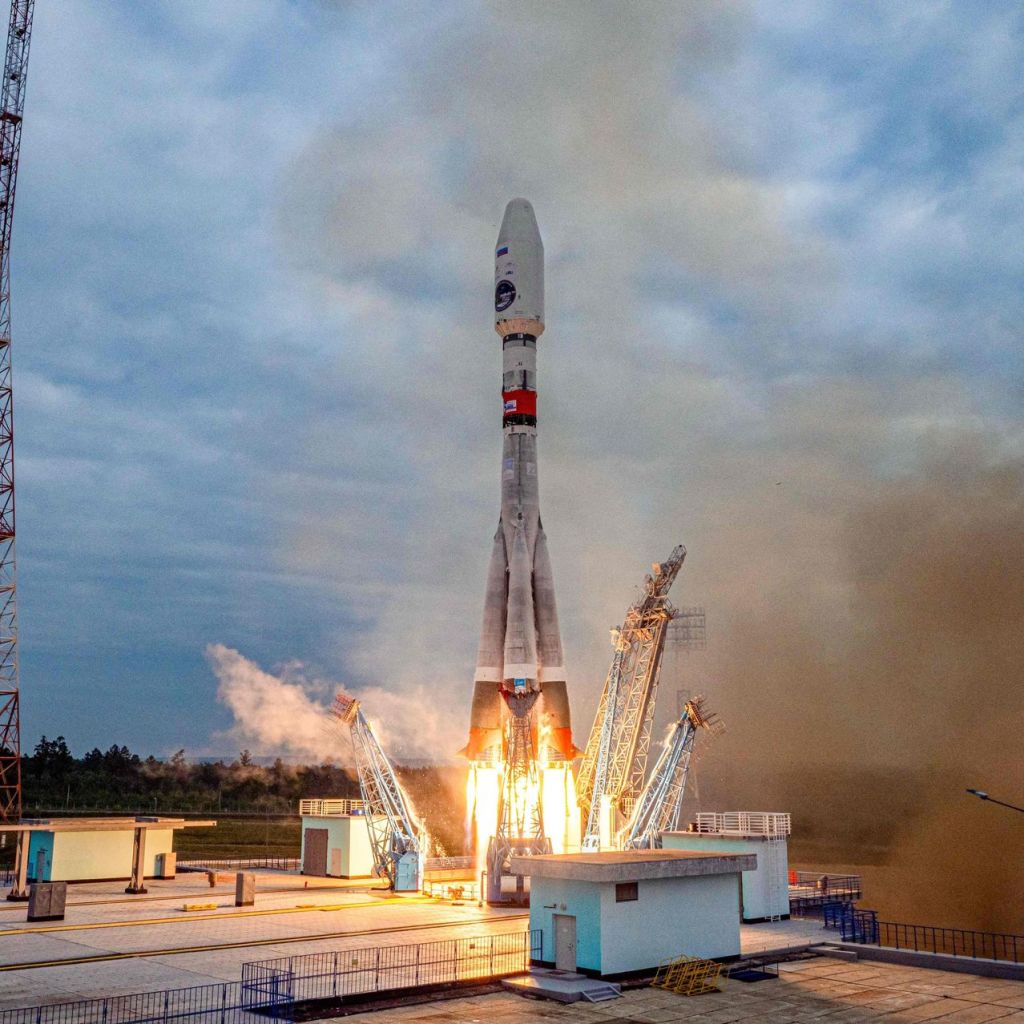
Image (Credit): The Soyuz rocket carrying the Luna-25 lander launched from Russia’s Vostochny Cosmodrome. (Agence France-Presse)
Russia’s Luna-25 mission has begun with the successful lift-off of the Soyuz 2.1 rocket yesterday (2:11 a.m. on Friday Moscow time or Thursday at 7:10 pm EDT). After its planned arrival on August 21, Luna-25 will be searching for water at the lunar south pole.
The mission was off and then on again over the years as Russia became super cautious with its return to the Moon. The country’s invasion of Ukraine led to the loss of European partners as well as sanction-related shortages, so Russia has no one to blame but itself. Science was pushed aside as it bullied its neighbors.
One can only wonder whether Russia knows how to start anew. Even the name of the mission, Luna, is a Cold War leftover. It would be the same as NASA restarting the Apollo program rather than the more comprehensive and Mars-focused Artemis mission.
There is plenty of room on the Moon for multiple national missions. Moreover, similar to the International Space Station, it would be beneficial for US and Russian scientists to share data and ideas. It would just be easier if Russian rockets were only focused on the Moon rather than Ukrainian cities.
The length of Mars’ day is shortening by three-quarters of a millisecond each year as the planet’s rotation spins up, according to new results from NASA’s InSight lander…Planetary scientists are not entirely sure why this is happening, but it is likely related to the redistribution of Mars’ mass, which can have an effect on the planet’s rotation like an ice skater pulling in their arms to spin faster. This redistribution might be caused by the accumulation of ice on Mars’ polar caps, experts believe, or by the surface itself slowly rebounding from residing under the weight of immense glaciers that existed at equatorial latitudes during the world’s most recent ice ages, which ended about 400,000 years ago.
NASA has left the door open for changing the scope of Artemis 3, currently set to be the first crewed lunar landing of the program, if key elements suffer major delays. Speaking at an Aug. 8 briefing at the Kennedy Space Center, Jim Free, NASA associate administrator for exploration systems development, said the Artemis 3 mission still has a formal launch date of December 2025 but that he was monitoring potential delays in hardware needed for the mission. “We may end up flying a different mission if that’s the case,” he said. “If we have these big slips out, we’ve looked at if can we do other missions.” Artemis 3 could also change based on the outcome of Artemis 2, he added.
One of the oldest known objects in the universe is wandering around the Milky Way. Star cluster M92, a densely packed ball of stars roughly 27,000 light-years from Earth, is about 13.8 billion years old, researchers report in a paper submitted June 3 to arXiv.org. The newly refined age estimate makes this clump of stars nearly the same age as the universe. Refining the ages of clusters like M92 can help put limits on the age of the universe itself. It can also help solve cosmic conundrums about how the universe evolved.
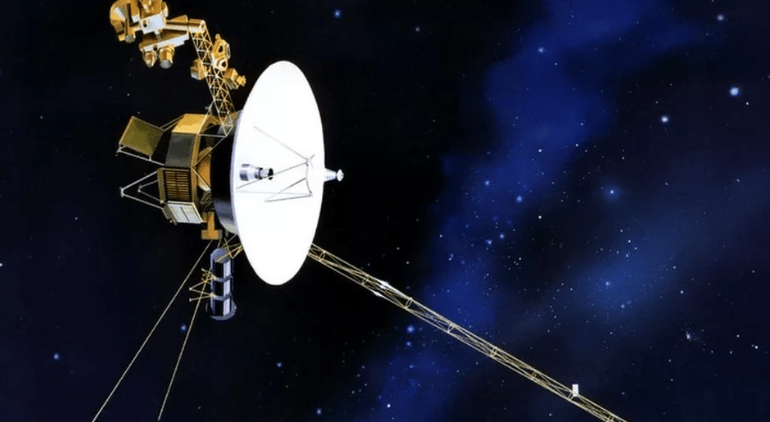
Image (Credit): Artist’s rendering of Voyager 2. (NASA)
After two weeks with no word, Voyager 2 is back to communicating with us as it continues its journey beyond our solar system. The whole incident started when NASA sent a bad command, but all is well.
Voyager 2 first left Earth back in August 1977 and exited the solar system in December 2018. Like Voyager 1, which is also outside the solar system now, Voyager 2 had the initial task of studying the planets. Voyager 2 focused on Jupiter, Saturn, Uranus and Neptune. It has shown it was capable of much more as it dragged the human race to the bleeding edge of space.
You can read all about Voyager 2’s accomplishments at this NASA site, including:
Voyager 2 is the only spacecraft to study all four of the solar system’s giant planets at close range.
Voyager 2 discovered a 14th moon at Jupiter.
Voyager 2 was the first human-made object to fly past Uranus.
At Uranus, Voyager 2 discovered 10 new moons and two new rings.
Voyager 2 was the first human-made object to fly by Neptune.
At Neptune, Voyager 2 discovered five moons, four rings, and a “Great Dark Spot.”
An impressive list of accomplishments, and the spacecraft is still ticking as it goes into the great unknown.
We need to keep these achievements in mind as we battle over this year’s NASA budget. We also need to remember that there was supposed to be four Voyager-like spacecraft rather than two, but budget cuts nixed the second set. Meaning we can still get some great things done even if we don’t have the budget to fund every piece of a grand vision.
NASA’s Mars Ascent Vehicle (MAV) recently reached some major milestones in support of the Mars Sample Return program. The Mars Ascent Vehicle would be the first launch of a rocket from the surface of another planet. The team developing MAV conducted successful tests of the first and second stage solid rocket motors needed for the launch.Mars Sample Return will bring scientifically selected samples to Earth for study using the most sophisticated instrumentation around the world. This strategic partnership with ESA (European Space Agency) features the first mission to return samples from another planet. The samples currently being collected by NASA’s Perseverance Rover during its exploration of an ancient river delta have the potential to reveal the early evolution of Mars, including the potential for ancient life.
The James Webb Space Telescope has spotted objects in the early universe that might be a new kind of star — one powered by dark matter. These “dark stars” are still hypothetical. Their identification in JWST images is far from certain. But if any of the three candidates — reported in the July 25 Proceedings of the National Academy of Sciences — turn out to be this new type of star, they could offer a glimpse of star formation in the early universe, hint at the nature of dark matter and possibly explain the origins of supermassive black holes.
The head of Russia’s space agency has extended an offer to Moscow’s partners in the BRICS group – Brazil, India, China and South Africa – to participate in the construction of a joint module for its planned orbital space station, state media reported Monday. Construction of the planned space station follows Moscow’s decision last year to end its decades-long partnership with NASA and withdraw from the aging International Space Station – one of the last remaining channels of cooperation between Russia and the United States.



 Our Awesome Universe