Space Mission: IBEX is Not Communicating with NASA

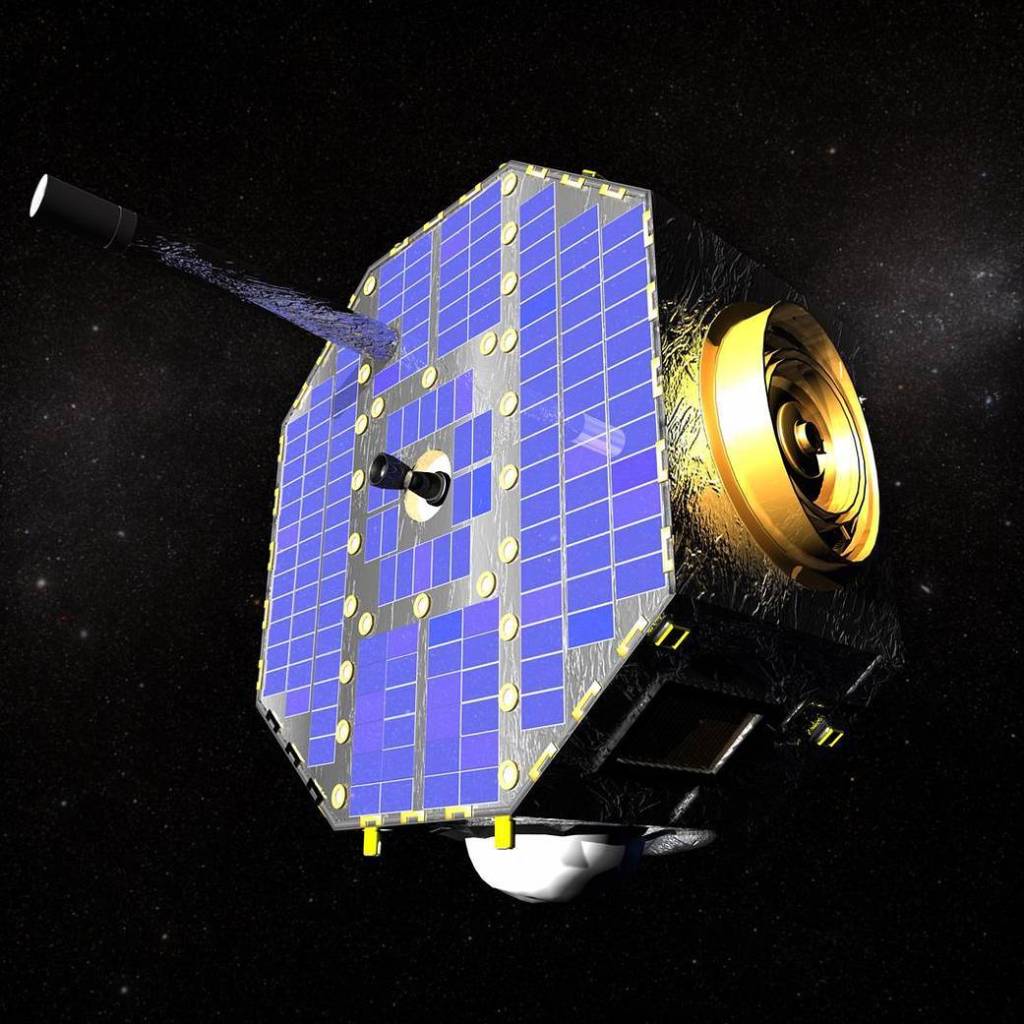
Image (Credit): Artist’s rendering of NASA’s IBEX spacecraft. (NASA)

NASA’s Interstellar Boundary Explorer (IBEX) is having some problems. On February 18, the IBEX flight computer reset itself and placed the spacecraft into contingency mode. This is not good for it ongoing mission to map the boundary of our solar system. The spacecraft’s system should do a full reset again in a few days, so NASA may get a break and be able to communicate with IBEX again shortly.

The IBEX spacecraft was launched back in October 2018 as the first spacecraft specifically designed to collect data across the entire sky about the heliosphere and its boundary. The mission has already been very instructive, as NASA explains:

Scientists have used this [IBEX] data to make the first maps of our heliosphere boundary. Our heliosphere boundary does not emit light that we can detect, which means it would be impossible to image using conventional telescopes. Instead of collecting light, like other telescopes do, IBEX collects particles coming from the boundary so that we can learn about the processes occurring there. The boundary of the Solar System protects us from harmful cosmic rays. Without it, four times more cosmic rays would enter our Solar System and potentially damage our ozone layer and DNA. It is important to study this region to know how it works.

Image (Credit): Artist’s rending of our solar system’s heliosphere. (NASA/IBEX/Adler Planetarium)

Update: As of March 2, the IBEX spacecraft is fully functional again. You can read more about it here.

Space Mission: What’s Up with Juno?

Image (Credit): Image from “Where is Juno” earlier today showing its approximate location in relation to other bodies in the solar system. (NASA)

Are we witnessing the slow blinding of the Juno spacecraft? NASA is having trouble receiving images from the spacecraft’s solar-powered JunoCam. As a result, of the 258 images recently obtained by NASA, only 44 were usable. NASA is still investigating this issue and hopes to come up with a way to mitigate it.

Launched in August 2011, Juno has been a reliable workhorse studying the secrets of Jupiter while also capturing amazing images of the planet and its 80+ moons since it entered into Jovian orbit on July 4, 2016. Its extended mission was supposed to last until September 2025, harvesting additional data to assist NASA’s upcoming Europa Clipper mission as well as the European Space Agency’s Jupiter Icy Moons Explorer (JUICE) mission.

While Juno has numerous scientific instruments that are still plugging away producing key data on Jupiter and its surroundings, the images were an important link between the mission and the public. The images shown below are just a small sample of what has been sent back (click here for more). It will be a sad day when we can no longer see the Jovian neighborhood in this way.

Image (Credit): The shadow of the moon Io on Jupiter. (NASA/JPL-Caltech/SwRI/MSSS)
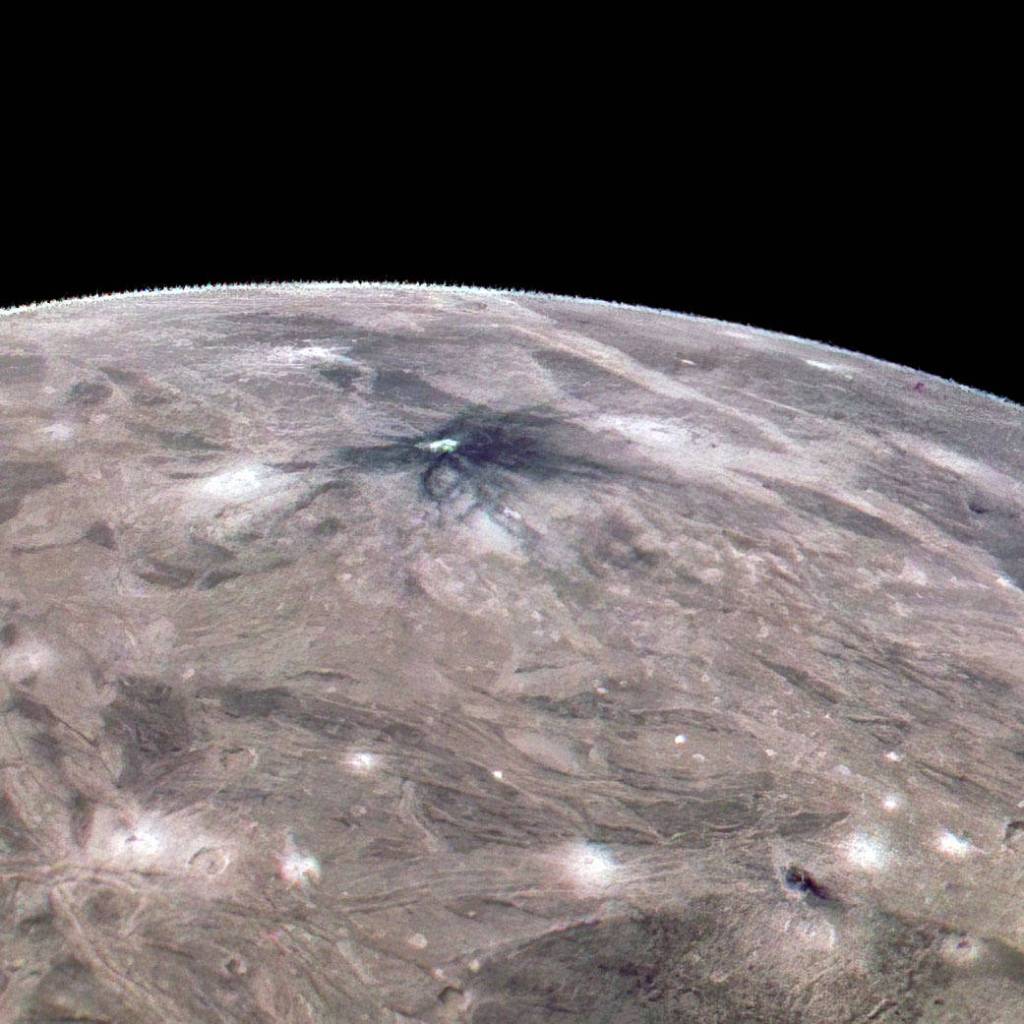
Image (Credit): The surface of Jupiter’s moon Ganymede. (NASA/JPL-Caltech/SwRI/MSSS)
Image (Credit): Jupiter’s south pole. (NASA/JPL-Caltech/SwRI/MSSS/John Landino)

Space Mission: Ongoing Problems with Lucy’s Sails

Image (Credit): Artist’s rendering of Lucy near an asteroid. The two large discs are the solar arrays. (Southwest Research Institute)

NASA’s Lucy spacecraft continues to face some engineering issues as it travels away from Earth after the first of two flybys before it can reach the Trojan asteroids where it will begin its survey. While the earlier problems with deploying its solar array continue, the matter will most likely need to be resolved in 2024 when the spacecraft is closer to Earth again. Fortunately, the array is 98 percent deployed, so there is no risk to the 12-year mission at this time.

NASA will keep all of us posted. You can read more about the solar array issues here.

Image (Credit):  Lucy’s orbital path (shown in green). (NASA)

Space Mission: The End of InSight Mars Lander

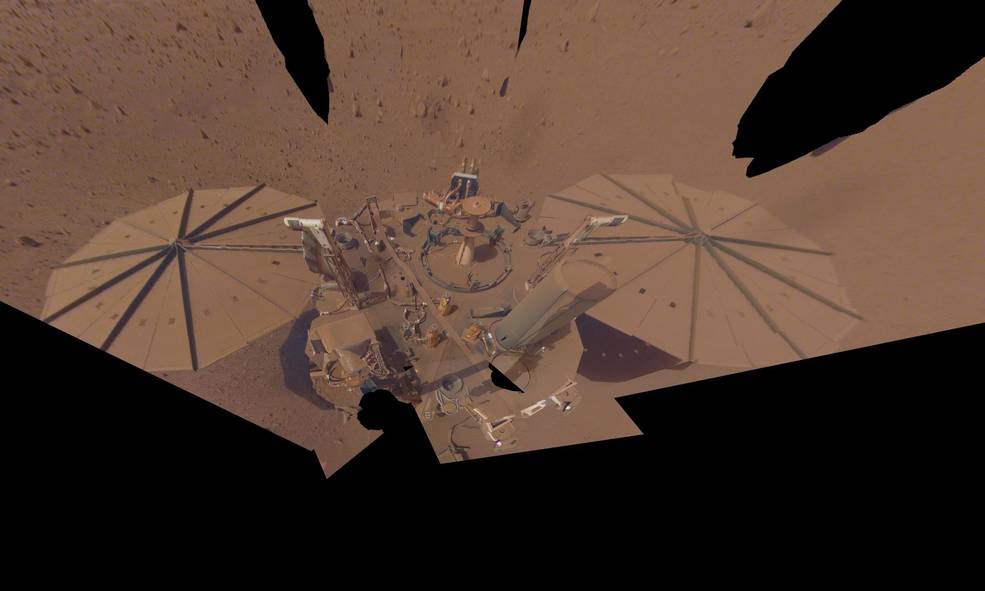
Image (Credit): The final selfie taken by NASA’s InSight Mars lander on April 24, 2022. (NASA)

NASA’s Jet Propulsion Laboratory (JPL) is no longer able to contact the Interior Exploration using Seismic Investigations, Geodesy and Heat Transport (InSight) Mars lander, which has been hard at work on the Red Planet for the past four years detecting more than 1,300 marsquakes. However, the accumulation of dust on the lander’s solar panels has ended its ability to power itself. The last communication from InSight was December 15.

Philippe Lognonné of Institut de Physique du Globe de Paris, principal investigator of InSight’s seismometer, stated:

With InSight, seismology was the focus of a mission beyond Earth for the first time since the Apollo missions, when astronauts brought seismometers to the Moon…We broke new ground, and our science team can be proud of all that we’ve learned along the way.

You can read more about the InSight Mar lander’s findings here.

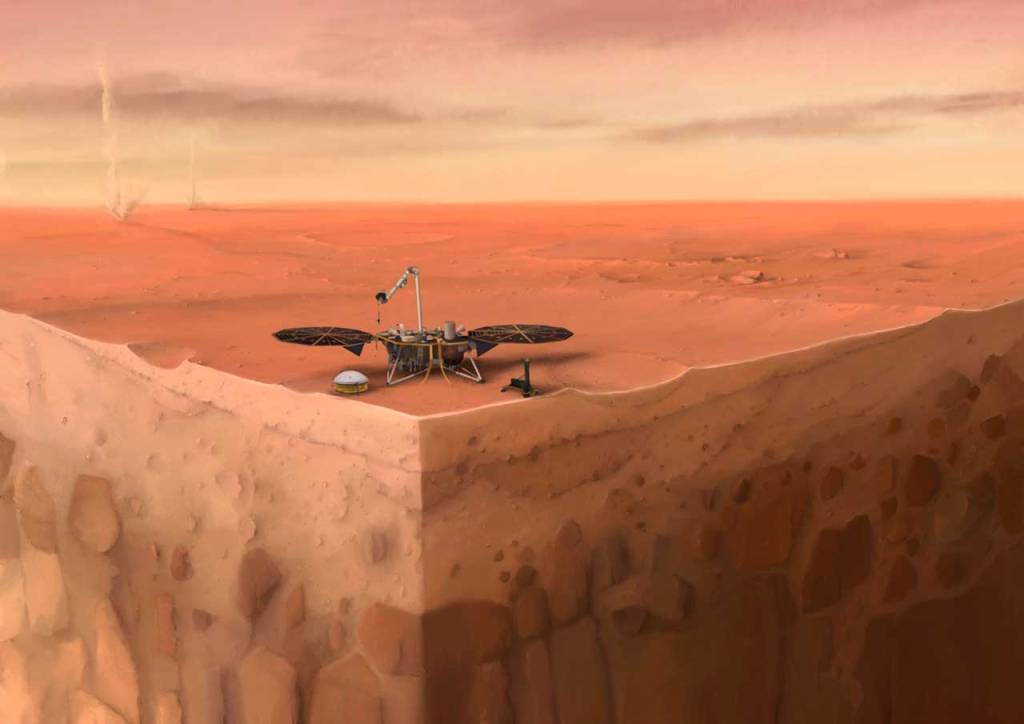
Image (Credit): Artist’s concept of NASA’s InSight lander on Mars, showing layers of the planet’s subsurface below and dust devils on the surface. (IPGP/Nicolas Sarter)

Space Mission: Saudi Arabians to Visit the International Space Station

Image (Credit): Nighttime photograph of Riyadh, Saudi Arabia, taken in November 2012 by one of the Expedition 33 crew members aboard the ISS. (NASA)

While the Biden Administration appears to have its issues with Saudi Arabia, this is not stopping the visit of two Saudi Arabian private astronauts to the International Space Station (ISS). Space News reports that NASA has confirmed that a male and female astronaut from Saudi Arabia will travel to the ISS next spring aboard a SpaceX rocket as part of the privately-run Axiom Space. Plans for this mission were reported back in September.

This will be the second Axiom Space mission to the ISS. Other missions are being planned involving additional countries, including astronauts from Turkey, Hungary, Canada, and the United Arab Emirates. Mission participants need to be approved by a NASA-chaired panel that includes the countries involved with the ISS program.

Axiom Space will send four crew members to the ISS for 12 days. Here is the pitch for the second mission, or Ax-2:

The Axiom Mission 2 (Ax-2) astronauts are part of the latest class of space explorers and Axiom’s next crew to advance a new method of access to the International Space Station (ISS) and low-Earth orbit. Aboard the orbiting laboratory, the four-person, multinational crew will conduct extensive research, investigate novel technologies, and engage with audiences around the world as champions of science, technology, engineering, mathematics, and the arts. Their efforts will continue to lay the groundwork and establish key capabilities for the future Axiom Station, the world’s first commercial space station.  

You may recall that Saudi Arabia also signed onto the Artemis Accords over the summer. The Accords were established in 2020 to affirm each signatory’s commitment to sustainable space exploration “guided by a common set of principles that promote the beneficial use of space for all of humanity.”

All of this shows that space still remains a realm that does not need to be militarized or abused even if we have yet to figure out to resolve these issues here on Earth. Whatever problems with have with our neighbors, it’s good to see we are building some things together.

As noted earlier, even if the press on this Ax-2 mission demonstrates some unity, let’s just hope these “astronauts” are there for more than a joy ride. I am not convinced that space tourism is what we need. But given that Axiom Space is considering its own commercial space station, maybe there is some interest in real work in space by these parties.