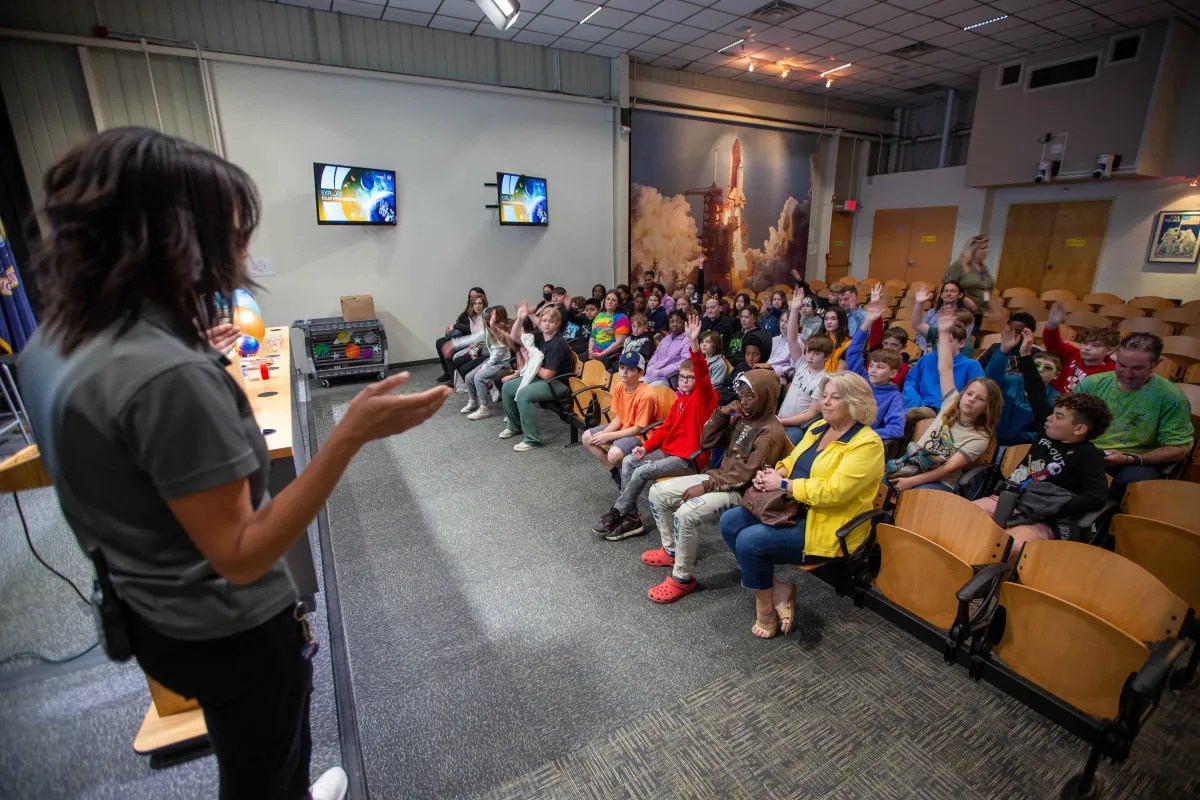
Image (Credit): Presentation to students at the Wallops Flight Facility Visitor Center. (Wallops Flight Facility Visitor Center).
“This is an unacceptable and drastic step that will have a significant impact on local employees, residents, and visitors…My staff and I are in contact with NASA to better understand the reasoning behind this reported decision as it is contradictory to the proposed House budget. Wallops has long been a vital part of our community, and we will do everything we can to support the work that’s done there and the people who work there.”
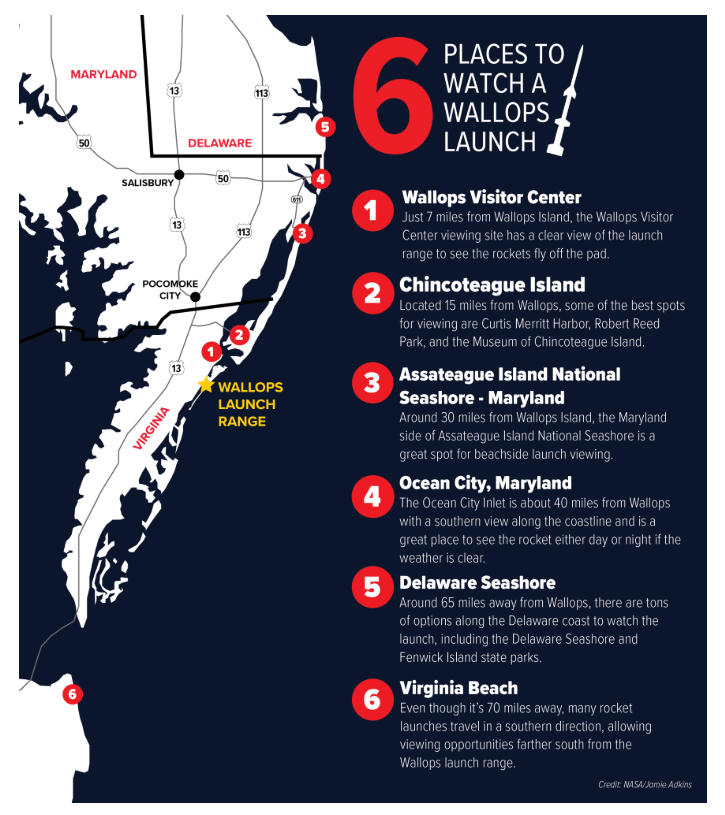
-Statement by Congresswoman Jen Kiggans (R-VA), as quoted in The Virginian-Pilot, after NASA announced plans to close the visitor center at the Wallops Flight Facility on the Virginia coast. The visitor center has a NASA museum visited by students on field trips as well as the general public. It also acts as a viewing location for rocket launches from the site, which includes unmanned cargo missions to the International Space Station. Surprisingly, the White House did not bother keeping even the Republican congressional members in the loop on these cuts. Cutting back on public outreach is a sure way to undermine support for US space missions.
The Trump administration has asked NASA employees to draw up plans to end at least two major satellite missions, according to current and former NASA staffers. If the plans are carried out, one of the missions would be permanently terminated, because the satellite would burn up in the atmosphere. The data the two missions collect is widely used, including by scientists, oil and gas companies and farmers who need detailed information about carbon dioxide and crop health. They are the only two federal satellite missions that were designed and built specifically to monitor planet-warming greenhouse gases.
Acting NASA Administrator Sean Duffy has directed the agency to fast-track plans to put a nuclear reactor on the moon. Expediting work to place a reactor on the lunar surface to help power moon exploration efforts would keep the United States ahead of China and Russia, both of which have “announced on at least three occasions” a joint effort to develop such a project by the mid-2030s, according to a directive dated July 31 and obtained by CNN.
NASA’s Lunar Trailblazer ended its mission to the Moon on July 31. Despite extensive efforts, mission operators were unable to establish two-way communications after losing contact with the spacecraft the day following its Feb. 26 launch. The mission aimed to produce high-resolution maps of water on the Moon’s surface and determine what form the water is in, how much is there, and how it changes over time. The maps would have supported future robotic and human exploration of the Moon as well as commercial interests while also contributing to the understanding of water cycles on airless bodies throughout the solar system.
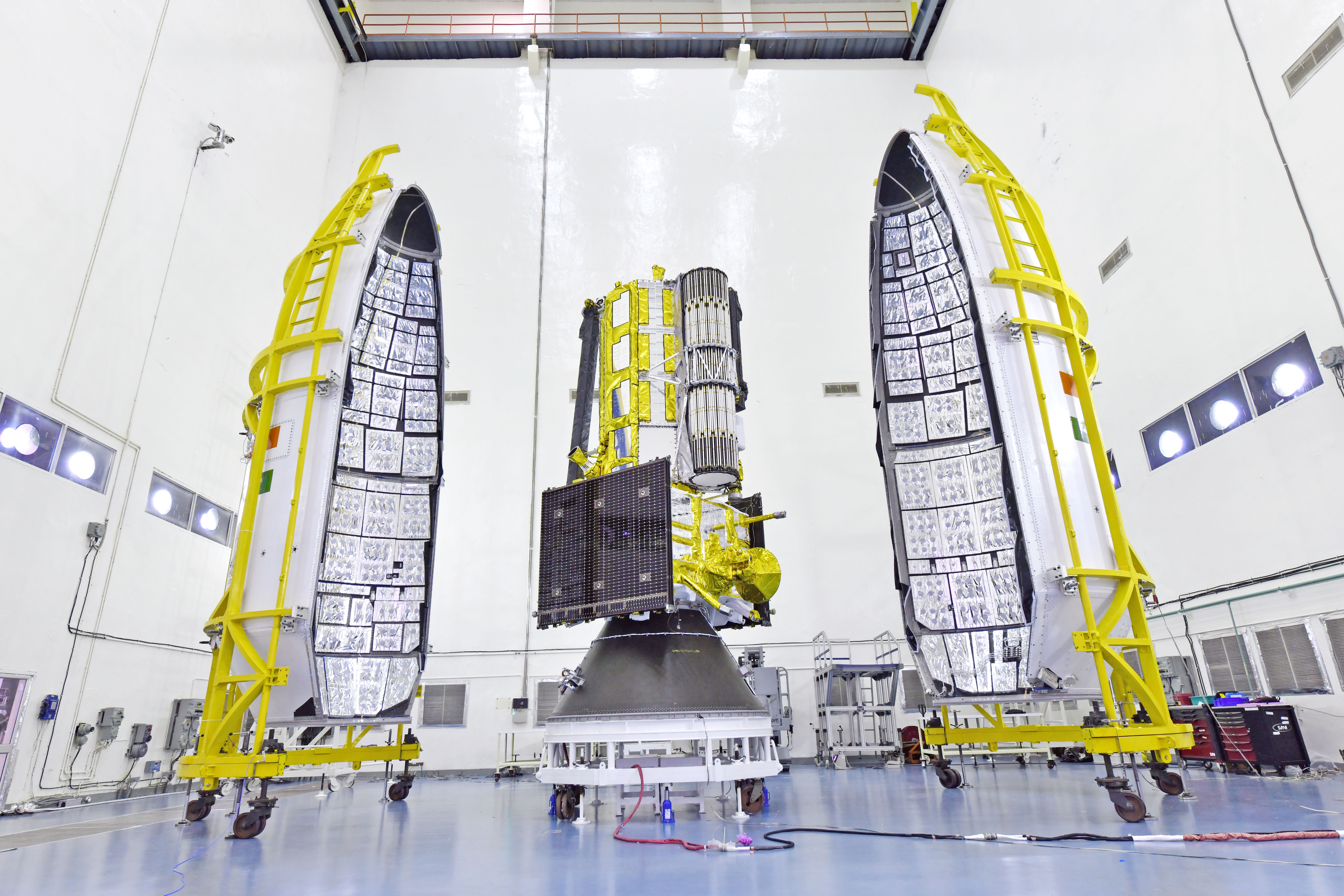
Image (Credit): The NISAR satellite and its casing. (ISRO)
Earlier today the NASA-ISRO Synthetic Aperture Radar (NISAR) satellite was successfully launched from India’s Satish Dhawan Space Centre. ISRO stands for the Indian Space Research Organisation, which is India’s national space agency.
This first of its kind mission between NASA and India puts into orbit the NISAR satellite that can see the Earth in a new way, detecting the smallest of changes in the Earth’s surface from its 464 mile high orbit, including ground deformation, ice sheet movement, and vegetation dynamics. The addition list of satellite capabilities on the ISRO site include:
…sea ice classification, ship detection, shoreline monitoring, storm characterization, changes in soil moisture, mapping & monitoring of surface water resources and disaster response.
NASA’s Earth Science division director, Karen St. Germain, stated:
Observations from NISAR will provide new knowledge and tangible benefits for communities both in the U.S. and around the world…This launch marks the beginning of a new way of seeing the surface of our planet so that we can understand and foresee natural disasters and other changes in our Earth system that affect lives and property.
This will be useful information given that we run the risk of reverse-terraforming our Earth.
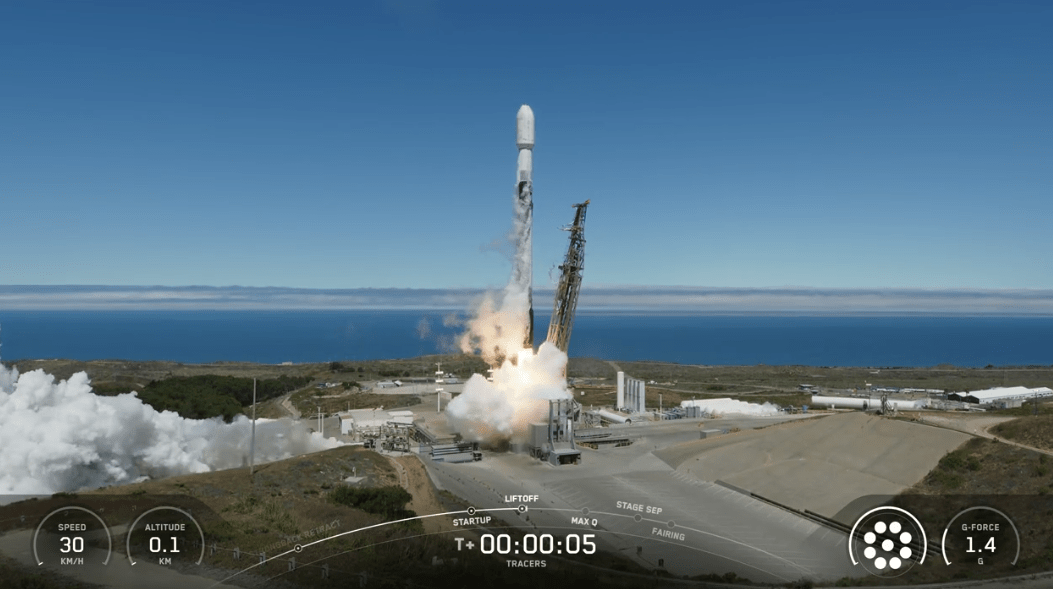
The TRACER mission’s goal is to study magnetic reconnection and its effects in Earth’s atmosphere. Magnetic reconnection is the interplay between solar winds and the Earth’s magnetic field.
The two satellites, each about the size of a washing machine, will be in orbit over both the North and South poles for the next 12 months taking measurements.
In this interview, David Miles, TRACERS Principal Investigator at the University of Iowa, answers a number of questions about the current mission, including:
Can you explain what space weather is?
Why was this mission designed to have two spacecraft instead of just one?
Why is understanding space weather important for protecting our astronauts as well as technology in space and on the ground?
You can learn even more about the mission from this NASA fact sheet.
It is encouraging to see scientific missions underway to better understand outside influences on our upper atmosphere. Let’s hope we can also maintain and expand on space missions that help us understand man-made influences on our atmosphere. Closing our eyes for political reasons is never a good idea.
Astronomers may have caught a still-forming planet in action, carving out an intricate pattern in the gas and dust that surrounds its young host star. Using ESO’s Very Large Telescope (VLT), they observed a planetary disc with prominent spiral arms, finding clear signs of a planet nestled in its inner regions. This is the first time astronomers have detected a planet candidate embedded inside a disc spiral. “We will never witness the formation of Earth, but here, around a young star 440 light-years away, we may be watching a planet come into existence in real time,” says Francesco Maio, a doctoral researcher at the University of Florence, Italy, and lead author of this study, published today in Astronomy & Astrophysics.
Astronomers have discovered a massive new solar system body located beyond the orbit of Pluto. The weird elongated orbit of the object suggests that if “Planet Nine” exists, it is much further from the sun than thought, or it has been ejected from our planetary system altogether. The strange orbit of the object, designated 2023 KQ14 and nicknamed “Ammonite,” classifies it as a “sednoid.” Sednoids are bodies beyond the orbit of the ice giant Neptune, known as trans-Neptunian objects (TNOs), characterized by a highly eccentric (non-circular) orbit and a distant closest approach to the sun or “perihelion.”
NASA’s Tandem Reconnection and Cusp Electrodynamics Reconnaissance Satellites (TRACERS) mission, a collaborative effort led by the University of Iowa (UI) with substantial contributions from Southwest Research Institute (SwRI), has entered its final integration phase. NASA is set to launch TRACERS’ two satellites into low Earth orbit on July 22, 2025, from Vandenberg Space Force Base in California. The TRACERS mission will explore the dynamic interactions between the Sun’s and Earth’s magnetic fields.



 Our Awesome Universe