Space Stories: Kuiper Launch, NASA Workforce Cuts, and Prepping for Moon Landing

Image (Credit): ULA launches the Kuiper 1 mission from Cape Canaveral on April 28, 2025. (ULA)

Here are some recent stories of interest.

ABC News: Amazon Launches First Kuiper Internet Satellites, Taking on Starlink

The first 27 satellites for Amazon’s Kuiper broadband internet constellation were launched into space from Florida on Monday, kicking off the long-delayed deployment of an internet-from-space network that will rival SpaceX’s Starlink. The satellites are the first of 3,236 that Amazon plans to send into low-Earth orbit for Project Kuiper, a $10 billion effort unveiled in 2019 to beam broadband internet globally for consumers, businesses and governments – customers that SpaceX has courted for years with its powerful Starlink business.

Government Executive: NASA preparing for steep workforce cuts but hopeful it can avoid more layoffs

As NASA ramps up plans to return to the moon and, eventually, Mars, it is moving forward with plans to shrink its workforce by incentivizing employees to leave government...NASA officials have told employees they may receive a second “deferred resignation” offer to allow staff to take paid leave until they exit government by Sept. 30, as well as early retirement and buyouts, to incentivize departures from the agency. These options were submitted as part of NASA’s reduction-in-force and reorganization plan, employees who attended the meetings in which the plans were shared said, which all agencies had to turn over to the Office of Personnel Management and the White House in recent weeks.

NASA: NASA Marshall Fires Up Hybrid Rocket Motor to Prep for Moon Landings

To better understand the physics behind the interaction of exhaust from the commercial human landing systems and the Moon’s surface, engineers and scientists at NASA’s Marshall Space Flight Center in Huntsville, Alabama, recently test-fired a 14-inch hybrid rocket motor more than 30 times. The 3D-printed hybrid rocket motor, developed at Utah State University in Logan, Utah, ignites both solid fuel and a stream of gaseous oxygen to create a powerful stream of rocket exhaust.
Space Stories: Safe Return of Astronaut & Cosmonauts from ISS, Resupply of ISS Successful, and Continuing Concerns About ISS Risks

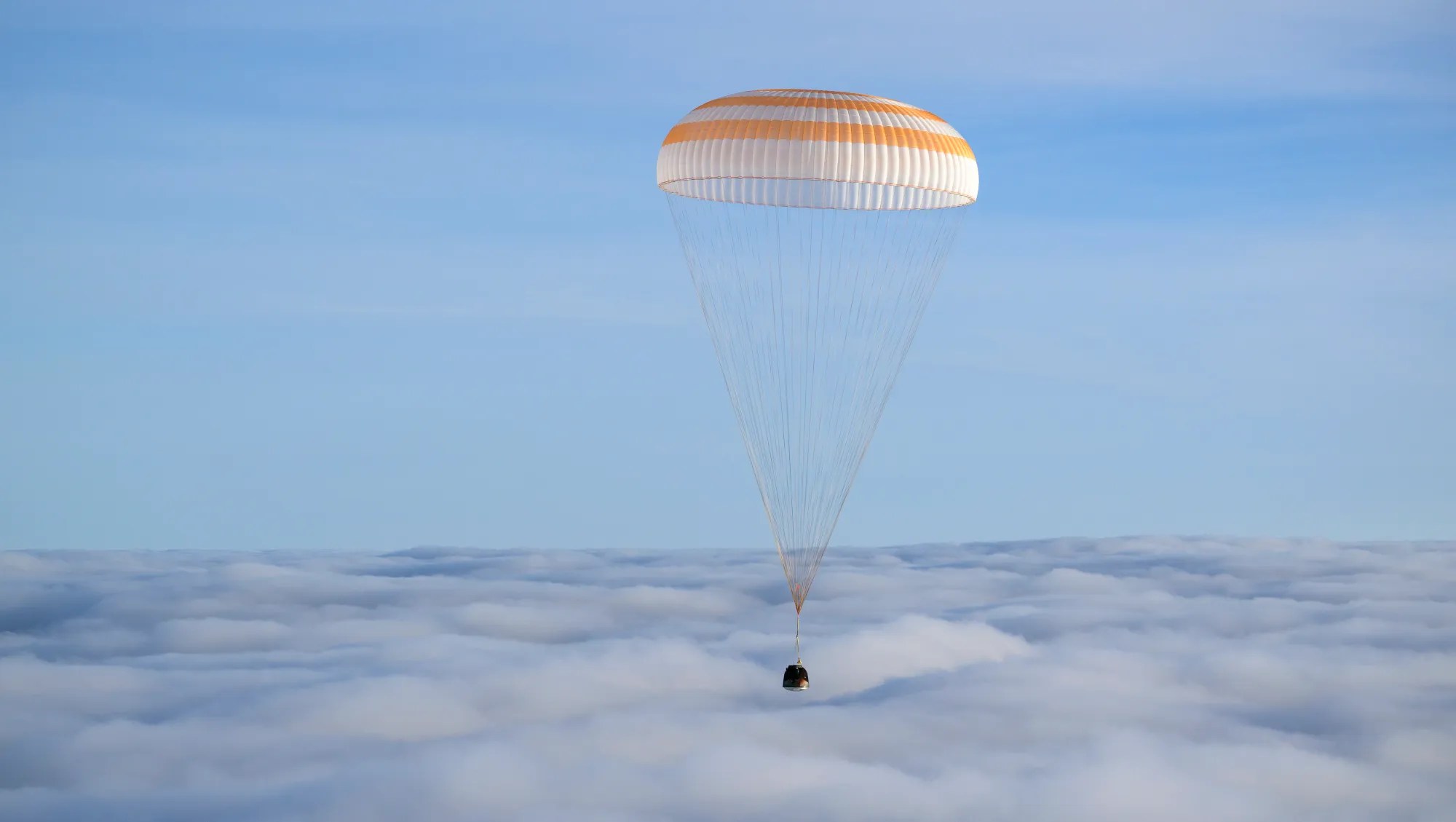
Image (Credit): The Soyuz MS-26 spacecraft carrying Expedition 72 NASA astronaut Don Pettit, and Roscosmos cosmonauts Alexey Ovchinin and Ivan Vagner back to Earth from the ISS on April 19, 2025 (April 20, 2025, Kazakhstan time). (NASA/Bill Ingalls)

Here are some recent stories of interest related to the International Space Station (ISS).

ABC News: Capsule with 1 American, 2 Russians returns to Earth from International Space Station

A Soyuz capsule carrying two Russians and one American from the International Space Station landed Sunday in Kazakhstan, ending their seven-month research assignment. According to Russian space agency Roscosmos, the capsule carrying Roscosmos cosmonauts Alexey Ovchinin and Ivan Vagner and astronaut Don Pettit of U.S. space agency NASA landed on the Kazakh steppe near the city of Zhezkazgan at 6:20 a.m. (0120 GMT). Roscosmos said the parachute-assisted landing was a trouble-free descent.

Space.com: SpaceX CRS-32 Dragon Cargo Capsule Arrives at the ISS with 6,700 Pounds of Supplies

A SpaceX Dragon cargo capsule has arrived at the International Space Station (ISS) this morning (April 22), wrapping up about 28 hours traveling on orbit to close the gap between them. Elon Musk’s company launched its 32nd robotic resupply mission to the ISS for NASA early Monday morning (April 21), sending a Dragon freighter aloft from Florida’s Space Coast.

Gizmodo: The ISS Is in the ‘Riskiest Period of Its Existence,’ NASA Safety Panel Warns

During a meeting of the Aerospace Safety Advisory Panel (ASAP) held on Thursday, members of a NASA safety panel stated that there are growing risks threatening the space station as it nears the end of its use, SpaceNews reported. “The ISS has entered the riskiest period of its existence,” Rich Williams, a member of the panel, said during the meeting. At the top of the list of growing risks is a leak where air has been escaping at an increasing rate from a tunnel that connects a docking port to a Russian module.

Space Stories: Even More Space Tourists, Upcoming Asteroid Encounter, and Copernicus Had Help

Image (Credit): New Shepard’s NS-31 Mission crew. (Blue Origin)

Here are some recent stories of interest.

ABC News: Blue Origin Mission with All-female Crew, Including Katy Perry, Completes Space Trip

Blue Origin’s all-female crew, which included pop star Katy Perry, completed their trip into space Monday morning. The flight lasted around 11 minutes and traveled more than 60 miles above Earth, according to Blue Origin, passing the Kármán line, which at 62 miles above sea level is considered to be the boundary between Earth’s atmosphere and outer space. Along with Perry, the crew included Blue Origin owner Jeff Bezos’ journalist fiancée, Lauren Sanchez, who is also a helicopter pilot.

NASA: NASA’s Lucy Spacecraft Prepares Second Asteroid Encounter

NASA’s Lucy spacecraft is 6 days and less than 50 million miles (80 million km) away from its second close encounter with an asteroid; this time, the small main belt asteroid Donaldjohanson. This upcoming event represents a comprehensive “dress rehearsal” for Lucy’s main mission over the next decade: the exploration of multiple Trojan asteroids that share Jupiter’s orbit around the Sun.

University of Sharjah: Copernicus May Have Leaned on Ancient Muslim Astronomer in Developing his Cosmological System

New research has revealed that the cosmological model developed by Nicolaus Copernicus, the renowned European Renaissance polymath, bears striking resemblance to the one designed by an Arab Muslim astronomer nearly two centuries earlier. The research conducted at the University of Sharjah is a comparative and analytical study which examines in parallel the writings of Copernicus in correlation with the works of the 14th century Muslim astronomer Ibn al-Shatir.

Space Stories: More Space Tourists, Chinese Maglev Rocket Launches, and New Hubble Findings on Uranus

Image (Credit): Launch of the Fram2 mission earlier this week. (SpaceX)

Here are some recent stories of interest.

South China Morning Post: SpaceX Launches Fram2: 4 Astronauts Seek to Make Historic Flight Over Earth’s Poles

A SpaceX spacecraft carrying four international astronauts is on a pioneering journey circling Earth over its poles after launching Monday night from Florida…Fram2 follows in the footsteps of other commercial spaceflight ventures, including Inspiration4 and Polaris Dawn – two missions also bankrolled and led by billionaire Jared Isaacman. In fact, the Fram2 crew is now traveling on the same Dragon spacecraft that the Polaris Dawn crew rode to orbit in September for a five-day mission in which they completed a historic spacewalk.

South China Morning Post: China in Bid to Challenge SpaceX by Deploying Maglev Rocket Launch Pad by 2028

In a bid to disrupt the United States’ long-held dominance in space exploration, China is quietly advancing a radical new rocket launch system – powered not by roaring engines but by electromagnetic force – that could propel satellites into orbit with unprecedented speed and efficiency. At the heart of the ambitious project is Galactic Energy, a private aerospace company that plans to debut the world’s first electromagnetic rocket launch pad by 2028, a project that could redraw the competitive lines of the global space industry.

Space Telescope Science Institute: 20-Year Hubble Study of Uranus Yields New Atmospheric Insights

Halfway through its fourth decade, Hubble’s long life has proven invaluable for studying the atmosphere of the mysterious ice giant Uranus. By repeatedly training Hubble on the distant cyan planet over the course of 20 years, researchers chronicled a two-decade story of seasonal changes. These astronomers have gained new understanding of the atmospheric dynamics of Uranus, which can serve as a proxy for studying exoplanets of similar size and composition.

Space Stories: Cygnus Spacecraft Damaged, AI & Astronomy, and Toxic Martian Dust

Image (Credit): The Cygnus cargo shit at the International Space Station. (Northrup Grumman)

Here are some recent stories of interest.

Ars Technica: After a Spacecraft was Damaged en route to Launch, NASA Says it Won’t Launch

Three weeks ago, NASA revealed that a shipping container protecting a Cygnus spacecraft sustained “damage” while traveling to the launch site in Florida. Built by Northrop Grumman, Cygnus is one of two Western spacecraft currently capable of delivering food, water, experiments, and other supplies to the International Space Station. This particular Cygnus mission, NG-22, had been scheduled for June. As part of its statement in early March, the space agency said it was evaluating the NG-22 Cygnus cargo supply mission along with Northrop.

Intelligent Computing: AI Reshapes How We Observe the Stars

AI tools are transforming how we observe the world around us—and even the stars beyond. Recently, an international team proved that deep learning techniques and large language models can help astronomers classify stars with high accuracy and efficiency. Their study, “Deep Learning and Methods Based on Large Language Models Applied to Stellar Light Curve Classification,” was published Feb. 26 in Intelligent Computing.

CNN: Toxic Dust on Mars Would Present Serious Hazard for Astronauts

Toxic dust on Mars would make a future mission to the red planet extremely hazardous for astronauts and require significant countermeasures, new research suggests. Substances such as silica, gypsum, perchlorates and nanophase iron oxides contained in Martian dust could have life-threatening effects on members of a potential Mars mission, according to a study published in the journal GeoHealth last month.