Space Stories: Venus Without Oceans, Evidence of Black Holes on Earth, and Organic Material on Ceres

Image (Credit): The planet Venus. (NASA)

Here are some recent stories of interest.

Astronomy.comVenus May Never Have Had Oceans

The story of the inner early Solar System goes something like this: Billions of years ago, there were three rocky worlds with oceans of liquid water. Perhaps all three could have been primed for life. But as Mars lost its atmosphere and Venus’ atmosphere experienced a runaway greenhouse effect, only Earth could support life by the end. But a trio of researchers at the University of Cambridge, U.K., have a different view — that all those billions of years ago, Venus was already too hot to support oceans. There was water vapor (we still see evidence of this today), but it never had the chance to condense into oceans. Instead, Venus was a steam world, one that could reach surface temperatures as high as 1,340 degrees Fahrenheit (727 degrees Celsius). By most metrics, this means the surface of Venus was already a hellish, inhospitable world — and it never got much better.

University at BuffaloEvidence of Primordial Black Holes may be Hiding in Planets, or Even Everyday Objects Here on Earth

Imagine the formation of a black hole and you’ll probably envision a massive star running out of fuel and collapsing in on itself. Yet the chaotic conditions of the early universe may have also allowed many small black holes to form long before the first stars. These primordial black holes have been theorized for decades and could even be ever-elusive dark matter, the invisible matter that accounts for 85% of the universe’s total mass. Still, no primordial black hole has ever been observed. New research co-led by the University at Buffalo proposes thinking both big and small to confirm their existence, suggesting that their signatures could range from very large — hollow planetoids in space — to minute — microscopic tunnels in everyday materials found on Earth, like rocks, metal and glass.

Astronomy.comNew Evidence of Organic Material Identified on Ceres, the Inner Solar System’s Most Water-rich Object After Earth

Six years ago, NASA’s Dawn mission communicated with Earth for the last time, ending its exploration of Ceres and Vesta, the two largest bodies in the asteroid belt. Since then, Ceres —a water-rich dwarf planet showing signs of geological activity— has been at the center of intense debates about its origin and evolution. Now, a study led by IAA-CSIC, using Dawn data and an innovative methodology, has identified eleven new regions suggesting the existence of an internal reservoir of organic materials in the dwarf planet. The results, published in The Planetary Science Journal, provide critical insights into the potential nature of this celestial body.

Martian Space Stories: Ocean Shoreline Located, Rings Turned to Moons, and Ancient Liquid Water

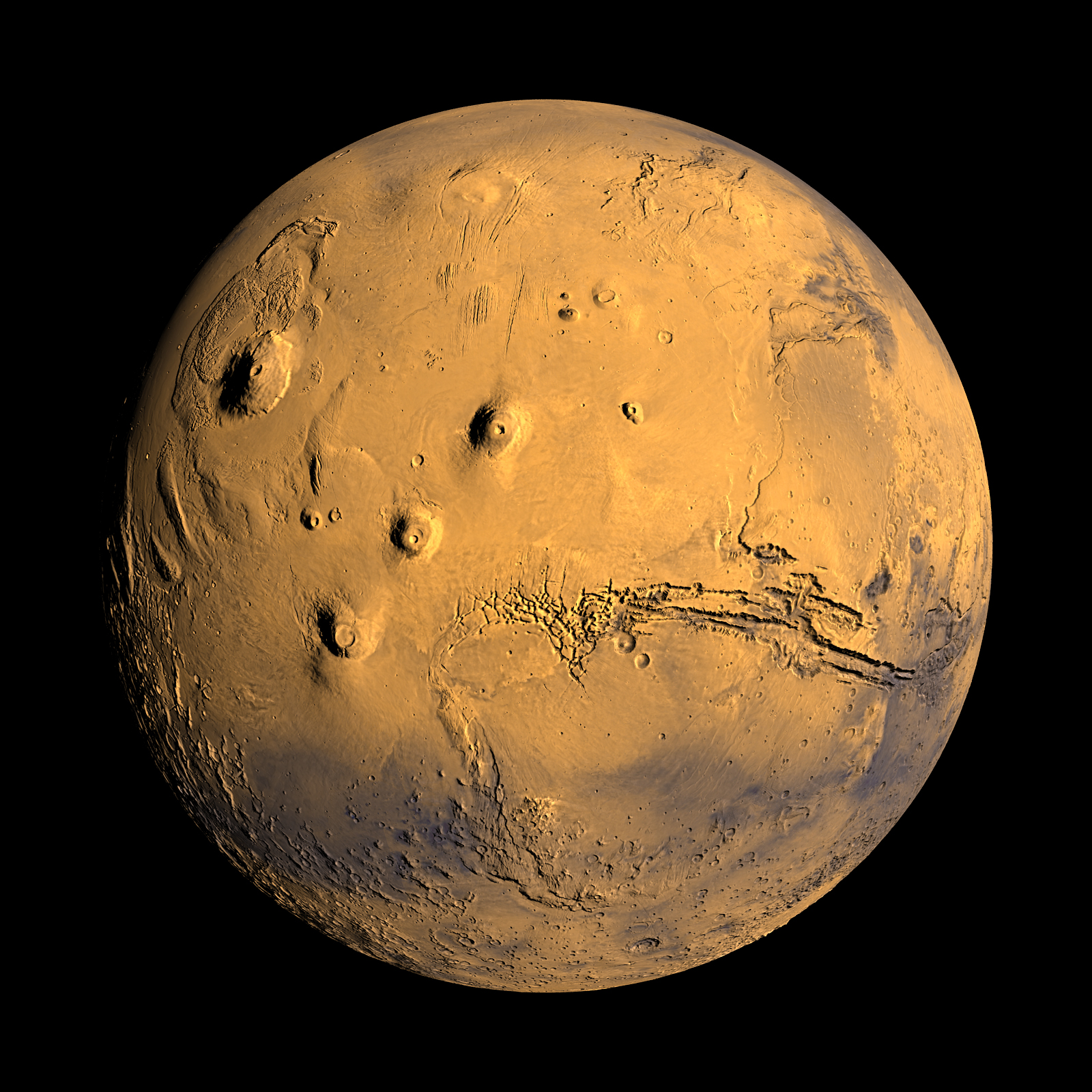
Image (Credit): The Red Planet. (NASA/JPL)

Here are some recent stories on Mars.

Earth.comChina’s Mars Zhurong Rover Finds an Ocean Shoreline on the Red Planet

The Chinese Mars rover Zhurong is adding an exciting twist to the story and history of water on Mars. After landing in southern Utopia Planitia on Mars in May 2021, the now-defunct Zhurong rover went to work exploring the Martian surface, and its latest findings might just change the way we think about the Red Planet. Bo Wu and a team of researchers from Hong Kong Polytechnic University believe they’ve found compelling evidence of an ocean shoreline for a massive body of water that once covered Mars’ northern lowlands.

New York TimesAn Asteroid’s Destruction May Have Given Mars Rings, Then Moons

Something’s not quite right about the moons of Mars. They are too small — Phobos is 17 miles across, and Deimos is a mere nine miles in length. And they aren’t round, but lumpy, misshaped objects. Frankly, they don’t resemble moons at all…A study published Wednesday in the journal Icarus makes a case that the moons did indeed start out in asteroid form. But it’s not the genesis everyone was expecting. Using supercomputer-powered simulations, scientists describe a situation in which a large-enough asteroid was captured by Mars long ago and torn to shreds by the planet’s gravity, briefly forming a debris cloud — and possibly a ring system — around Mars that ultimately clumped together to form two moons.

Astrobiology NewsMeteorite Contains Evidence Of Liquid Water On Mars 742 Million Years Ago

An asteroid struck Mars 11 million years ago and sent pieces of the red planet hurtling through space. One of these chunks of Mars eventually crashed into the Earth somewhere near Purdue and is one of the few meteorites that can be traced directly to Mars. This meteorite was rediscovered in a drawer at Purdue University in 1931 and therefore named the Lafayette Meteorite. During early investigations of the Lafayette Meteorite, scientists discovered that it had interacted with liquid water while on Mars. Scientists have long wondered when that interaction with liquid water took place. An international collaboration of scientists including two from Purdue University’s College of Science have recently determined the age of the minerals in the Lafayette Meteorite that formed when there was liquid water. The team has published its findings in Geochemical Perspective Letters.

Space Stories: Questions About Orion, NASA’s Impact on Economy, and a New Crew for the Chinese Space Station

Image (Credit): Components of the Orion spacecraft. (NASA)

Here are some recent stories of interest.

ARSTechnicaFor Some Reason, NASA is Treating Orion’s Heat Shield Problems as a Secret

For those who follow NASA’s human spaceflight program, when the Orion spacecraft’s heat shield cracked and chipped away during atmospheric reentry on the unpiloted Artemis I test flight in late 2022, what caused it became a burning question. Multiple NASA officials said Monday they now know the answer, but they’re not telling. Instead, agency officials want to wait until more reviews are done to determine what this means for Artemis II, the Orion spacecraft’s first crew mission around the Moon, officially scheduled for launch in September 2025.

NASANew Report Shows NASA’s $75.6 Billion Boost to US Economy

In its third agencywide economic impact report, NASA highlighted how its Moon to Mars activities, climate change research and technology development, and other projects generated more than $75.6 billion in economic output across all 50 states and Washington, D.C., in fiscal year 2023…Combined, NASA’s missions supported 304,803 jobs nationwide, and generated an estimated $9.5 billion in federal, state, and local taxes throughout the United States.

ABC NewsChina Launches New Crew to its Space Station as it Seeks to Expand Exploration

China declared a “complete success” after it launched a new three-person crew to its orbiting space station early Wednesday as the country seeks to expand its exploration of outer space with missions to the moon and beyond. The Shenzhou-19 spaceship carrying the trio blasted off from the Jiuquan Satellite Launch Center in northwest China at 4:27 a.m. local time atop a Long March-2F rocket, the backbone of China’s crewed space missions.

Space Stories: NASA’s Probe Explorers, Finding Exoplanet Atmospheres, and an Australian Space Antenna

Here are some recent stories of interest.

Universe TodayNASA Announces a New Class of Space Missions: Probe Explorers

NASA has sent a whole host of spacecraft across the Solar System and even beyond. They range from crewed ships to orbit and to the Moon to robotic explorers. Among them are a range of mission classes from Flagships to Discovery Class programs. Now a new category has been announced: Probe Explorers. This new category will fill the gap between Flagship and smaller missions. Among them are two proposed missions; the Advanced X-ray Imaging Satellite and the Probe Far-Infrared Mission for Astrophysics.

uChicago News: “UChicago Researchers Use New Method of Finding Atmospheres in Distant Planets

It is a major goal of astronomical research to find planets other than Earth that might be suitable for sustaining life. There are a number of factors which many scientists agree are essential to a planet being habitable, but an important one is whether or not a planet has an atmosphere. Scientists have found other rocky, Earth-like exoplanets, but none that we can definitively say have atmospheres. Finding these planets will reveal insights into how such atmospheres are formed and retained, so that we can better predict which planets could be habitable. A study conducted by University of Chicago PhD student Qiao Xue with Prof. Jacob Bean’s group has demonstrated a new way to determine if faraway exoplanets have an atmosphere—and showed that it was simpler and more efficient than previous methods. The new technique, when applied to more planets, has the potential to help us learn more about patterns in atmosphere formation.

European Space Agency: “ESA Crowns New Deep Space Antenna in Australia

A giant wakes as the Sun sets in Western Australia. The workers can finally rest easy after more than a day spent using an enormous crane to lift the colossal 122-tonne, 35-metre diameter reflector dish and crown ESA’s newest deep space communication antenna. With the dish and its quadrupole now installed, ESA is on track to inaugurate its fourth deep-space antenna, and second at the New Norcia site in Australia, by the end of 2025. Referred to as NNO3, the New Norcia 3 antenna will allow spacecraft to send and receive more valuable data collected from onboard scientific instruments and vital flight instructions for mission operations.

Space Stories: Mars MAVEN Hits 10 Years, a Martian Algorithm Helps Earth, and Enormous Black Hole Jets

Image (Credit): Artist’s rendering of the MAVEN spacecraft above Mars. (NASA)

Here are some recent stories of interest.

NASACelebrating 10 Years at Mars with NASA’s MAVEN Mission

A decade ago, on Sept. 21, 2014, NASA’s MAVEN (Mars Atmospheric and Volatile EvolutioN) spacecraft entered orbit around Mars, beginning its ongoing exploration of the Red Planet’s upper atmosphere. The mission has produced a wealth of data about how Mars’ atmosphere responds to the Sun and solar wind, and how these interactions can explain the loss of the Martian atmosphere to space. Today, MAVEN continues to make exciting new discoveries about the Red Planet that increase our understanding of how atmospheric evolution affected Mars’ climate and the previous presence of liquid water on its surface, potentially determining its prior habitability.

Georgia TechAward-Winning Algorithm Used on Mars Rover Helps Scientists on Earth See Data in a New Way

A new algorithm tested on NASA’s Perseverance Rover on Mars may lead to better forecasting of hurricanes, wildfires, and other extreme weather events that impact millions globally. Georgia Tech Ph.D. student Austin P. Wright is first author of a paper that introduces Nested Fusion. The new algorithm improves scientists’ ability to search for past signs of life on the Martian surface. This innovation supports NASA’s Mars 2020 mission. In addition, scientists from other fields working with large, overlapping datasets can use Nested Fusion’s methods for their studies. Wright presented Nested Fusion at the 2024 International Conference on Knowledge Discovery and Data Mining (KDD 2024) where it was a runner-up for the best paper award. KDD is widely considered the most prestigious conference for knowledge discovery and data mining research.

Times of India23 Million Light-Years-Wide Black Hole Jets Discovered

Astronomers have made a breathtaking revelation: The most massive discovered black hole jets, extending on to incredibly 23 million light-years. To look at it through that lens, that’s approximately the length of 140 Milky Way galaxies positioned in a straight line. The immense jets, named ‘Porphyrion’ after a  Greek giant, emerge from a supermassive black hole at the center of a faraway galaxy that was in existence when the universe was only 6.3 billion years old – – close to half its existing age of 13.8 billion years.