Space Stories: Spaceplane Planned for ISS, AI Assists Astronomy, and Water Older Than the Sun

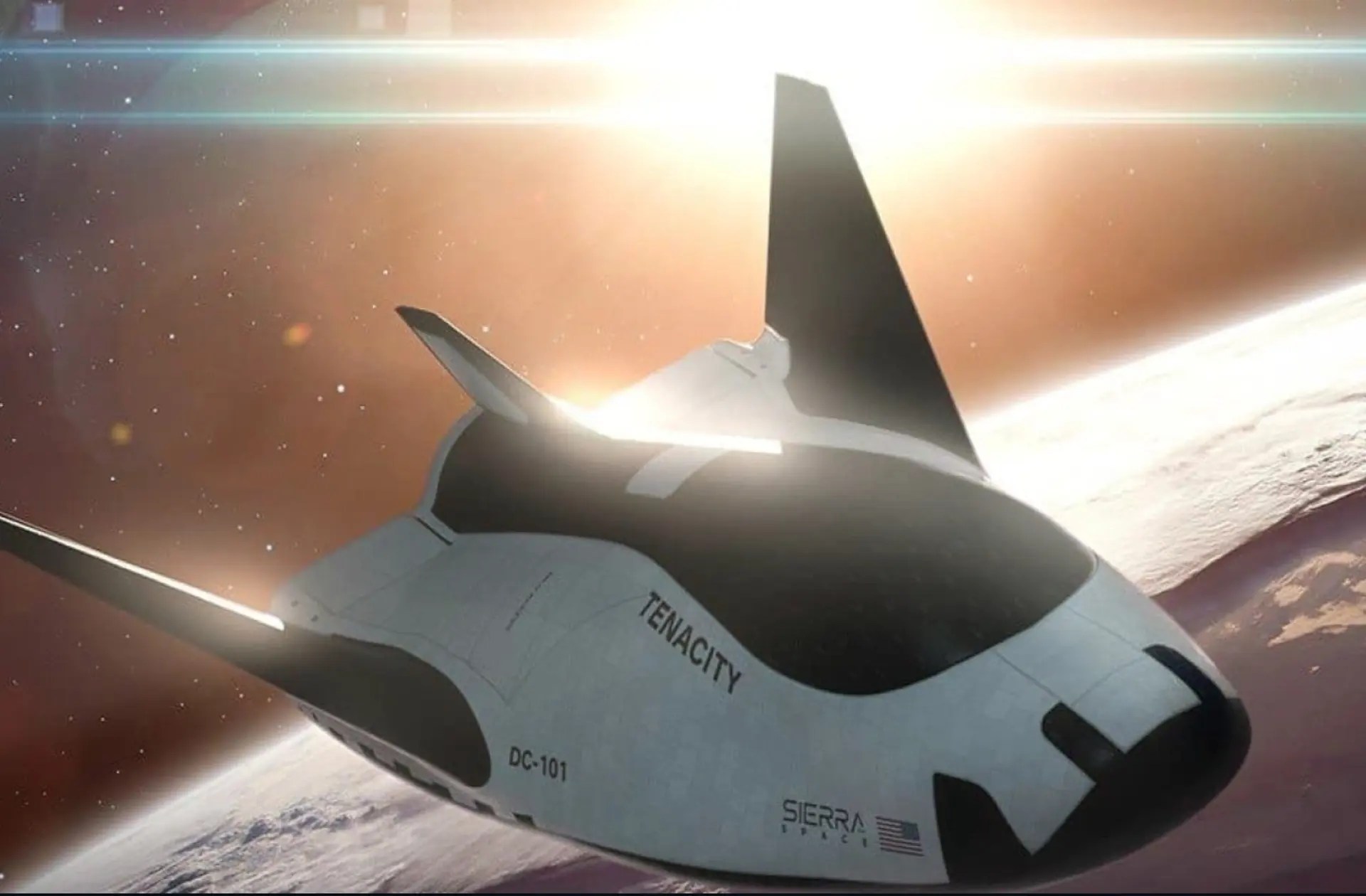
Image (Credit): Artist’s rendering of the Dream Chaser DC-100 spaceplane. (Sierra Space)

Here are some recent stories of interest.

New Atlas: World’s First Commercial Spaceplane in Final Stages Before Debut ISS Flight

The world’s first winged commercial spaceplane has arrived at NASA’s Kennedy Space Center in Florida, its final destination before its first mission to the International Space Station (ISS) later this year. Following rigorous testing at Ohio’s Neil Armstrong Test Facility, the Dream Chaser DC-100 spaceplane named Tenacity got the green light to commence final pre-launch preparations, such as finishing its thermal protection system and payload integration, before it hitches a ride on a United Launch Alliance (ULA) Vulcan rocket to deliver 7,800 pounds (3,540 kg) of food, water and science experiments to the ISS.

MIT Technology Review: Astronomers are Enlisting AI to Prepare for a Data Downpour

In deserts across Australia and South Africa, astronomers are planting forests of metallic detectors that will together scour the cosmos for radio signals. When it boots up in five years or so, the Square Kilometer Array Observatory will look for new information about the universe’s first stars and the different stages of galactic evolution.  But after syncing hundreds of thousands of dishes and antennas, astronomers will quickly face a new challenge: combing through some 300 petabytes of cosmological data a year—enough to fill a million laptops…In preparation for the information deluge, astronomers are turning to AI for assistance, optimizing algorithms to pick out patterns in large and notoriously finicky data sets. Some are now working to establish institutes dedicated to marrying the fields of computer science and astronomy—and grappling with the terms of the new partnership.

BBC Sky at Night: Earth’s Water is Even Older Than the Sun, Having Formed Billions of Years Ago, Say Astronomers

How old is Earth’s water? Could it be older even than the planet itself? A team of astronomers say they’ve found the “missing link” that shows how water is delivered from gaseous star-forming regions in space to planets like Earth. The research suggests that Earth’s water is even older than the Sun. The news comes as a result of studies of a dusty planet-forming disc surrounding a star 1,300 lightyears from Earth

Space Stories: Robot Trains on the Moon, Commercial Space Stations, and Russian Lunar Reactors

Image (Credit): Artist’s rendering of the Flexible Levitation on a Track system on the lunar surface with planet Earth on the horizon. (NASA/Ethan Schaler)

Here are some recent stories of interest.

NDTV: NASA Announces Plans To Build First Railway System On Moon

As the National Aeronautics and Space Administration (NASA) readies to return astronauts to the moon, it has announced its plans to build a levitating robot train on the lunar surface. In a blog post, the American space agency provided details about the project called “Flexible Levitation on a Track (FLOAT)”, which aims to provide a “robotic transport system” to support future lunar activities of astronauts visiting the moon. The transport system will be critical to the daily operation of a sustainable lunar base in the 2030s, NASA said in a statement. 

IEEE Spectrum: Commercial Space Stations Approach Launch Phase

A changing of the guard in space stations is on the horizon as private companies work toward providing new opportunities for science, commerce, and tourism in outer space. Blue Origin is one of a number of private-sector actors aiming to harbor commercial activities in low Earth orbit (LEO) as the creaking and leaking International Space Station (ISS) approaches its drawdown. Partners in Blue Origin’s Orbital Reef program, including firms Redwire, Sierra Space, and Boeing, are each reporting progress in their respective components of the program. The collaboration itself may not be on such strong ground. Such endeavors may also end up slowed and controlled by regulation so far absent from many new, commercial areas of space.

Newsweek: Russia Reveals New China Nuclear Moon Base Details

Details about joint plans between Moscow and Beijing to put a lunar nuclear reactor within the next decade have been revealed by the head of Russia’s space agency. In March, Roscosmos announced plans to work with China to build an automated nuclear reactor to power a proposed lunar base that the two countries would operate together within the next decade. To construct the site, Roscosmos director general Yury Borisov said two months ago it was looking at using nuclear-powered rockets to transfer cargo to the moon, but had not yet figured out how to build these spacecraft safely. In an article published Wednesday by state news outlet RIA Novosti, Borisov said that development of the plant was underway and the countries were working on creating experimental and research facilities as part of the project.

Space Stories: Missing Water on Venus, More About Planet Nine, and Possible Life on an Exoplanet

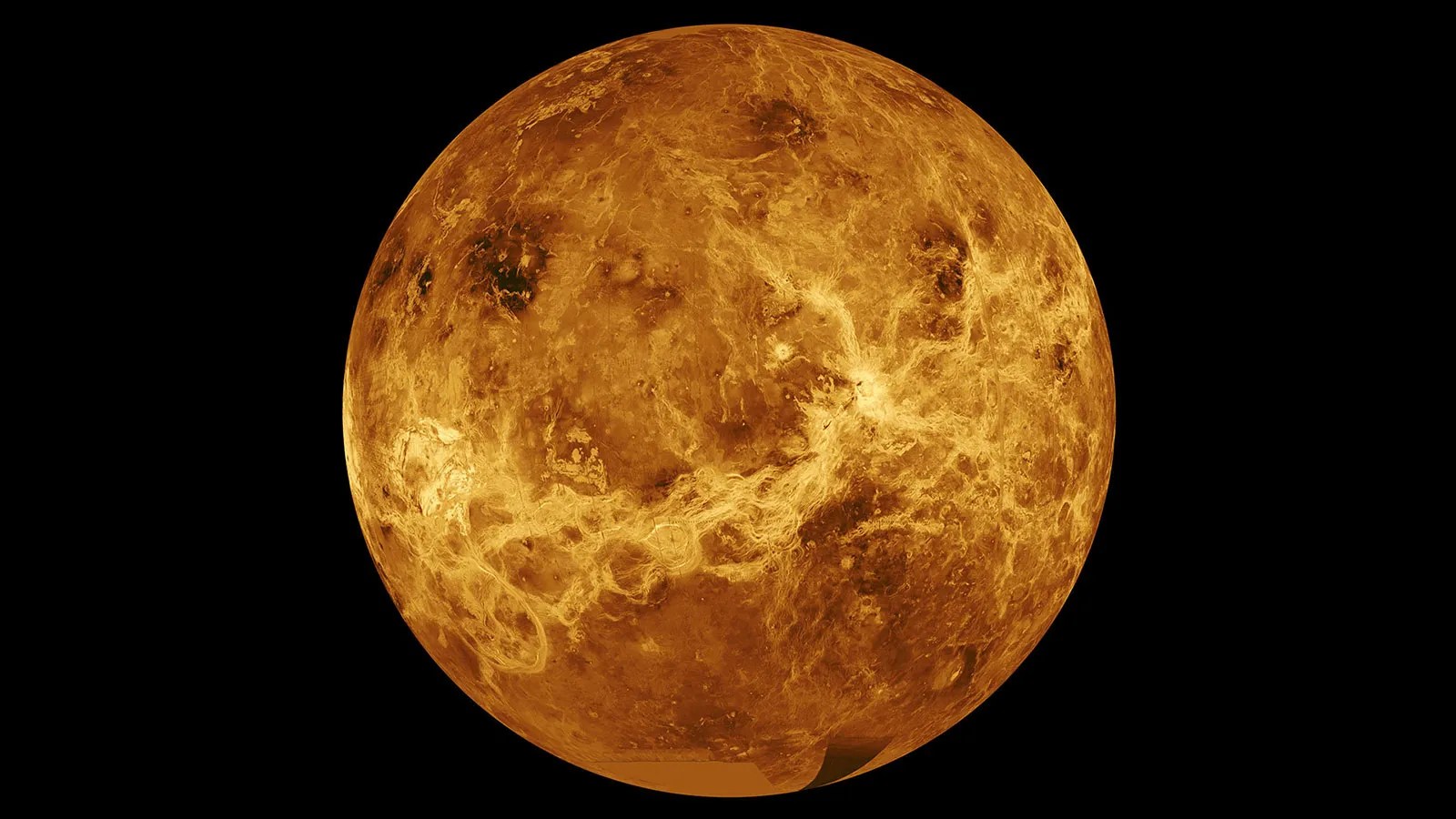
Image (Credit): Venus from a composite of data from NASA’s Magellan spacecraft and Pioneer Venus Orbiter. (NASA/JPL-Caltech)

Here are some recent stories of interest.

University of Colorado at Boulder: Venus Has Almost No Water: A New Study May Reveal Why

Planetary scientists at the University of Colorado Boulder have discovered how Venus, Earth’s scalding and uninhabitable neighbor, became so dry. The new study fills in a big gap in what the researchers call “the water story on Venus.” Using computer simulations, the team found that hydrogen atoms in the planet’s atmosphere go whizzing into space through a process known as “dissociative recombination” — causing Venus to lose roughly twice as much water every day compared to previous estimates.

UniverseToday: New Evidence for Our Solar System’s Ghost: Planet Nine

Does another undetected planet languish in our Solar System’s distant reaches? Does it follow a distant orbit around the Sun in the murky realm of comets and other icy objects? For some researchers, the answer is “almost certainly.” The case for Planet Nine (P9) goes back at least as far as 2016. In that year, astronomers Mike Brown and Konstantin Batygin published evidence pointing to its existence. Along with colleagues, they’ve published other work supporting P9 since then. Now, they’ve published another paper along with colleagues Alessandro Morbidelli and David Nesvorny, presenting more evidence supporting P9. It’s titled “Generation of Low-Inclination, Neptune-Crossing TNOs by Planet Nine.” It’s published in The Astrophysical Journal Letters.

Astonomy.com: Possible Hints of Life Found on Exoplanet K2-18b – How Excited Should We Be?”

Data from the James Webb Space Telescope (JWST) has shown that an exoplanet around a star in the constellation Leo has some of the chemical markers that, on Earth, are associated with living organisms. But these are vague indications. So how likely is it that this exoplanet harbours alien life? …The planet in question is named K2-18b. It’s so named because it was the first planet found to orbit the red dwarf star K2-18.

Space Stories: New Observatory in Chile, Why Exoplanets Spiral Towards their Sun, and Citizens Help Find an Exoplanet

Image (Credit): University of Tokyo Atacama Observatory, built on the summit of a desert mountain in northern Chile. (The University of Tokyo Atacama Observatory Project)

Here are some recent stories of interest.

University of Tokyo: New Observatory in Chile—the Highest in the World—Aims to Reveal Origins of Planets, Galaxies and More

At an altitude of 5,640 meters, the University of Tokyo Atacama Observatory (TAO), built on the summit of a desert mountain in northern Chile, is the highest astronomical observatory in the world, which should give it unrivaled capabilities, but presents some novel challenges…”Construction on the summit of Cerro Chajnantor was an incredible challenge, not just technically, but politically too. I have liaised with Indigenous peoples to ensure their rights and views are considered, the Chilean government to secure permission, local universities for technical collaboration, and even the Chilean Health Ministry to make sure people can work at that altitude in a safe manner. Thanks to all involved, research I’ve only ever dreamed about can soon become a reality, and I couldn’t be happier.”

Durham University: Scientists Explain Why Some Exoplanets are Spiraling Towards their Stars

According to existing theories, the closeness of hot Jupiters should create powerful gravitational ‘tidal waves’ between the planet and star. Over billions of years, these tides transfer energy, causing the planets to spiral inwards until they are eventually consumed by their stars. However, some hot Jupiters like WASP-12b seem to be spiralling in way too quickly for the theories to explain. Scientists were missing a key part of the mystery. Our scientists say they have found the missing piece – magnets!

Simons Foundation: Citizen Scientists Help Discover Record-Breaking Exoplanet in Binary Star System

With an orbit longer than those of most of its brethren, the new planet spotted by volunteer planet hunters and confirmed by Flatiron Institute scientists and their colleagues could offer insights into how exoplanets form and remain stable in multi-star systems…The newfound planet — formally called TOI 4633 c, but nicknamed Percival (after a character from the “Harry Potter” book series) by the scientists — was first identified by citizen scientists sifting through data collected by NASA’s Transiting Exoplanet Survey Satellite (TESS). 

Space Stories: More on Planet 9, A Collision with Pluto, and Explaining Free-Floating Planets

Here are some recent stories of interest.

IFLScience: Astronomers Find Evidence Of A Massive Object Beyond The Orbit Of Neptune

A team of researchers say they have found the “strongest statistical evidence yet that Planet 9 is really out there” in the solar system after studying a population of distant, unstable objects that cross Neptune’s orbit...In a new paper, the team looked at long-period objects that crossed the path of Neptune’s orbit, finding that their closest point of orbit to the sun was around 15-30 astronomical units (AU), with one AU being the distance between the sun and the Earth.

CNN: Pluto Gained a ‘Heart’ After Colliding with a Planetary Body

A huge heart-shaped feature on the surface of Pluto has intrigued astronomers since NASA’s New Horizons spacecraft captured it in a 2015 image. Now, researchers think they have solved the mystery of how the distinctive heart came to be — and it could reveal new clues about the dwarf planet’s origins…an international team of scientists has determined that a cataclysmic event created the heart. After an analysis involving numerical simulations, the researchers concluded a planetary body about 435 miles (700 kilometers) in diameter, or roughly twice the size of Switzerland from east to west, likely collided with Pluto early in the dwarf planet’s history.

University of Nevada: Astronomers Offer New Model for Formation of Recently Discovered ‘Free-floating’ Planets

The recent discovery of a potential new class of distant and mysterious “free-floating” planets has intrigued astronomers since stunning new images captured by the James Webb Space Telescope were shared late last year. These candidate planets, known as Jupiter-mass Binary Objects (JuMBOs), seem to orbit one another as they float freely in space unbound to any star—which counters prevailing theories of how planetary systems were thought to work. Now, a new study by a team of astrophysicists from UNLV and Stony Brook University, published April 19 in the journal Nature Astronomy, introduces a compelling model for how these JuMBOs may have formed.