Space Stories: Preparing for a Commercial Space Station, Ukraine Protests New ISS Crew, and Metal 3D Printing in Space

Image (Credit): Artist’s rendering of the Starlab commercial space station in orbit. (Starlab Space)

Here are some recent stories of interest related to space stations.

SpaceNews: Starlab Commercial Space Station to Launch on Starship

Starlab Space, the joint venture developing the Starlab commercial space station, has selected SpaceX’s Starship to launch the station on a single flight. Starlab Space, a joint venture of Voyager Space and Airbus Space and Defence, announced Jan. 31 it reached an agreement with SpaceX to launch the Starlab station on Starship. The companies did not disclose terms of the agreement or a projected launch date, although a spokesperson for Starlab Space said the company was confident that Starlab would be launched before the decommissioning of the International Space Station, currently scheduled for 2030.

Kyiv Post: Ex-Russian Military Officer Joins NASA for ISS Mission; Ukrainian Outrage Follows

Alexander Grebenkin, a former Russian military officer and current Roscosmos cosmonaut, is set to travel to the International Space Station as part of the NASA team, as announced on the NASA website, where Ukrainians have commented their outrage. NASA, in collaboration with SpaceX, plans to launch Crew-8 to the International Space Station no earlier than Thursday, Feb. 22.

Aviation Week Network: European Space Agency Launches ‘First’ Metal 3D Printer To ISS

The European Space Agency (ESA) has launched what it says is the “first metal 3D printer” to be hosted on the International Space Station (ISS). While plastic 3D printers have been used aboard the ISS since 2014, a machine that prints stainless steel would be new and could allow astronauts greater self-sufficiency, including the ability to make complex metallic structures in orbit, as well as at future Moon and Mars bases, ESA said Jan. 30.
Space Stories: The ISS Succession Plan, Privately-built Moon Landers, and Working with Moonquakes

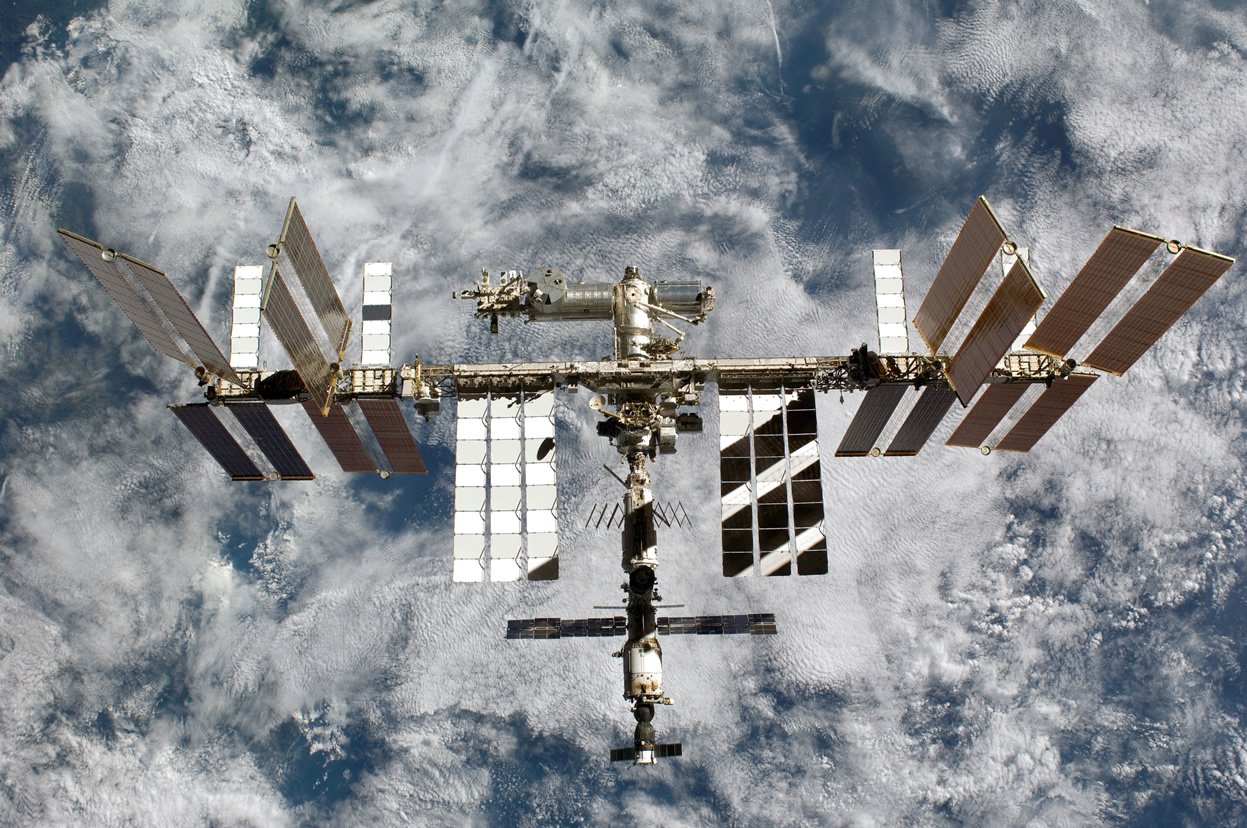
Image (Credit): View of the International Space Station. (NASA)

Here are some recent stories of interest.

Aviation Week Network: Safety Panel Raises Commercial Space Station Transition Concerns

Concerns over a “very tight” timeline for NASA to transition human low-Earth-orbit operations from the International Space Station (ISS) to commercial successors tops a list of seven concerns raised by an agency safety panel. The latest annual report by NASA’s Aerospace Safety Advisory Panel’s (ASAP) was released Jan. 25. The 56-page report expresses concerns over sufficient evidence of a viable business case to make NASA one of multiple tenants of at least one ISS successor. The effort is currently supported by NASA and the European, Japanese, Russian and Canadian space agencies.

Astronomy.com: Vertex Moon Mission Getting Closer to Launch

 A new era in lunar research is coming, and Lunar Vertex is getting ready to lead the way. Lunar Vertex is NASA’s first so-called PRISM mission (Payloads and Research Investigations on the Surface of the Moon). PRISM taps into the Commercial Lunar Payload Services program that uses privately built landers to deliver NASA science and other payloads to the lunar surface. PRISM missions are meant to be lower-cost, faster-to-flight programs. There is a mass limit of just over 100 pounds (45 kilograms) — so the science instruments have to be small — and the budget for the first PRISM suite is just $30 million (excluding the lander and the launch vehicle). Lunar Vertex is first in line, and recently has hit a number of major milestones on its way to a June 2024 launch.

NASA: Shrinking Moon Causing Moonquakes and Faults Near Lunar South Pole

As NASA continues to make progress toward sending astronauts to the lunar South Pole region with its Artemis campaign, data from a NASA-funded study is helping scientists better understand this strategic part of the Moon. The study presents evidence that moonquakes and faults generated as the Moon’s interior gradually cools and shrinks are also found near and within some of the areas the agency identified as candidate landing regions for Artemis III, the first Artemis mission planned to have a crewed lunar landing.

Space Stories: Finding Water on Mars, Mini Solar Sails, and a Balloon-borne Telescope

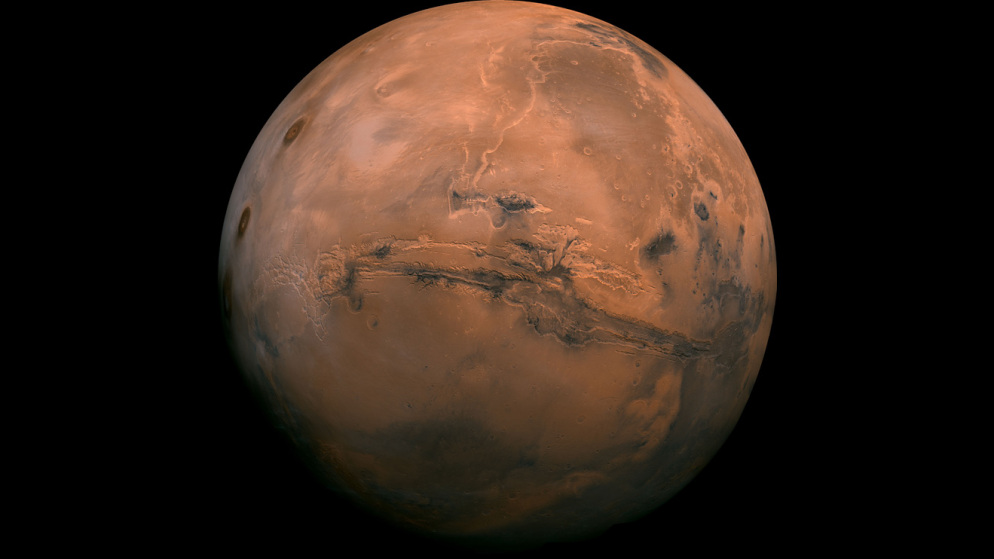
Image (Credit): Image of Mars. (NASA)

Here are some recent stories of interest.

Planetary Science Institute: Vast, Potential Ice-Rich Deposit Found in Martian Equatorial Region

A potential ice-rich portion of the Medusae Fossae Formation deposits may contain the largest volume of water in the equatorial region of Mars. Data from the Mars Advanced Radar for Subsurface and Ionospheric Sounding (MARSIS) –  a subsurface radar sounder on the Mars Express orbiter searching for water and studying the Martian atmosphere – reveals layering in the Medusae Fossae Formation (MFF) deposits. These layers are likely due to transitions between mixtures of ice-rich and ice-poor dust, analogous to those in Polar Layered Deposits, according to the paper “Evidence of Ice-Rich Layered Deposits in the Medusae Fossae Formation of Mars” in Geophysical Research Letters. 

University of California: “Small Solar Sails Could be the Next ‘Giant Leap’ for Interplanetary Space Exploration

Nearly 70 years after the launch of the first satellite, we still have more questions than answers about space. But a team of Berkeley researchers is on a mission to change this with a proposal to build a fleet of low-cost, autonomous spacecraft, each weighing only 10 grams and propelled by nothing more than the pressure of solar radiation. These miniaturized solar sails could potentially visit thousands of near-Earth asteroids and comets, capturing high-resolution images and collecting samples.

NASA: “NASA’s GUSTO Prepares to Map Space Between the Stars

On a vast ice sheet in Antarctica, scientists and engineers are preparing a NASA experiment called GUSTO to explore the universe on a balloon. GUSTO will launch from the Ross Ice Shelf, near the U.S. National Science Foundation’s McMurdo Station research base, no earlier than Dec. 21. GUSTO, which stands for Galactic/Extragalactic ULDB Spectroscopic Terahertz Observatory, will peer into the space between stars called the interstellar medium. The balloon-borne telescope will help scientists make a 3D map of a large part of the Milky Way in extremely high-frequency radio waves. Examining a 100-square-degree area, GUSTO will explore the many phases of the interstellar medium and the abundances of key chemical elements in the galaxy.

Space Stories: Old Stars Harboring Exoplanets, a Hot “Earth” Located, and the Role of Exomoons

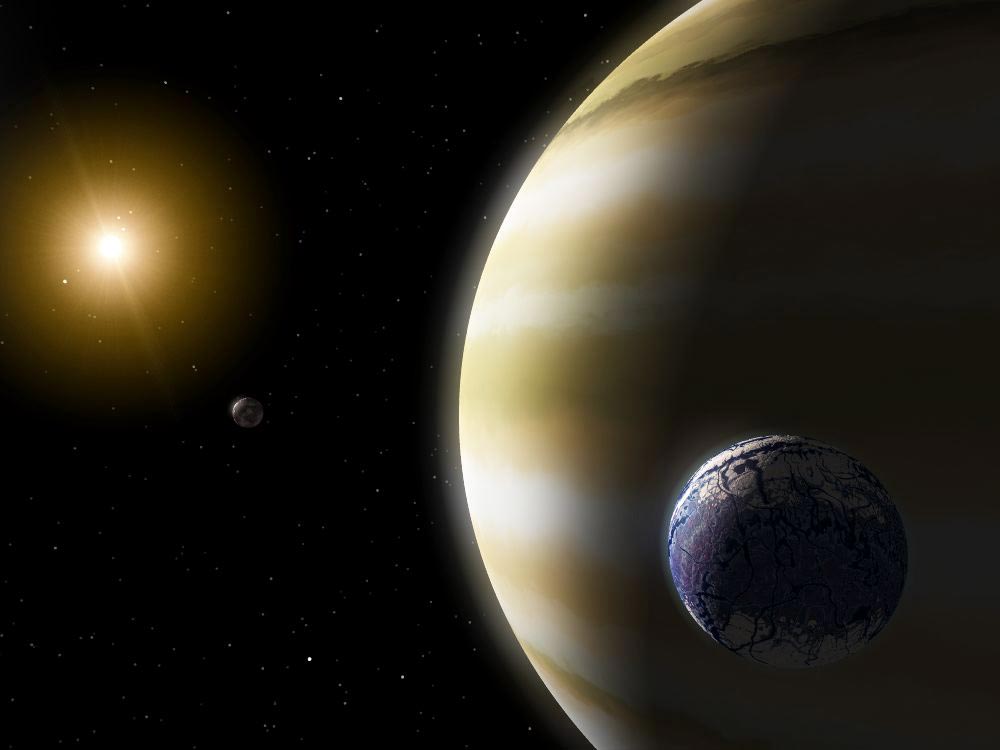
Image (Credit): Artist’s rendering of an Earth-like exomoon orbiting a gas giant planet in a star’s habitable zone. (NASA/JPL-Caltech)

Here are some recent stories of interest related to exoplanets.

Phys.org: “Old Stars May Be the Best Places to Search for Life

Once upon a cosmic time, scientists assumed that stars apply an eternal magnetic brake, causing an endless slowdown of their rotation. With new observations and sophisticated methods, they have now peeked into a star’s magnetic secrets and found that they are not what they expected. The cosmic hotspots for finding alien neighbors might be around stars hitting their midlife crisis and beyond. This groundbreaking study, shedding light on magnetic phenomena and habitable environments, has been published in The Astrophysical Journal Letters.

NASA: “Earth-sized Planet Has a ‘Lava Hemisphere’

In a system with two known planets, astronomers spotted something new: a small object transiting across the Sun-sized star. This turned out to be another planet: extra hot and Earth-sized…The newly-spotted planet, called HD 63433 d, is tidally locked, meaning there is a dayside which always faces its star and a side that is constantly in darkness. This exoplanet, or planet outside of our solar system, orbits around the star HD 63433 (TOI 1726) in the HD 63433 planetary system. This scorching world is the smallest confirmed exoplanet younger than 500 million years old. It’s also the closest discovered Earth-sized planet this young, at about 400 million years old.

UniverseToday: “Big Planets Don’t Necessarily Mean Big Moons’”

Does the size of an exomoon help determine if life could form on an exoplanet it’s orbiting? This is something a February 2022 study published in Nature Communications hopes to address as a team of researchers investigated the potential for large exomoons to form around large exoplanets (Earth-sized and larger) like how our Moon was formed around the Earth. Despite this study being published almost two years ago, its findings still hold strong regarding the search for exomoons, as astronomers have yet to confirm the existence of any exomoons anywhere in the cosmos. But why is it so important to better understand the potential for large exomoons orbiting large exoplanets?

Space Stories: A Volcanic Moon, an Indian X-ray Launch, and New Chinese Communication Satellites

Image (Credit): JunoCam image of Jupiter’s moon Io during its close encounter. The image was taken at an altitude of about 1,500 miles. (NASA JPL and Southwest Research Institute)

Here are some recent stories of interest.

Forbes: “A NASA Spacecraft Just Had A Close Encounter With A Volcanic Moon—See The Stunning First Image

NASA’s spacecraft Juno just had a super-close encounter with the most volcanic world in the solar system—but its stunning first image could be among its last after 56 orbits of Jupiter. On December 30, the bus-sized spacecraft—orbiting Jupiter since 2016—got very close to Io, the giant moon of Jupiter. It reached a mere 930 miles (1,500 kilometers) from the moon’s surface. However, the spacecraft’s camera has suffered radiation damage and may not last much longer.

Fox51 News: “India Kicks Off 2024 with X-ray Astronomy Satellite Launch

India began 2024 with the launch of an X-ray astronomy satellite aboard the sixtieth flight of its Polar Satellite Launch Vehicle. The PSLV C58 mission lifted off at 9:10 AM local time (03:40 UTC) on Monday, Jan. 1, from the Satish Dhawan Space Centre. XPoSat, or X-ray Polarimeter Satellite, carries a pair of instruments that will be used to study X-ray emissions from astronomical sources. After deploying XPoSat, PSLV C58’s upper stage has remained in orbit as the third flight of the PSLV Orbital Experimental Module (POEM-3), serving as a free-flying platform hosting a range of attached payloads.

SpaceNews: “First Satellite for Chinese G60 Megaconstellation Rolls Off Assembly Line

The first satellite for a second planned Chinese low Earth orbit communications megaconstellation has been produced in new facilities in Shanghai. A new generation flat-panel satellite rolled off the assembly at the G60 digital satellite production factory in Shanghai’s Songjiang District Tuesday, Dec. 27, according to Chinese press reports. The satellite is the first for the G60 Starlink low Earth orbit communications megaconstellation. An initial 108 satellites of a total of around 12,000 G60 Starlink satellites are to be launched across 2024.