Space Stories: Name-dropping on Europa, Flying Toolboxes, and Space Veggies

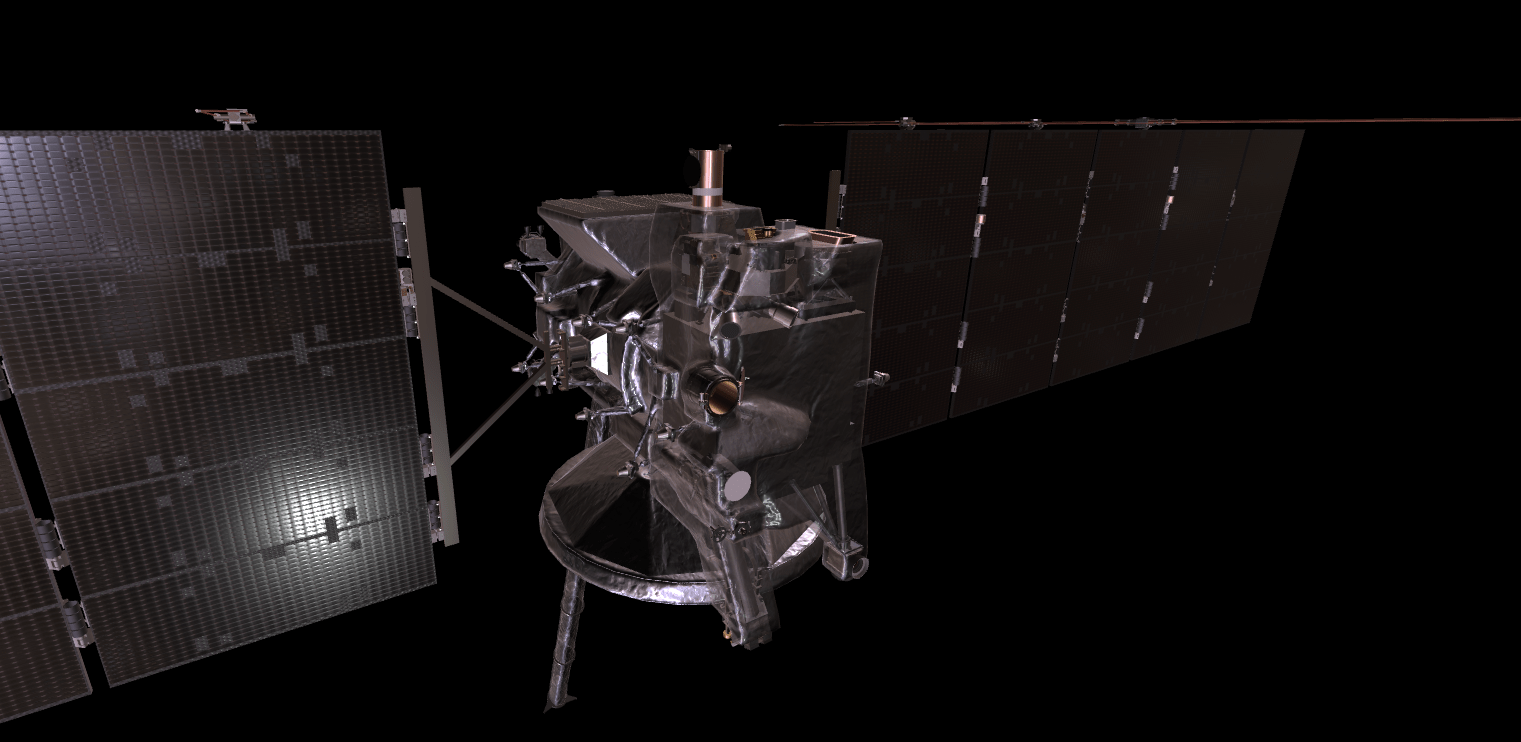
Image (Credit): NASA’s Europa Clipper. (NASA)

Here are some recent stories of interest.

NASA JPL: “Time is Running Out to Add Your Name to NASA’s Europa Clipper

Six weeks remain for you to add your name to a microchip that will ride aboard the spacecraft as it explores Jupiter’s moon Europa. It’s not every day that members of the public have the chance to send their names into deep space beyond Mars, all the way to Jupiter and its moon Europa. But with NASA’s Europa Clipper, you have that opportunity: Names will ride aboard the spacecraft as it journeys 1.8 billion miles (2.6 billion kilometers) to this icy moon, where an ocean hides beneath a frozen outer shell. The deadline to join the mission’s “Message in a Bottle” campaign is only six weeks away. The campaign closes at 11:59 p.m. EST, Dec. 31, 2023.

NBC News: “Look! Up in the sky! It’s a bird! It’s a plane! It’s … a tool bag?

That’s no moon. An astronaut’s tool bag that accidentally floated away during a routine spacewalk at the International Space Station is now orbiting Earth and may be bright enough to spot by keen-eyed skywatchers. The bag drifted away from the space station this month when NASA astronauts Jasmin Moghbeli and Loral O’Hara were performing maintenance on the exterior of the orbiting outpost.

LiveScience: “China Successfully Grows Lettuce and Tomatoes Aboard Tiangong Space Station

China’s Shenzhou 16 astronauts have been growing vegetables aboard the Tiangong space station, as part of plans for future deep space exploration. Mission commander Jing Haipeng and rookie astros Zhu Yangzhu and Gui Haichao have been aboard Tiangong since late May and are due to return to Earth on Oct. 31, after handing over control of the station to the newly arrived Shenzhou 17 mission crew. Jing and company have spent time cultivating veggies using two sets of specialized equipment. The first started operation in June and has reaped four batches of lettuce. The second one was put into operation in August for growing cherry tomatoes and green onions.
Space Stories: Curiosity Continues, Exoplanets with Dinosaurs, and Nasty Jupiters

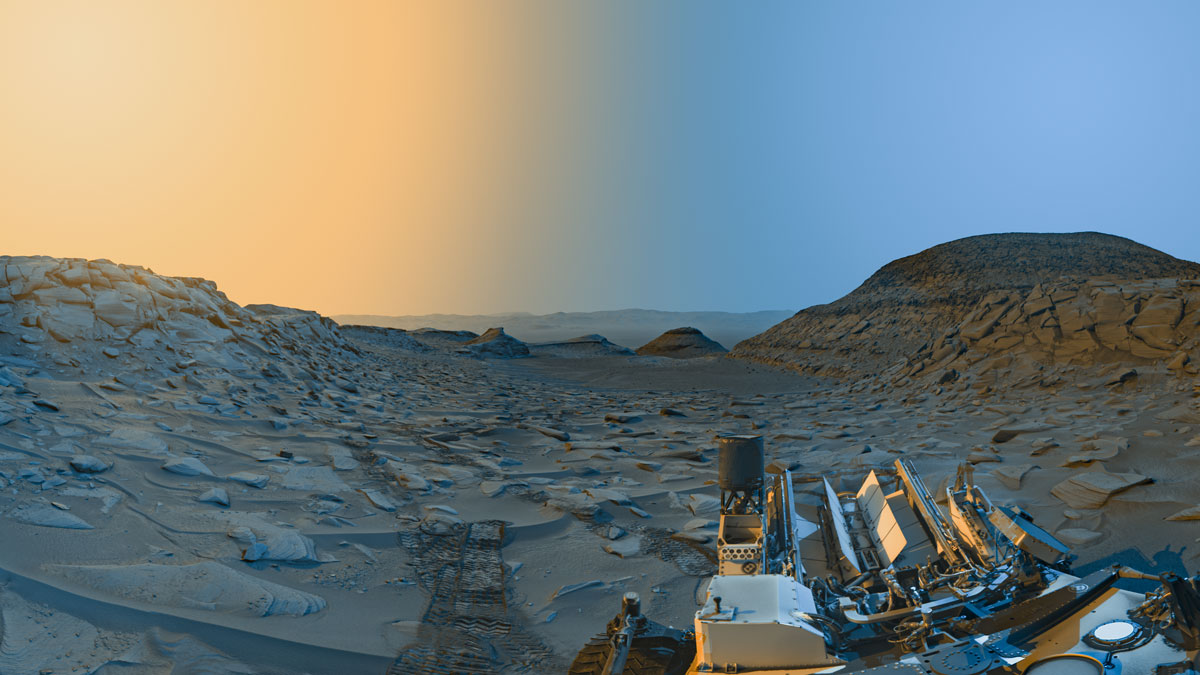
Image (Credit): Curiosity’s view of the Martian surface. (NASA)

Here are some recent stories of interest.

NASA JPL: “NASA’s Curiosity Rover Clocks 4,000 Days on Mars

Four thousand Martian days after setting its wheels in Gale Crater on Aug. 5, 2012, NASA’s Curiosity rover remains busy conducting exciting science. The rover recently drilled its 39th sample then dropped the pulverized rock into its belly for detailed analysis. To study whether ancient Mars had the conditions to support microbial life, the rover has been gradually ascending the base of 3-mile-tall (5-kilometer-tall) Mount Sharp, whose layers formed in different periods of Martian history and offer a record of how the planet’s climate changed over time.

Cornell University: “‘Jurassic Worlds’ Might be Easier to Spot than Modern Earth

Things may not have ended well for dinosaurs on Earth, but Cornell University astronomers say the “light fingerprint” of the conditions that enabled them to emerge here provide a crucial missing piece in our search for signs of life on planets orbiting alien stars. Their analysis of the most recent 540 million years of Earth’s evolution, known as the Phanerozoic Eon, finds that telescopes could better detect potential chemical signatures of life in the atmosphere of an Earth-like exoplanet more closely resembling the age the dinosaurs inhabited than the one we know today.

UC Riverside: “Giant Planets Cast a Deadly Pall

Jupiter, by far the biggest planet in our solar system, plays an important protective role. Its enormous gravitational field deflects comets and asteroids that might otherwise hit Earth, helping create a stable environment for life. However, giant planets elsewhere in the universe do not necessarily protect life on their smaller, rocky planet neighbors. A new Astronomical Journal paper details how the pull of massive planets in a nearby star system are likely to toss their Earth-like neighbors out of the “habitable zone.” This zone is defined as the range of distances from a star that are warm enough for liquid water to exist on a planet’s surface, making life possible.

Space Stories: Dinosaur Dust, Missing Stars, and SETI Signals

Image (Credit): The end of the dinosaurs. (NYT, Roger Harris/Science Source)

Here are some recent stories of interest.

Royal Observatory of Belgium: “Dust Played a Major Role in Dinosaur Demise

Fine dust from pulverized rock generated by the Chicxulub impact likely played a dominant role in global climate cooling and the disruption of photosynthesis following the event. This is suggested by a new study published in Nature Geoscience, in which researchers Cem Berk Cenel, Özgür Karatekin and Orkun Temel of the Royal Observatory of Belgium contributed.

Express: “Astronomers Trying to Unravel Mystery of Three Stars that Suddenly Disappeared from Sky

A team of Spanish astronomers is leading the investigation into one of stargazing’s most perplexing mysteries. Three bright stars photographed in the night sky above southern California in 1952 vanished just an hour later. Generations of scientists have sought to explain the rare phenomenon over the past half-century, but nothing has yet convinced the community. Researchers at the Centre for Astrobiology (CAB) in Madrid tried to solve the riddle of the “triple transient” that has “remained absent from telescope exposures for 71 years” in a new paper published online.

Sci.News: “New Study Sets Clearer Bounds on Search for Technosignatures from Extraterrestrial Intelligences

A stable-frequency transmitter with relative radial acceleration to a receiver will show a change in received frequency over time, known as a ‘drift rate.’ For a transmission from an exoplanet, astronomers must account for multiple components of drift rate: the exoplanet’s orbit and rotation, the Earth’s orbit and rotation, and other contributions. Understanding the drift rate distribution produced by exoplanets relative to Earth, can help scientists constrain the range of drift rates to check in a Search for Extraterrestrial Intelligence (SETI) project to detect radio technosignatures, and help them decide validity of signals-of-interest, as they can compare drifting signals with expected drift rates from the target star. In a new study, University of California, Los Angeles astronomer Megan Grace Li and colleagues modeled the drift rate distribution for over 5,300 confirmed exoplanets, using parameters from the NASA Exoplanet Archive.

Space Stories: Distant Spacecraft Updates, Lucy Gets Ready for a Flyby, and Lunar Near-Earth Asteroids

Image (Credit): Voyager II spacecraft instruments. (NASA)

Here are some recent stories of interest.

Space.com: “NASA’s interstellar Voyager Probes Get Software Updates Beamed from 12 Billion Miles Away

About 46 years after NASA’s Voyager 1 and Voyager 2 launched on an epic journey to explore space, the probes’ antique hardware continues to receive tweaks from afar. One update, a software fix, ought to tend to the corrupted data that Voyager 1 began transmitting last year, and another set aims to prevent gunk from building up in both spacecraft’s thrusters. Together, these updates intend to keep the spacecraft in contact with Earth for as long as possible.

NASA: “NASA’s Lucy Spacecraft Preparing for its First Asteroid Flyby

NASA’s Lucy spacecraft is preparing for its first close-up look at an asteroid. On Nov. 1, it will fly by asteroid Dinkinesh and test its instruments in preparation for visits in the next decade to multiple Trojan asteroids that circle the Sun in the same orbit as Jupiter. Dinkinesh, less than half a mile, or 1 kilometer, wide, circles the Sun in the main belt of asteroids located between the orbits of Mars and Jupiter. Lucy has been visually tracking Dinkinesh since Sept. 3; it will be the first of 10 asteroids Lucy will visit on its 12-year voyage. To observe so many, Lucy will not stop or orbit the asteroids, instead it will collect data as it speeds past them in what is called a “flyby.”

UC San Diego: “How Could a Piece of the Moon Become a Near-Earth Asteroid? Researchers Have an Answer

A team of astronomers has found a new clue that a recently discovered near-Earth asteroid, Kamooalewa, might be a chunk of the moon. They hypothesized that the asteroid was ejected from the lunar surface during a meteorite strike–and they found that a rare pathway could have allowed Kamooalewa to get into orbit around the sun while remaining close to the orbits of the Earth and the Moon. The research team details their findings in the Oct. 23 issue of the journal Nature Communications Earth & Environment. Kamo`oalewa has been the object of several astronomy studies in recent years. As a result, a Chinese mission launching in 2025 is set to land on the asteroid and return samples to Earth.

Space Stories: Roving Students, Preparing for Roman Times, and a New Space Center

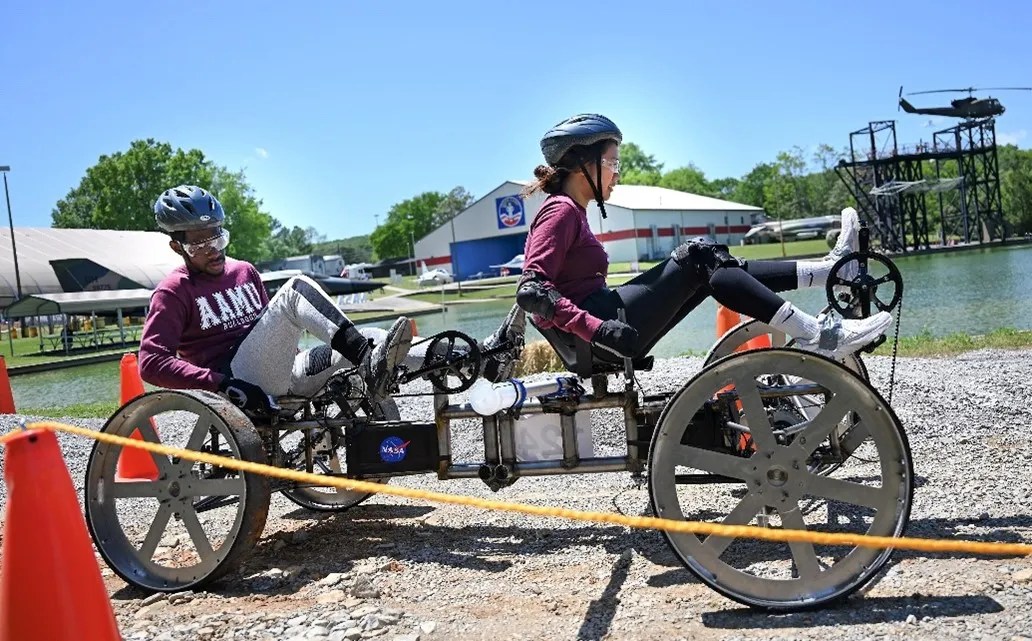
Image (Credit): Students at this year’s obstacle course at the U.S. Space & Rocket Center during NASA’s Human Exploration Rover Challenge event. (NASA)

Here are some recent stories of interest.

NASA: “Dozens of Student Teams Worldwide to Compete in NASA Rover Challenge

NASA has selected 72 student teams to begin an engineering design challenge to build human-powered rovers that will compete next April at the U.S. Space & Rocket Center in Huntsville, Alabama, near the agency’s Marshall Space Flight Center. Celebrating its 30th anniversary in 2024, the Human Exploration Rover Challenge tasks high school, college, and university students to design, build, and test lightweight, human-powered rovers on an obstacle course simulating lunar and Martian terrain, all while completing mission-focused science tasks.

Space.com: “NASA’s Roman Space Telescope will Launch in 2027. Here’s How Scientists are Getting Ready

NASA is mobilizing the scientific community to ensure the agency’s next big space telescope will be ready to deliver a “big picture” view of the universe almost immediately after launching. The Nancy Grace Roman Telescope — also known as the Roman Space Telescope, or just Roman — is set to launch in 2027 and will view the cosmos with a staggeringly wide field of view. Its big-picture observations of distant and early galaxies could help scientists solve the mysteries of dark matter and dark energy. Collectively, this so-called dark universe accounts for 95% of the energy and matter in the cosmos, yet the true nature of dark matter and dark energy eludes scientists.

SF YIMBY: “UC Berkeley Announces $2 Billion Space Center At NASA Ames Research Center

New plans have been revealed for a $2 billion research center run by UC Berkeley at the NASA Ames Center in Mountain View, Santa Clara County. The Berkeley Space Center, as it will be called, will reshape 36 acres on the sprawling Ames Research Center, providing a hub for future companies to collaborate with the school and NASA scientists & engineers to improve technology for aviation, space exploration, and how people live and work in space.