Space Stories: Lost Lunar Lander, Exoplanet Elements, and the Molten Middle of Mars

Image (Credit): Artist’s rendering of the HAKUTO-R Mission 1 Lunar Lander orbiting the Moon. (ispace)

Here are some recent stories of interest.

Astronomy.com:Japanese Lunar Lander Loses Contact Moments Before Touchdown

The Japanese start-up ispace attempted to become the first private company to successfully soft-land a commercial spacecraft on the Moon today (Tuesday, April 25). However, it now appears that the landing attempt — like several other such attempts in recent years — has failed…Ispace currently plans to attempt at least two more lunar landings over the next few years, applying lessons learned during today’s landing attempt to increase their odds of success.

Phys.com:Scientists Discover Rare Element in Exoplanet’s Atmosphere

The rare metal terbium has been found in an exoplanet’s atmosphere for the first time. The researchers at Lund University in Sweden have also developed a new method for analyzing exoplanets, making it possible to study them in more detail…”Detecting heavy elements in the atmospheres of ultra-hot exoplanets is another step towards learning how the atmospheres of planets work. The better we get to know these planets, the greater chance we have of finding Earth 2.0 in the future,” concludes Nicholas Borsato.

NASA:NASA InSight Study Provides Clearest Look Ever at Martian Core

While NASA retired its InSight Mars lander in December, the trove of data from its seismometer will be pored over for decades to come. By looking at seismic waves the instrument detected from a pair of temblors in 2021, scientists have been able to deduce that Mars’ liquid iron core is smaller and denser than previously thought.
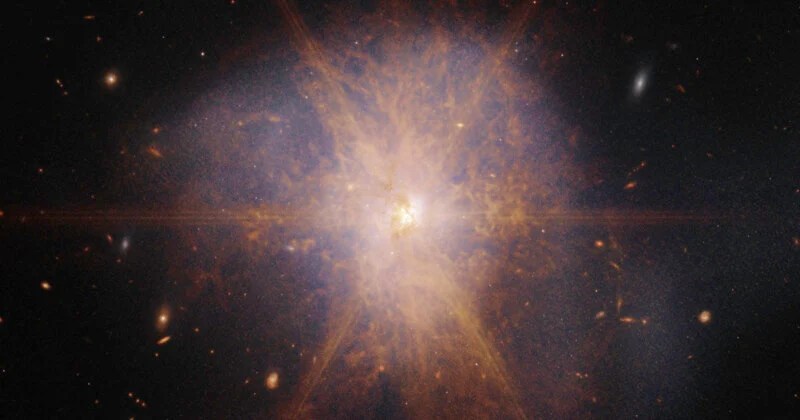
Space Stories: Merging Galaxies, Anniversary for TESS, and Helicopter Flights on Mars

Image (Credit): Arp 220 as captured by NASA’s James Webb Space Telescope. (NASA, ESA, CSA, STScI, Alyssa Pagan)

Here are some recent stories of interest.

PetaPixel:Webb Captures Star-Forming Galactic Merger Brighter Than 1 Trillion Suns’”

NASA’s James Webb Space Telescope has captured a stunning “smash-up” of two spiral galaxies. Collectively called Arp 220, the collision of the pair of galaxies has facilitated massive star formation. Arp 220 is located within the constellation Serpens, about 250 million light-years from Earth. Arp 220 gets its namesake because it is the 220th object in Hallton Art’s Atlas of Peculiar Galaxies. Arp 220 is “peculiar” because it’s an ultra-luminous infrared galaxy (ULIRG), and the nearest ULIRG to Earth.

Phys.org:NASA’s TESS Celebrates Fifth Year Scanning the Sky for New Worlds’”

Now in its fifth year in space, NASA’s TESS (Transiting Exoplanet Survey Satellite) remains a rousing success. TESS’s cameras have mapped more than 93% of the entire sky, discovered 329 new worlds and thousands more candidates, and provided new insights into a wide array of cosmic phenomena, from stellar pulsations and exploding stars to supermassive black holes.

NASA:NASA’s Ingenuity Mars Helicopter Completes 50th Flight’”

NASA’s Ingenuity Mars Helicopter has completed its 50th flight on Mars. The first aircraft on another world reached the half-century mark on April 13, traveling over 1,057.09 feet (322.2 meters) in 145.7 seconds. The helicopter also achieved a new altitude record of 59 feet (18 meters) before alighting near the half-mile-wide (800-meter-wide) “Belva Crater.”

Space Stories: Sagan as Scripture, Chinese Lunar Plans, and Outer Space in NYC

Credit: Ballantine Books

Here are some recent stories of interest.

Gizmodo.com: “New NASA Official Took Her Oath of Office on Carl Sagan’s ‘Pale Blue Dot’”

When Dr. Makenzie Lystrup was sworn in as the new director of NASA’s Goddard Space Flight Center last week, she didn’t take her oath of office on the Bible or the U.S. Constitution, but rather on a tome revered by space enthusiasts everywhere: Carl Sagan’s Pale Blue Dot. The book, published in 1994, is named after an iconic image of Earth, snapped by the Voyager I probe, that depicts the planet as a small speck smothered by the emptiness of space. That photo inspired astronomer Carl Sagan to write: “Look again at that dot. That’s here. That’s home. That’s us.” For many, the book serves as a reminder of humanity’s place in the universe and the need to preserve our home planet, which makes it similar to holy scripture for a newly appointed NASA director.

Time: “In Five Years, China Will Start Building a Lunar Base With Bricks Made From Moon Soil

China plans to start building a lunar base in about five years, kicking off with bricks made of moon soil, according to scientists with ties to the project, the South China Morning Post reported. Ding Lieyun, a top scientist at Huazhong University of Science and Technology, told local media that the first brick would be made from moon soil during the Chang’e 8 mission around 2028.

AFAR: “NASA Teams With NYC Museum on New Immersive Outer Space Exhibit

With its blazing city lights, New York is one of the worst places to go stargazing. But space aficionados will want to visit lower Manhattan this spring—dark skies or not—thanks to a new digital art exhibit created with participation from NASA and CNES (the French space agency) that opened April 7 at Hall des Lumières, the city’s first permanent immersive art center. An earlier iteration of this show premiered at Hall des Lumières’ sister museum in Paris, Atelier des Lumières, in 2021. Destination Cosmos: The Immersive Space Experiencewill run for eight weeks through June 4, 2023, at Hall des Lumières, which opened in 2022 in the former Emigrant Savings Bank across from City Hall.

Space Stories: Volcanoes on Venus, Exoplanet Radio Signals, and Bright Baby Jupiter

Image (Credit): Map of volcanoes located on Venus. (Washington University in St. Louis)

Here are some recent stories of interest.

Washington University in St. Louis: “Scientists Share ‘Comprehensive’ Map of Volcanoes on Venus — all 85,000 of Them

Byrne and Hahn’s new study includes detailed analyses of where volcanoes are, where and how they’re clustered, and how their spatial distributions compare with geophysical properties of the planet such as crustal thickness. Taken together, this work provides the most comprehensive understanding of Venus’ volcanic properties — and perhaps of any world’s volcanism so far. That’s because, although we know a great deal about the volcanoes on Earth that are on land, there are still likely a great many yet to be discovered under the oceans. Lacking oceans of its own, Venus’ entire surface can be viewed with Magellan radar imagery.

CNN: “Repeating Radio Signal Leads Astronomers to an Earth-Size Exoplanet

Astronomers have detected a repeating radio signal from an exoplanet and the star that it orbits, both located 12 light-years away from Earth. The signal suggests that the Earth-size planet may have a magnetic field and perhaps even an atmosphere…Scientists noticed strong radio waves coming from the star YZ Ceti and the rocky exoplanet that orbits it, called YZ Ceti b, during observations using the Karl G. Jansky Very Large Array of telescopes in New Mexico. The researchers believe the radio signal was created by interactions between the planet’s magnetic field and the star.

ScienceNews: “Baby Jupiter Glowed so Brightly it Might have Desiccated its Moon

A young, ultrabright Jupiter may have desiccated its now hellish moon Io. The planet’s bygone brilliance could have also vaporized water on Europa and Ganymede, planetary scientist Carver Bierson reported March 17 at the Lunar and Planetary Science Conference. If true, the findings could help researchers narrow the search for icy exomoons by eliminating unlikely orbits. Jupiter is among the brightest specks in our night sky. But past studies have indicated that during its infancy, Jupiter was far more luminous. “About 10 thousand times more luminous,” said Bierson, of Arizona State University in Tempe.

Space Stories: An Exoplanet’s Atmosphere, A Cosmic Explosion, and Stars Halfway to the Andromeda Galaxy

Here are some recent stories of interest.

WebbTelescope.org: “Weather Report: Expect Scattered, Patchy Clouds Made Up of Silicates on Planet VHS 1256 b

Ever had hot sand whip across your face? That’s a soothing experience compared to the volatile conditions discovered high in the atmosphere of planet VHS 1256 b. Researchers using NASA’s James Webb Space Telescope proved that its clouds are made up of silicate particles, ranging from fine specks to small grains. Plus, its near-constant cloud cover is on the move! The team projects that the silicates swirling in these clouds periodically get too heavy and rain into the depths of the planet’s atmosphere. Webb’s observations also show clear signatures of water, methane and carbon monoxide, and provide evidence for carbon dioxide. This is only the beginning of the team’s research – many more findings are expected as they continue to dig in to Webb’s “downpour” of data.

The Guardian: “Cosmic Explosion Last Year May be ‘Brightest Ever Seen’”

A cosmic explosion that blinded space instruments last year may be the brightest ever seen, according to astronomers. The blast took place 2bn light years from Earth, producing a pulse of intense radiation that swept through the solar system in October last year. The cosmic event, known as a gamma-ray burst (GRB), produced some of the strongest and brightest explosions in the universe, triggering detectors on multiple spacecraft. The October blast was deemed so exceptional that astronomers said it was the brightest of all time since the beginning of human civilisation.

Astronomy.com: “Milky Way Stars Found Nearly Halfway to Andromeda Galaxy

Astronomers have discovered a slew of stars lingering in the far fringes of our galaxy. And when we say far, we mean far. The most distant of these stars is located more than 1 million light-years away. That’s almost halfway to our largest galactic neighbor, the Andromeda Galaxy, which is located some 2.5 million light-years away. “This study is redefining what constitutes the outer limits of our galaxy,” said Raja GuhaThakurta, professor and chair of astronomy and astrophysics at UC Santa Cruz, in a news release. “Our galaxy and Andromeda are both so big, there’s hardly any space between the two galaxies.”