Space Stories: Stalled Martian Rover, Early Mega-Galaxies, and Soviet Space Debris

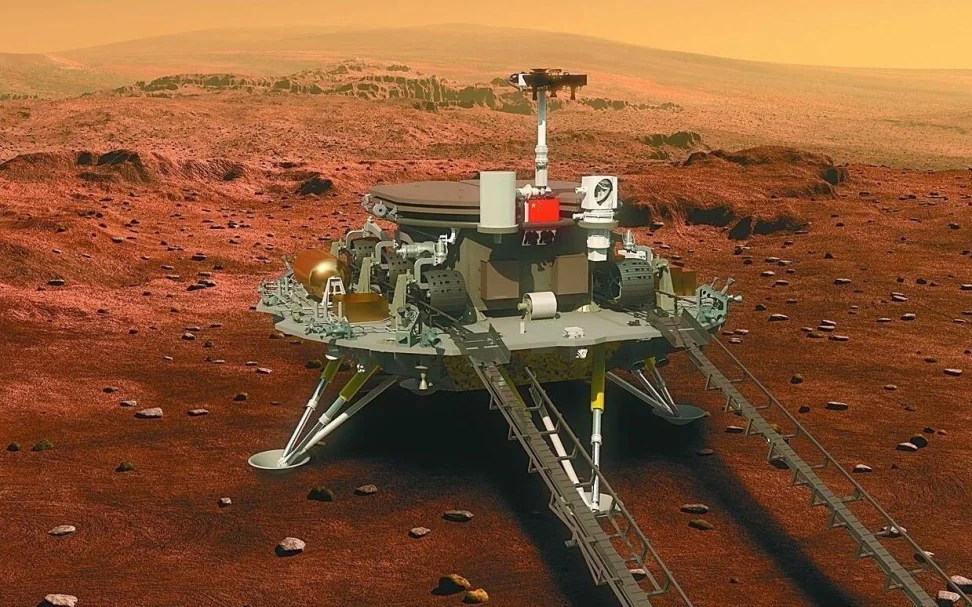
Image (Credit): Artist’s rendering of China’s Zhurong rover about to roll off the lander and drive onto Mars. (WEIBO)

Here are some recent stories of interest.

SpaceNews: “NASA Mars Orbiter Reveals China’s Zhurong Rover Has Not Moved for Months

Images from NASA’s Mars Reconnaissance Orbiter reveal that China’s Zhurong rover remains stationary on the Red Planet as China remains silent on the status of its spacecraft. The High Resolution Imaging Science Experiment (HiRISE) camera aboard the Mars Reconnaissance Orbiter (MRO) captured images of the rover on March 11, 2022, a second on Sept. 8, 2022 and finally Feb. 7, 2023. The images were published Feb. 21 by the HiRISE Operations Center.

Los Angeles Times: “Space Telescope Spots Massive Galaxies Near Cosmic Dawn and Blows Astronomers’ Minds

Astronomers have discovered what appear to be massive galaxies dating back to within 600 million years of the big bang, suggesting the early universe may have had a stellar fast-track that produced these “monsters.” While the new James Webb Space Telescope has spotted even older galaxies, dating to within a mere 300 million years of the beginning of the universe, it’s the size and maturity of these six apparent mega-galaxies that stunned scientists. They reported their findings Wednesday in the journal Nature.

Newsweek: “Russian Rocket Crashes Back Into Russia After 42 Years

A decades-old Soviet era piece of space junk has crashed back to Earth after over 40 years in orbit, improbably crash landing back in its home country, Russia. The abandoned Soviet Vostok-2M Blok E rocket stage, weighing more than 3,000 pounds, “made an uncontrolled reentry over Novaya Zemlya at 1016 UTC Feb 20 after 42.7 years in orbit,” tweeted Jonathan McDowell, an astrophysicist and group leader at the Chandra X-ray Center Science Data Systems.

Space Stories: Black Holes & Dark Energy, New Forms of Ice, and Dark Dwarf Galaxies

Image (Credit): Ship from the Disney film The Black Hole. (Disney)

Here are some recent stories of interest.

University of Hawaii: “First Observational Evidence Linking Black Holes to Dark Energy

Searching through existing data spanning 9 billion years, a team of researchers led by scientists at University of Hawaiʻi at Mānoa has uncovered the first evidence of “cosmological coupling” –a newly predicted phenomenon in Einstein’s theory of gravity, possible only when black holes are placed inside an evolving universe.

UH Mānoa astrophysicists Duncan Farrah, a faculty member at the Institute for Astronomy and the Department of Physics and Astronomy, and Kevin Croker, a professor of physics and astronomy led this ambitious study, combining Hawaiʻi’s expertise in galaxy evolution and gravity theory with the observation and analysis experience of researchers across nine countries to provide the first insight into what might exist inside real black holes.

Astronomy.com: “Scientists Create New Form of Ice that Might Exist on Ocean Moons

Chemists have discovered a new form of ice, and their work may have major consequences for our understanding of the outer solar system. We usually encounter three forms of water on the surface of Earth: solid, liquid, and vapor. On our planet, solid ice mainly comes in one variety, where water molecules arrange themselves into an orderly and repeated crystalline structure. But scientists have discovered 19 other varieties of water-ice that may appear throughout the universe.

Phys.org: “Chinese Astronomers Discover an Isolated Dark Dwarf Galaxy

Using the Five-hundred-meter Aperture Spherical radio Telescope (FAST), Chinese astronomers have detected a new galaxy, which received designation FAST J0139+4328. The newfound galaxy is isolated, has a relatively low stellar mass, and is dominated by dark matter. The discovery was detailed in a paper published February 6 on the arXiv pre-print server.

Space Stories: Jovian Moons, Charon’s Canyons, and a New Space Telescope

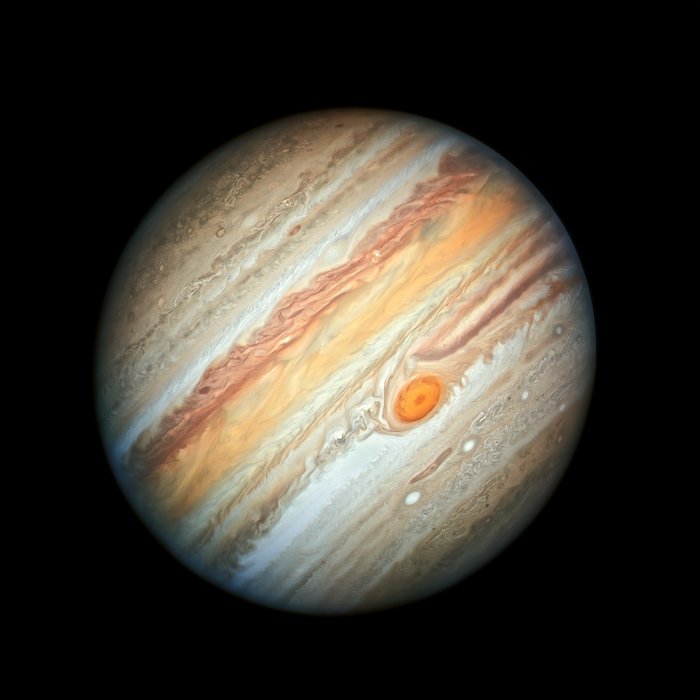
Image (Credit): Jupiter as seen by the NASA/ESA Hubble Space Telescope. (NASA, ESA, A. Simon (Goddard Space Flight Center), and M.H. Wong (University of California, Berkeley)

Here are some recent stories of interest.

Live Science: “Jupiter Officially has the Most Moons in the Solar System, Discovery of 12 New Satellites Confirms

Jupiter was already the king of the solar system, and new discoveries give the massive planet another way to reign supreme: It now has the most moons. Twelve new moons discovered orbiting Jupiter have been confirmed, bumping the count from 80 to 92, and knocking Saturn — which has 83 moons — down a peg. 

Phys.org: “Models Explain Canyons on Pluto’s Large Moon Charon

In 2015, when NASA’s New Horizons spacecraft encountered the Pluto-Charon system, the Southwest Research Institute-led science team discovered interesting, geologically active objects instead of the inert icy orbs previously envisioned. An SwRI scientist has revisited the data to explore the source of cryovolcanic flows and an obvious belt of fractures on Pluto’s large moon Charon. These new models suggest that when the moon’s internal ocean froze, it may have formed the deep, elongated depressions along its girth but was less likely to lead to cryovolcanoes erupting with ice, water and other materials in its northern hemisphere.

Big Think: “NASA’s Habitable Worlds Observatory to Finally Answer the Epic Question: “Are we Alone?”

…perhaps the biggest question of all — that of “Are we alone in the Universe?” — remains a mystery. While the current generation of ground-based and space-based telescopes can take us far into the Universe, this is a question that’s currently beyond our reach. To get there, we’ll need to directly image Earth-like exoplanets: planets with sizes and temperatures similar to Earth, but that orbit Sun-like stars, not the more common red dwarf stars like Proxima Centauri or TRAPPIST-1. Those capabilities are precisely what NASA is aiming for with its newly announced flagship mission: the Habitable Worlds Observatory. It’s an ambitious project but one that’s well worth it. After all, finding out we’re not alone in the Universe would quite possibly be the biggest revolution in all of science history.

Space Stories: Congressional Space Medal, Asteroid Rings, and Dancing Exoplanets

Image (Credit): Former NASA astronauts Robert Behnken, left, and Douglas Hurley, right, and are seen after being awarded the Congressional Space Medal of Honor by Vice President Kamala Harris during a ceremony in the Eisenhower Executive Office Building. (NASA/Joel Kowsky)

Here are some recent stories of interest.

NASA: “VP Awards Former NASA Astronauts Congressional Space Medal of Honor

On behalf of President Joe Biden, Vice President Kamala Harris awarded former NASA astronauts Douglas Hurley and Robert Behnken the Congressional Space Medal of Honor Tuesday for their bravery in NASA’s SpaceX Demonstration Mission-2 (Demo-2) to the International Space Station in 2020. Hurley and Behnken are the first recipients of the honor since 2006 and accepted the awards during a televised event in Washington.

CNET: “NASA Webb Telescope Zooms in on One of Solar System’s Oddest Objects

Scientists using NASA’s new James Webb Space Telescope say they’ve been able to get a closer look at an asteroid that also hosts just the fifth ring system to be discovered in our solar system (the others circle Saturn, Jupiter, Uranus and Neptune).  Astronomers initially discovered the rings in 2013 while watching Chariklo occult, or pass in front of, a distant star. To their surprise, two other smaller objects also appeared to pass in front of the background star for an instant. These turned out to be two thin rings around Chariklo. 

Northwestern University: “Watch Distant Worlds Dance Around their Sun

In 2008, HR8799 was the first extrasolar planetary system ever directly imaged. Now, the famed system stars in its very own video. Using observations collected over the past 12 years, Northwestern University astrophysicist Jason Wang has assembled a stunning time lapse video of the family of four planets — each more massive than Jupiter — orbiting their star. The video gives viewers an unprecedented glimpse into planetary motion. 

Space Stories: Europeans Not Joining Chinese Space Station, the Milky Way is Odd, and Lucy has a New Target

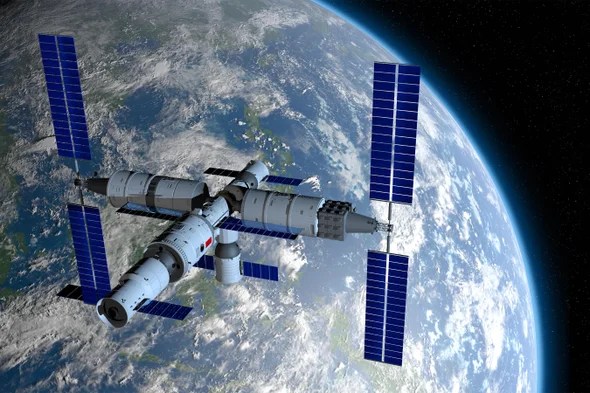
Image (Credit): A computer rendering of China’s new Tiangong space station in orbit. (Alejandro Miranda/Alamy Stock Photo)

Here are some recent stories of interest.

Royal Astronomical Society: “European Space Agency Says it has No Plans to Send Astronauts to China’s Tiangong Space Station

A top official with the European Space Agency said it had no plans to send European astronauts to the newly completed Chinese space station, making it clear for the first time that the agency is no longer committed to working with China in human space flight in the near future. “We are very busy supporting and ensuring our commitments and activities on the International Space Station,” ESA director general Josef Aschbacher told a press conference in Paris on Monday.

Royal Astronomical Society: “Milky Way Found to be More Unique than Previously Thought

Is the Milky Way special, or, at least, is it in a special place in the Universe? An international team of astronomers has found that the answer to that question is yes, in a way not previously appreciated. A new study shows that the Milky Way is too big for its “cosmological wall”, something yet to be seen in other galaxies. The new research is published in Monthly Notices of the Royal Astronomical Society.

Southwest Research Institute: “SwRI-Led Lucy Team Announces New Asteroid Target

NASA’s Lucy spacecraft will add another asteroid encounter to its 4-billion-mile journey. On Nov. 1, 2023, the Southwest Research Institute-led Lucy mission will get a close-up view of a small main belt asteroid to conduct an engineering test of the spacecraft’s innovative asteroid-tracking navigation system. The Lucy mission was already on course to break records by its planned visit of nine asteroids during its 12-year mission to tour the Jupiter Trojan asteroids, which orbit the Sun at the same distance as Jupiter. Originally, Lucy was not expected to get a close-up view of any asteroids until 2025, when it will fly by the main belt asteroid (52246) Donaldjohanson. However, the SwRI-led Lucy team identified a small, as-yet unnamed asteroid in the inner main belt as a potential new and useful target for the Lucy spacecraft.