Space Stories: The End of Geotail, a Galactic Map, and Sweden Gets a Spaceport

Image (Credit): An artist’s rendering of the Geotail spacecraft. (NASA)

Here are some recent stories of interest.

NASA: “NASA’s Geotail Mission Operations Come to an End After 30 Years

After 30 years in orbit, mission operations for the joint NASA-JAXA Geotail spacecraft have ended, after the failure of the spacecraft’s remaining data recorder. Since its launch on July 24, 1992, Geotail orbited Earth, gathering an immense dataset on the structure and dynamics of the magnetosphere, Earth’s protective magnetic bubble. Geotail was originally slated for a four-year run, but the mission was extended several times due to its high-quality data return, which contributed to over a thousand scientific publications. While one of Geotail’s two data recorders failed in 2012, the second continued to work until experiencing an anomaly on June 28, 2022. After attempts to remotely repair the recorder failed, the mission operations were ended on November 28, 2022.

Phys.org: “Billions of Celestial Objects Revealed in Gargantuan Survey of the Milky Way

Astronomers have released a gargantuan survey of the galactic plane of the Milky Way. The new dataset contains a staggering 3.32 billion celestial objects—arguably the largest such catalog so far. The data for this unprecedented survey were taken with the Dark Energy Camera, built by the US Department of Energy, at the NSF’s Cerro Tololo Inter-American Observatory in Chile, a Program of NOIRLab.

Advanced Television: “Sweden Inaugurates Rocket Launch Site

While much of the world’s press recently focused on Virgin Orbit’s failed ‘horizontal’ aircraft launch of a batch of 9 small satellites from Spaceport Cornwall, other rivals are gearing up to tap into the growing demand for satellite launches. Sweden has claimed the crown as “mainland Europe’s first orbital launch site”. Ursula von der Leyen, President of the European Commission, helped cut the ribbon at Kiruna, Sweden, saying: “This spaceport offers an independent European gateway to space. It is exactly the infrastructure we need, not only to continue to innovate but also to further explore the final frontier.”
Space Stories: JWST Confirms Earth-Size Exoplanet, Russia Sending Rescue Mission to ISS, and IO Erupts

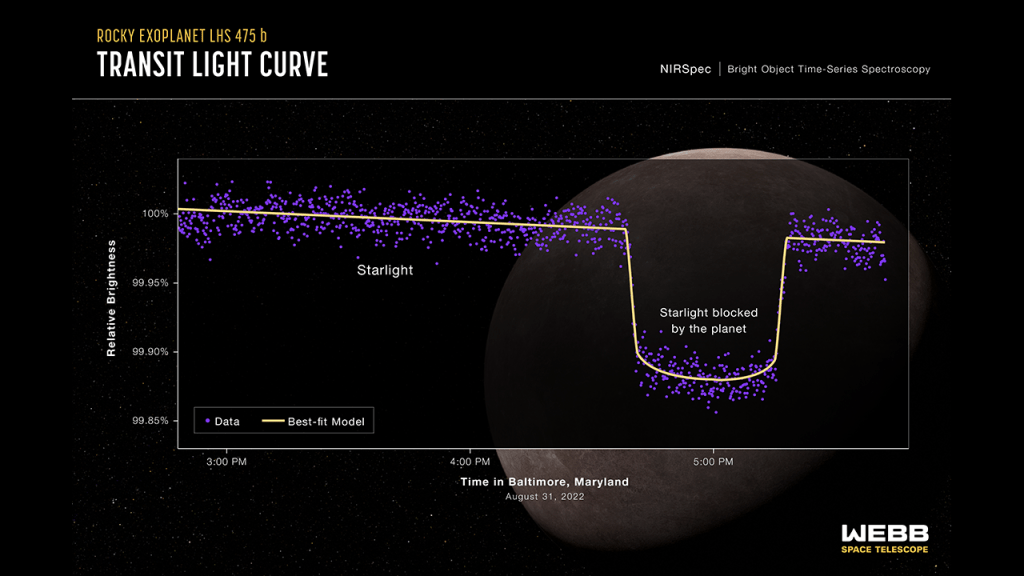
Image (Credit): James Webb Space Telescope (JWST) data associated with exoplanet LHS 475 b. (NASA, ESA, CSA, Leah Hustak (STScI))

Here are some recent stories of interest.

Webb Space Telescope: “NASA’s Webb Confirms Its First Exoplanet

Researchers confirmed an exoplanet, a planet that orbits another star, using NASA’s James Webb Space Telescope for the first time. Formally classified as LHS 475 b, the planet is almost exactly the same size as our own, clocking in at 99% of Earth’s diameter. The research team is led by Kevin Stevenson and Jacob Lustig-Yaeger, both of the Johns Hopkins University Applied Physics Laboratory in Laurel, Maryland.

ABC News: “Russia Will Launch New Capsule to Return Space Station Crew

Russia will send up a new capsule next month to bring back three space station crew members whose original ride home was damaged, officials said Wednesday. The two Russians and one American will stay several extra months at the International Space Station as a result of the capsule switch, possibly pushing their mission to close to a year, NASA and Russian space officials told reporters.

MSN Science Alert: “Massive Volcanic Outburst Detected on Jupiter’s Hellish Moon Io

In the space around Jupiter, a torus of plasma created and fed by Io’s volcanic emissions grew significantly richer between July and September of last year and persisted until December, showing the moon underwent a spate of volcanic activity that released a huge amount of material. For something that’s just a little bit bigger than Earth’s Moon, Io is an absolute beast of volcanism. It’s bristling with volcanoes, with around 150 of the 400 known volcanoes erupting at any given time, creating vast lakes of molten lava.

Space Stories: Passing of Apollo Astronaut Walter Cunningham, Opal on Mars, and Juno Recovers

Image (Credit): Walter Cunningham adjusts his pressure suit before the Apollo 7 launch on October 11, 1968. (NASA)

Here are some recent stories of interest.

NASA: “Apollo Astronaut Walter Cunningham Dies at 90

Former astronaut Walter Cunningham, who flew into space on Apollo 7, the first flight with crew in NASA’s Apollo Program, died early Tuesday morning in Houston. He was 90 years old. “Walt Cunningham was a fighter pilot, physicist, and an entrepreneur – but, above all, he was an explorer. On Apollo 7, the first launch of a crewed Apollo mission, Walt and his crewmates made history, paving the way for the Artemis Generation we see today,” said NASA Administrator Bill Nelson. “NASA will always remember his contributions to our nation’s space program and sends our condolences to the Cunningham family.”

New Atlas: “Curiosity Finds Opal on Mars – a Possible Water Source for Astronauts

NASA’s Curiosity rover has discovered opal on Mars. The deposits may prove to be valuable to future Martian explorers not as jewelry but as a potential source of water. Opal is formed when water weathers silica-rich rocks, forming a solution that settles into cracks and crevices in the rock. Over time, this solution hardens into a solid lump that can be cloudy and dull or a dazzling display of color. Most supplies come from either Australia or Ethiopia, but now a new source has been discovered – Mars.

Space.com: “Juno Spacecraft Recovering its Memory After Mind-blowing Jupiter Flyby, NASA Says

NASA’s Juno probe is continuing to recover its memory at Jupiter after a data disruption interrupted communications between the spacecraft and its operators on Earth following a flyby of the giant planet in December. The Juno spacecraft’s latest flyby of Jupiter, its 47th close pass of the planet, was completed on Dec. 14. But as its operators at NASA’s Jet Propulsion Laboratory were receiving science data from the flyby they found they could no longer directly access the spacecraft’s memory. The team successfully rebooted Juno’s computer and on Dec. 17 they placed the spacecraft into “safe mode” with only essential systems operating as a precaution. 

Space Stories: Chinese Space Partnerships, Approaching Comet, and European Rocket Shortage

Image (Credit): Chinese space program poster. (Asia Times)

Here are some recent stories of interest.

SpaceNews.com: “China Looks to Build Space Partnerships with Gulf Nations

China is aiming to grow cooperation with emerging space nations including Saudi Arabia and the United Arab Emirates. Space was named as one of a number of priority areas for the next three to five years during the first China-Gulf Cooperation Council (GCC) Summit held in Riyadh earlier this month. “China stands ready to work with GCC countries on remote sensing and communications satellite, space utilization, aerospace infrastructure, and the selection and training of astronauts,” according to the text of the keynote speech made by Chinese President Xi Jinping at the summit, Dec. 9. The GCC intergovernmental group comprises Saudi Arabia, the United Arab Emirates, Bahrain, Kuwait, Oman and Qatar.

Newsweek: “Once-in-a-Lifetime Cosmic Event Could Be Visible to the Naked Eye

A comet zooming through the solar system could soon be visible to the naked eye from Earth in what will be a once-in-a-lifetime event. And some astronomical predictions indicate that the object may never return to our cosmic neighborhood. C/2022 E3 (ZTF) is currently located around 100 million miles away from Earth and will make a close approach to our planet in early February 2023.

Atalayar.com: Europe Runs out of Rockets for Autonomous Access to Space

Overnight, the European Space Agency (ESA) headed by Austrian Josef Aschbacher has been left without any capacity to position its own satellites in outer space. Neither Aschbacher nor his director of space transport, the Swiss Daniel Neuenschwander, have any space vector model to fulfil their commitments to the European Union to renew the Copernicus constellation and place their Sentinel environmental monitoring satellites in orbit. Much less is ESA in a position to meet the growing global demand for launch services that is knocking on its doors, those of the United States, China and India.

Space Stories: ISS Leak, Revamped Space Council, and Asteroid Space Stations

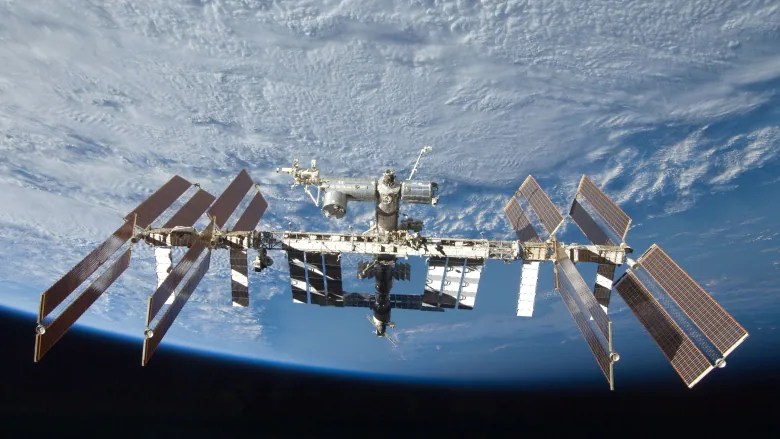
Image (Credit): International Space Station. (Canadian Space Agency)

Here are some recent stories of interest.

CBS News: “Soyuz Ferry Ship Temperatures Remain Within Limits Despite Major Coolant Leak

Temperatures in a Russian Soyuz crew ferry ship docked at the International Space Station — a lifeboat for three of the lab’s seven crew members — remain within safe limits despite a dramatic overnight leak in the spacecraft’s cooling system, officials said Thursday. The leak developed around 7:45 p.m. EST Wednesday amid preparations for a planned 6-hour and 40-minute spacewalk by cosmonauts Sergey Prokopyev and Dmitri Petelin to move a radiator from the Rassvet module, where the Soyuz MS-22/68S spacecraft is docked, to the new Nauka laboratory module.

SpaceNews.com: “White House Revamps Membership of National Space Council Advisory Group

The White House announced the new membership of an advisory group of the National Space Council Dec. 16 with wholesale changes in the roster reflecting a new emphasis on climate change and workforce issues. Vice President Kamala Harris, chair of the National Space Council, announced a roster of 30 members of the Users’ Advisory Committee (UAG), the advisory group that supports the council on various space topics. Their membership on the committee is pending a formal appointment by the NASA administrator, a formality linked to NASA’s role in hosting the UAG.

Phys.org: “Rubble Pile Asteroids Might be the Best Places to Build Space Habitats

There has long been a dream of building a massive rotating space station to call home, such as the one featured in “2001: A Space Odyssey,” but the challenges of construction are huge, not to mention the logistics of lifting such large quantities of steel and other materials into space. A rotating station would need to be at least hundreds of feet across to make artificial gravity practical The bigger the better. So engineers have proposed spinning up asteroids as a kind of ready-built station. We would need to dig out the interior, but this would give us materials we could use.