Space Stories: Challenger Debris Located, Chinese Mars Engine, and Risky Trip to the Space Station

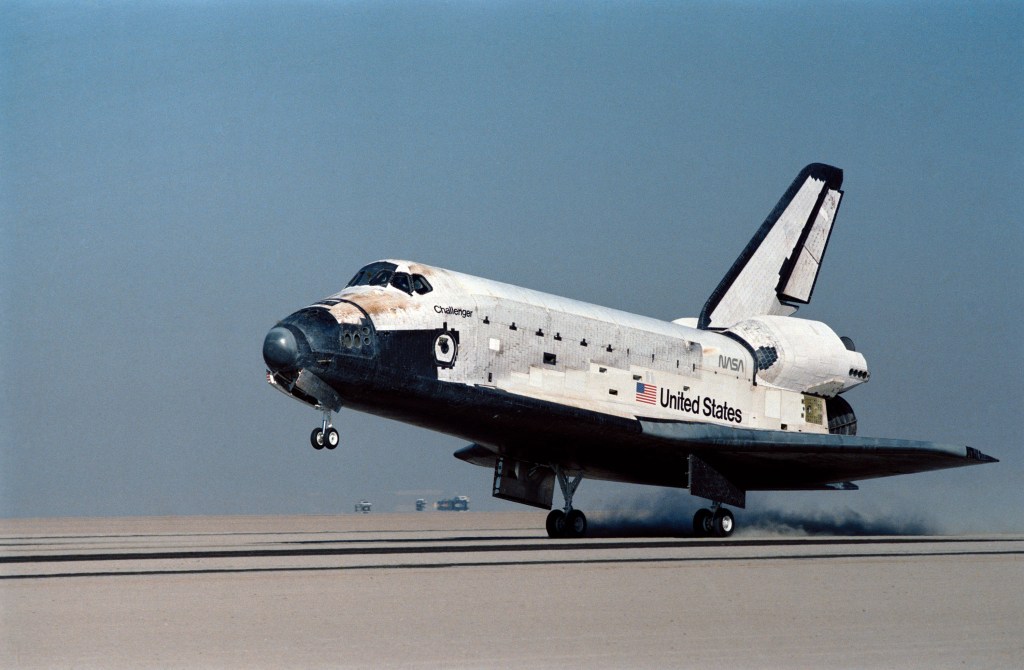
Image (Credit): Space shuttle Challenger landing at Edwards Air Force Base in California on Nov. 6, 1985. (NASA)

Here are some recent stories of interest.

NASA: “NASA Views Images, Confirms Discovery of Shuttle Challenger Artifact

NASA leaders recently viewed footage of an underwater dive off the East coast of Florida, and they confirm it depicts an artifact from the space shuttle Challenger. The artifact was discovered by a TV documentary crew seeking the wreckage of a World War II-era aircraft. Divers noticed a large humanmade object covered partially by sand on the seafloor. The proximity to the Florida Space Coast, along with the item’s modern construction and presence of 8-inch square tiles, led the documentary team to contact NASA.

Space.com:China Just Test-fired the Engine for its Huge New Moon and Mars Rocket

China has completed a first hot fire test of a fully-assembled powerful new engine that could power new launch vehicles and boost the country’s space capabilities. The full system test of the 500-ton-thrust, dual nozzle kerosene-liquid oxygen staged combustion cycle engine took place on Nov. 5, marking a milestone for the rocket engine. 

Phys.org:Cargo Ship Reaches Space Station Despite Jammed Solar Panel

A Northrop Grumman capsule delivered several tons of supplies to the International Space Station on Wednesday despite a jammed solar panel. The shipment arrived two days after launching from Virginia. Only one of the cargo ship’s two round solar panels opened following liftoff. Flight controllers tried in vain to open the stuck panel, but managed to draw enough power for the flight with just one.
Space Stories: A New Martian Crater, the Final Piece of China’s Space Station, and the Falcon Heavy Flies Again

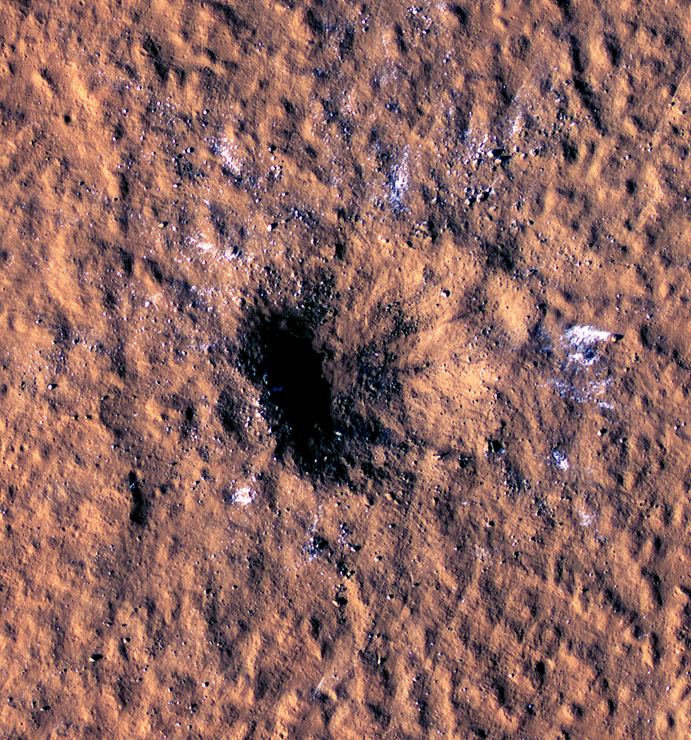
Image (Credit): Recent impact crater on the surface of Mars. It was formed on December 24, 2011 in the Amazonis Planitia region. (NASA/JPL-Caltech/University of Arizona)

Here are some recent stories of interest.

NASA: “NASA’s InSight Lander Detects Stunning Meteoroid Impact on Mars

NASA’s InSight lander recorded a magnitude 4 marsquake last Dec. 24, but scientists learned only later the cause of that quake: a meteoroid strike estimated to be one of the biggest seen on Mars since NASA began exploring the cosmos. What’s more, the meteoroid excavated boulder-size chunks of ice buried closer to the Martian equator than ever found before – a discovery with implications for NASA’s future plans to send astronauts to the Red Planet.

Aljazeera: “Final Module Docks at China’s ‘Heavenly Palace’ Space Station

The final module required for the completion of China’s Tiangong space station has successfully docked with the core structure, state media say, a key step in Beijing’s ambitious plans for space exploration…The module – named Mengtian, which means “heavenly dream” – was launched on Monday on a Long March 5B rocket from the Wenchang launch centre on China’s tropical island of Hainan, CCTV reported.

Wall Street Journal: “SpaceX’s Falcon Heavy Rocket, World’s Most Powerful Rocket, Launches After Three-year Hiatus

SpaceX’s Falcon Heavy — a towering, three-pronged vehicle that is the most powerful operational rocket in the world — returned to the skies on Tuesday for the first time since mid-2019. The rocket launched at 9:41 a.m. ET from NASA’s Kennedy Space Center in Florida, hauling satellites to space for the US military in a secretive mission dubbed USSF-44.

Space Stories: Approaching Lucy, Chinese Space Ambitions, and Conan the Bacterium

Image (Credit): Image from NASA’s Lucy spacecraft showing the Earth and Moon from 890,000 miles away (look closely – the moon on the left is a very pale dot). (NASA/Goddard/SwRI)

Here are some recent stories of interest.

NASA.gov: “NASA’s Lucy Spacecraft Captures Images of Earth, Moon Ahead of Gravity Assist

On October 13, 2022, NASA’s Lucy spacecraft captured [the above] image of the Earth and the Moon from a distance of 890,000 miles (1.4 million km). The image was taken as part of an instrument calibration sequence as the spacecraft approached Earth for its first of three Earth gravity assists. These Earth flybys provide Lucy with the speed required to reach the Trojan asteroids — small bodies that orbit the Sun at the same distance as Jupiter. On its 12 year journey, Lucy will fly by a record breaking number of asteroids and survey their diversity, looking for clues to better understand the formation of the solar system.

SpaceNews.com: “China Considering Mission to Ceres and Large Dark Matter Space Telescope

The Chinese Academy of Sciences is considering potential missions including a Ceres orbiter and a huge telescope to hunt for clues about the nature of dark matter. More than 20 candidates are vying for funding for further study under the Chinese Academy of Sciences Strategic Priority Program on Space Science, also known as the New Horizon Program, and are currently undergoing evaluation.

Space.com: “Extremophiles on Mars Could Survive for Hundreds of Millions of Years

One of Earth’s toughest microbes could survive on Mars, lying dormant beneath the surface, for 280 million years, new research has shown. The findings increase the probability that microbial life could still exist on the Red Planet. Deinococcus radiodurans, nicknamed “Conan the Bacterium,” is one of the world’s toughest microbes, capable of surviving in radiation strong enough to kill any other known life-form. Experiments have now shown that if Conan the Bacterium or a similar microbe existed on Mars, it could survive 33 feet (10 meters) beneath the surface, frozen and dried out, for 280 million years.

Space Stories: Volcanic Exoplanets, Medieval Star Maps, and Near-Earth Asteroids

Image (Credit): The lava lake that sits atop Mount Nyiragongo in the Democratic Republic of Congo (Stocktrek Images / Richard Roscoe via Getty Images)

Here are some recent stories of interest.

Universe.com: “Scientists Discover a New Way Exoplanets Could Make Oxygen; Unfortunately, it Doesn’t Require Life

The researchers have found an abiotic source of oxygen that stems from sulphur dioxide. Sulphur is not rare in celestial bodies, and since volcanoes produce sulphur and pump it into the atmosphere, terrestrial volcanic exoplanets may have oxygen in their atmospheres. And life needn’t be involved.

Nature.com: “First Known Map of Night Sky Found Hidden in Medieval Parchment

A medieval parchment from a monastery in Egypt has yielded a surprising treasure. Hidden beneath Christian texts, scholars have discovered what seems to be part of the long-lost star catalogue of the astronomer Hipparchus — believed to be the earliest known attempt to map the entire sky.

Phys.org: “30,000 Near-Earth Asteroids Discovered, and Numbers are Rising

We have now discovered 30,039 near-Earth asteroids in the solar system—rocky bodies orbiting the sun on a path that brings them close to Earth’s orbit. The majority of these were discovered in the last decade, showing how our ability to detect potentially risky asteroids is rapidly improving.

Space Stories: Venusian Balloons, Sun Observations, and a Private Moon Trip

Image (Credit): Test of the one-third scale prototype aerobot designed to withstand the corrosive chemicals in Venus’ atmosphere. (Near Space Corporation)

Here are some recent stories of interest.

NASA.gov: “JPL’s Venus Aerial Robotic Balloon Prototype Aces Test Flights

A scaled-down version of the aerobot that could one day take to the Venusian skies successfully completed two Nevada test flights, marking a milestone for the project…The shimmering silver balloon ascended more than 4,000 feet (1 kilometer) over Nevada’s Black Rock Desert to a region of Earth’s atmosphere that approximates the temperature and density the aerobot would experience about 180,000 feet (55 kilometers) above Venus. Coordinated by Near Space, these tests represent a milestone in proving the concept’s suitability for accessing a region of Venus’ atmosphere too low for orbiters to reach, but where a balloon mission could operate for weeks or even months.

SkyandTelescope.org: “‘Chinese Observatory Will Study Violent Events on the Sun

China has launched a solar observatory to study solar flares and eruptions, and their connection with the Sun’s magnetic field…[the Advanced Space-based Solar Observatory (ASO-S)] is planned to operate at 720 kilometers (447 miles) above Earth’s surface in a Sun-synchronous orbit that will allow it to observe the Sun at all times. Its primary, four-year mission is timed to make the most of the 2024–2025 solar maximum, when the Sun is at its most active during its 11-year cycle.

Space.com: “‘SpaceX Says its 2nd Private Starship Trip Around the Moon will Help Make Humanity Multiplanetary

SpaceX’s newly announced tourist mission to the moon could help humanity extend its footprint far beyond Earth, company representatives say. That mission, which was revealed today (Oct. 12), will send wealthy entrepreneur Dennis Tito, his wife Akiko and 10 other people on a weeklong journey around the moon aboard SpaceX’s huge Starship vehicle, which is still in development. Who those 10 other passengers will be is unknown; only the Titos have reserved seats at the moment.