Space Stories: Meteor Shakes Ohio, Executive Order Could Impact Pluto, and Musk May Muck Up Space Again

Image (Credit): Dwarf planet Pluto. (NASA/Johns Hopkins University Applied Physics Laboratory/Southwest Research Institute)

Here are some recent space-related stories of interest.

Fox 8 NewsNASA Confirms Boom was 17,000-pound Meteor

A loud “boom” was reported across Northeast Ohio just before 9 a.m. on Tuesday. People around Northeast Ohio flooded the FOX 8 newsroom with reports of what heard like a “large explosion” lasting several seconds and causing homes and businesses to “shake.” NASA has confirmed a 6-foot, 17,000-pound meteor traveled 44,000 miles per hour over northeast Ohio. It was 50 miles above Lake Erie when the first flash was detected.

USA Today: “NASA’s Isaacman Latest to Endorse Trump Reclassifying Pluto as a Planet

President Donald Trump campaigned on “America first,” but some of his supporters and appointees apparently want Pluto to once again be … ninth. The ninth planet in our solar system, that is. Ever since Pluto was infamously stripped of its planetary status two decades ago, debate has raged for years over the distant icy world – half the size of the United States – and just what sort of cosmic body it should be classified as. Now, Jared Isaacman, NASA’s new chief, has appeared to signal his support for Trump to designate Pluto as a planet once again through executive order.

Newsweek: New 1M‑Satellite Plans Could ‘Permanently Scar’ Night Sky, Astronomers Warn

The Royal Astronomical Society (RAS) has issued a stark warning over proposals by Elon Musk’s SpaceX and the California-based startup Reflect Orbital, saying the plans could cause lasting damage to ground‑based astronomy and dramatically alter the night sky for skywatchers. In comments submitted to U.S. regulators, the RAS said the scale and brightness of the proposed satellite constellations risk overwhelming astronomical observations from Earth. The society, alongside the European Southern Observatory (ESO), has formally opposed both projects in filings to the Federal Communications Commission (FCC), where the companies have sought approval.
Audit Report: Questions about the Human Landing System

Auditors with NASA’s Office of the Inspector General (OIG) evaluated three aspects of the Human Landing System (HLS) to be used with the Artemis Moon landing: (1) the extent to which the HLS providers are meeting cost, schedule, and performance goals; (2) the HLS Program’s implementation of the insight/oversight model; and (3) the Program’s identification and mitigation of risks to astronaut safety.

In its report, NASA’s Management of the Human Landing System Contracts, the auditors found issues in all three areas. In particular, the report stated:

…both SpaceX and Blue Origin have experienced schedule delays and face technical and integration challenges that have the potential to further impact lander costs and delivery schedules. In particular, SpaceX’s lander will not be ready for a June 2027 lunar landing.

It is possible that the draft version of this audit report was already the desk of NASA Administrator Isaacman right before he decided to move the Moon landing date again. Pending audit reports have a tendency to stir action.

Yet, even once we get to the moon, the auditors identified some safety issues. Specifically, the auditors stated:

We also observed limitations in the Agency’s approach to crew survival analyses—the evaluation of available crew survival capabilities to counter a catastrophic event—due to functional constraints and the availability of resources…While NASA is taking steps to prevent catastrophic events from occurring, ultimately, should the astronauts encounter a life-threatening emergency in space or on the lunar surface, NASA does not have the capability to rescue the stranded crew.

None of this is too surprising with a new approach like this one. Delays are inevitable, and even the best of plans cannot account for everything, as Apollo 13 demonstrated. It also shows that NASA has a tough balancing act, with the need for speed weighed against the mechanisms to ensure the safety of the astronauts.

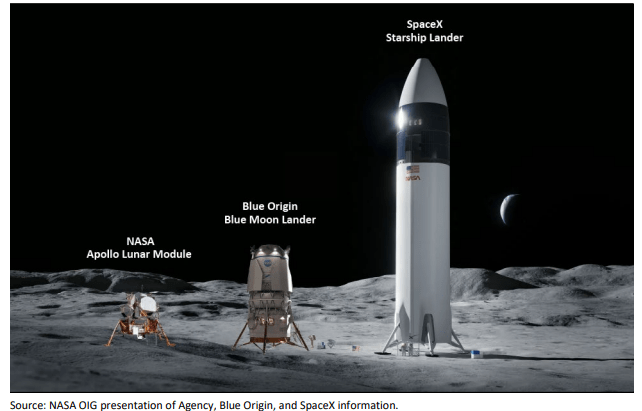
One of the safety concerns stated later in the report really should have been its own report. It discussed the height of the HLS. As shown in the image above, the Starship Lander is huge compared to the Apollo lander and even Blue Origin’s Blue Moon Lander. Here are the dimensions per the report:

Landers may also encounter hazards such as boulders or mounds that are too large or depressions that are too deep for the landing legs and stability design. For example, steep slopes of up to 20 degrees on the lunar South Pole present navigation and landing challenges. Given Starship’s height of 171 feet— about the equivalent of a 14-story tall commercial building—there is a risk that its momentum will continue after landing causing it to tip over. Blue Moon—standing at 53 feet tall—also faces landing risks, including exceeding the lander’s tilt tolerance for safe and effective execution of critical crew functions. Surpassing the tilt tolerance for either lander, which NASA established as not to exceed 8 degrees to support all post-landing crew activities, could impact the operation of equipment such as the hatch used by the crew to exit and enter the vehicle. By comparison, the Apollo Lunar Module stood 23 feet tall.

This is scary given the multiple spacecraft we have already witness toppling over onto the lunar surface just last year. Why would we ever want to land a 14-story tall rocket with an elevator on the Moon as our first attempt after 50 years? I can understand Elon Musk proposing this ridiculous idea, but it is not clear how the original planners could have gone along with it. This is a “catastrophic event” waiting to happen.

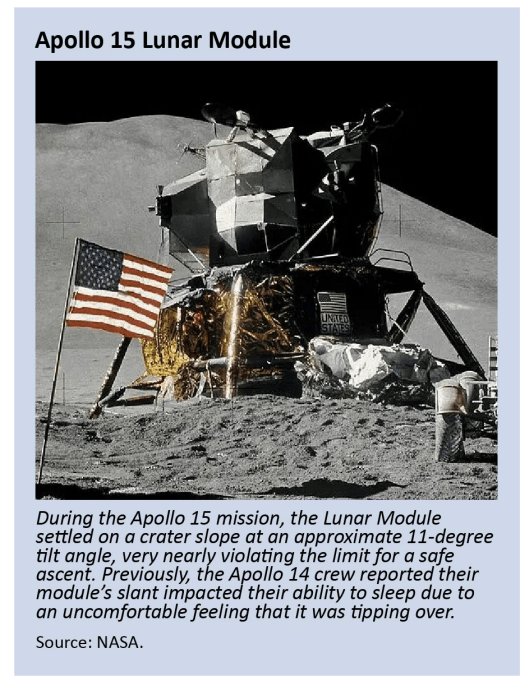
The auditors also added a Apollo 15 Lunar Module story (shown below) to the report. After reading this report and the Apollo 15 clip, I think I will also have trouble sleeping tonight due to an uncomfortable feeling that the current Artemis approach was a mess (if not doomed) from the start.

When is the Next Starship Launch?

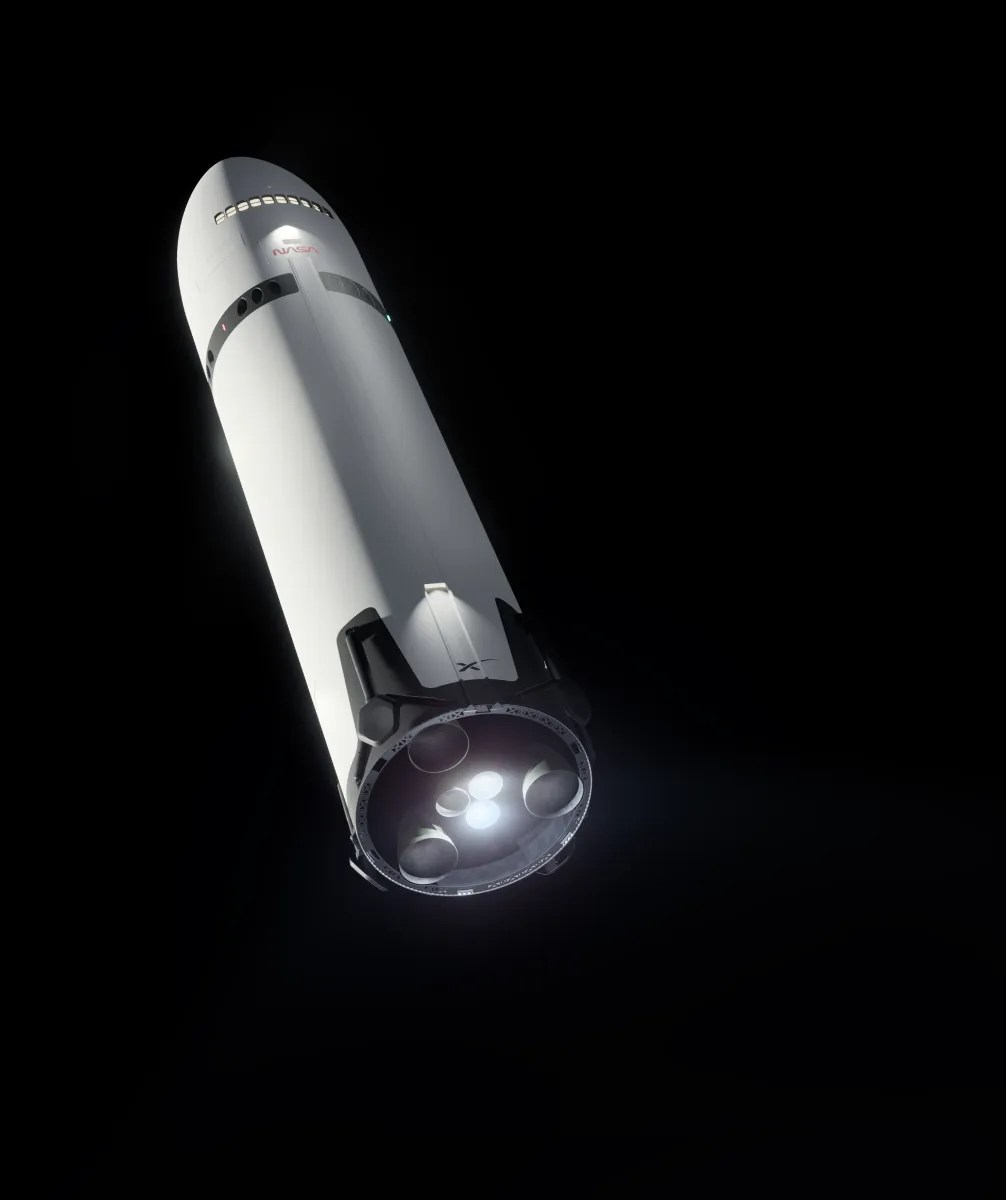
Image (Credit): Artist’s rendering of SpaceX’s Starship HLS preparing for a Moon landing. (SpaceX)

Mr. Musk seems to move like a weather vane regarding where SpaceX is going next, but whether SpaceX is heading for the Moon or Mars it still needs a functioning Starship.

First the confusion. For all of Musk’s ongoing criticism of a Moon mission, it appears he is finally focusing on Artemis III. On Sunday, he tweeted:

For those unaware, SpaceX has already shifted focus to building a self-growing city on the Moon, as we can potentially achieve that in less than 10 years, whereas Mars would take 20+ years.

The mission of SpaceX remains the same: extend consciousness and life as we know it to the stars.

It is only possible to travel to Mars when the planets align every 26 months (six month trip time), whereas we can launch to the Moon every 10 days (2 day trip time). This means we can iterate much faster to complete a Moon city than a Mars city.

That said, SpaceX will also strive to build a Mars city and begin doing so in about 5 to 7 years, but the overriding priority is securing the future of civilization and the Moon is faster.

It seems that someone explained planetary alignment to him over the weekend, but that’s a point for another day.

So the target this week will be the Moon. But a crewed landing on the Moon depends on SpaceX’s Human Landing System (HLS) at the moment, which is where the Starship comes in. Or, more to the point, this is where a multitude of Starships come into play between the refueling in orbit as well and the HLS.

Given that SpaceX planned for 25 Starship launches in 2025 yet achieved only 5, we have an issue Houston (or should I say “Starbase”?).

All indications are that the first launch in 2026 will be early next month (based on one sentence from Musk on January 26th stating “Starship launch in six weeks”), following the last launch of October 13th. Five months between launches is not a very robust schedule given that the Starship not only needs to work but also needs to test the idea of fueling in space before landing a crew on the Moon in 2028.

So far the only parts of Artemis that have proven to work are the Space Launch System and Orion capsule, which are also the two most demonized components said to be substandard based on what the private sector can provide. However, waiting on SpaceX for a workable Moon model is becoming about as logical as waiting for Twitter to become profitable.

Remember, Musk was supposed to have a crew on Mars two years ago. As the Planetary Society noted in 2017:

SpaceX’s previous plan called for landing its first transport ship on Mars in 2022. The timeline Musk gave today was similar; two cargo landers would land on Mars in 2022, with four vehicles launching in 2024. Two of those 2024 ships would be crewed, meaning, in Musk’s timeline, humans could walk on Mars in just seven years.

It now seems like 50/50 that SpaceX can get a crew on the Moon before the Chinese. NASA may need the help of Blue Origin before it has a workable plan.

It may be time to ignore SpaceX’s promises and plan for some new players without tossing out the older technology just yet.

Space Tourism Ends for Now at Blue Origin

Image (Credit): The 38th and last New Shepard crew for some time. The crew from left to right is Alain Fernandez, Dr. Linda Edwards, Dr. Laura Stiles, Tim Drexler, Alberto Gutiérrez, and Jim Hendren. (Blue Origin)

If you didn’t find your way into orbit yet, your chances to do so in the near future have dropped precipitously.

Blue Origin is ending its New Shepard rocket flights for tourists starting immediately. The pause will last for at least two years while the company focuses on the upcoming Artemis III lunar mission.

In a press release, the company stated:

Blue Origin today announced it will pause its New Shepard flights and shift resources to further accelerate development of the company’s human lunar capabilities. The decision reflects Blue Origin’s commitment to the nation’s goal of returning to the Moon and establishing a permanent, sustained lunar presence.  

New Shepard is the first reusable spaceflight system to vertically land and has flown 38 times and carried 98 humans above the Kármán line to date. New Shepard has launched more than 200 scientific and research payloads from students, academia, research organizations, and NASA. This consistent and reliable performance, combined with an exceptional customer experience, has resulted in a multi-year customer backlog. 

Blur Origin is working to be part of the first lunar lander craft on the moon, not just a later one as planned, due to SpaceX’s difficultly meeting its milestones. If only Mr. Musk took the lunar mission as seriously rather than spending his energy on right-wing politics and questionable AI projects.

Musk Madness: Tying SpaceX to xAI

Credit: Image by StellarUniverse from Pixabay

It was German philosopher Arthur Schopenhauer who said:

If you put a spoonful of wine in a barrel full of sewage, you get sewage. If you put a spoonful of sewage in a barrel full of wine, you get… sewage.

As much as Elon Musk interferes in German politics, I am not sure whether he reads its philosophers. It is unlikely, or he would have reconsidered merging his xAI with SpaceX.

This comes as a time when Mr. Musk is facing more questions about his ties to the Epstein files, his company Tesla is dealing with a 46 percent drop in profits due to his political antics, and his AI business (already tied to the flaying Twitter/X) is suffering from bad press due to his Grok chat bot creating sexualized images of children. I guess that brings us full circle back to the Epstein files. Of course, this disastrous set of stories not even include the French raid of the Twitter/X offices this week.

As Mr. Musk now prepares an initial public offering of SpaceX stock, it is unclear why he would saddle a successful company with the weight of his questionable AI initiates. It appears he sees an opportunity to use SpaceX as his vehicle for data centers in space one day, in the same way SpaceX has made a bundle of money with its Starlink internet satellites. As we all know, creating those sexualized images uses a lot of power, so why not put the porn portals in space?

It would have been nice to have SpaceX outside of all of the Musk nonsense (not that Starlink has been perfect), but that does not seem to be the plan.

Just as our allies are learning that relying on American arms has put them in a bind, the US space industry is learning that relying on Musk’s SpaceX has put them in a similar bind.

It almost makes you want to move to Mars.