“We really are trying to get in the details of that schedule because when we come up with a date, December of 2025, or whatever that date might be, we want to have confidence for our teams, that we all have a realistic path to get there.”
-Statement by Jim Free, NASA associate administrator of Exploration Systems Development, regarding the launch date of the Artemis III mission, as reported in Florida Today. The story highlights the potential delays related to SpaceX’s Starship and Axiom’s space suits.
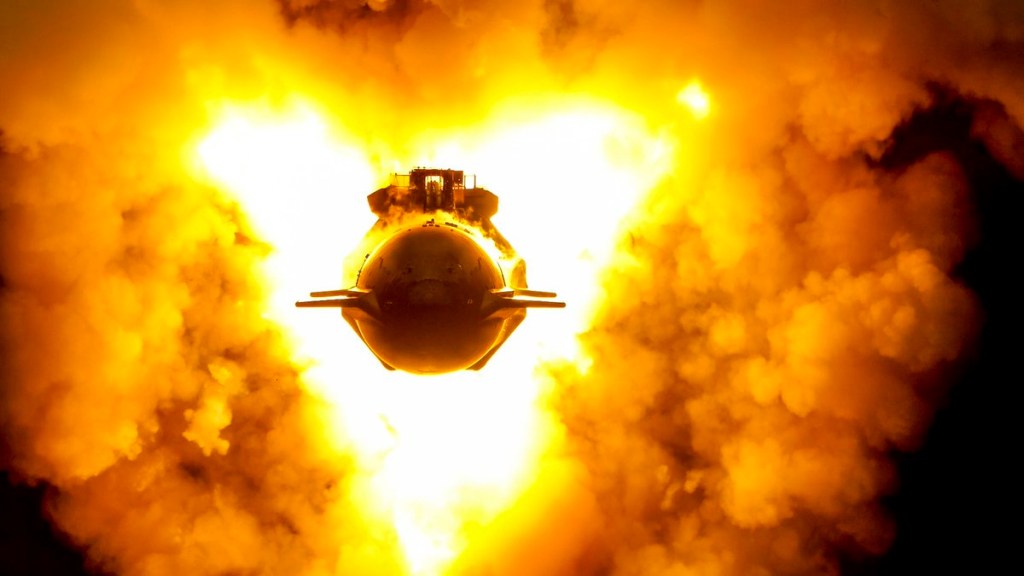
Image (Credit): June 26, 2023 Starship engine test viewed from above. (SpaceX)
The image above shows the SpaceX Ship 25 rocket from above as it tested it engines on June 26, 2023. Presumably, Elon Musk was tweeting out this and other such shots, but given the restrictions placed on Twitter these days, you may not be able to acquire this on your own without an account.
As far as the next Starship launch, the exact date has yet to be shared. However, NASA is already talking about delaying the Artemis III lunar mission, which will use the Starship, from 2025 to 2026.
Earier today, the European Space Agency’s (ESA) Euclid Space Telescope was safely launched from Cape Canaveral on a Space X Falcon 9 rocket (though the original plan was to use a Russian Soyuz rocket until the invasion nixed that idea). The space telescope is destined for the Sun-Earth Lagrange point 2 (L2), which is an average distance of 1 million miles beyond Earth’s orbit. It will join the James Webb Space Telescope.
In addition to the 1.2 meter diameter telescope, the mission includes two scientific instruments: a visible-wavelength camera (the VISible instrument, VIS) and a near-infrared camera/spectrometer (the Near-Infrared Spectrometer and Photometer, NISP).
The focus of the new space telescope will be to create a 3D map of the universe to better understand dark matter and dark energy. As noted on the ESA’s website, Euclid hopes to answer these questions:
What is the structure and history of the cosmic web?
What is the nature of dark matter?
How has the expansion of the Universe changed over time?
What is the nature of dark energy?
Is our understanding of gravity complete?
It is a tall order for this new telescope. Astronomer Isobel Hook from the UK’s Lancaster University put it this way to BBC News:
It will be like setting off on a ship before people knew where land was in different directions. We’ll be mapping out the Universe to try to understand where we fit into it and how we’ve got here – how the whole Universe got from the point of the Big Bang to the beautiful galaxies we see around us, the Solar System and to life.
Elon Musk got his way. The US Department of Defense (DOD) will be paying an undisclosed amount for the Starlink services being used in Ukraine. This is good news for the Ukrainians had they feared interruption of this vital link with the rest of the world, yet I imagine this will also put SpaceX’s Starlink system at greater risk given that it now is a clearly a subcontractor to the US defense initiatives.
As the media has pointed out, Musk started to cut back on Starlink services to make a point about it being used as part of the war, with one Senator noting:
I was personally disappointed to see discontinuation of full services at such a critical time for Ukraine self-defense…Do you feel there’s a connection between the availability of this capability to our partners in Ukraine in this conflict, and relationships we have with companies like SpaceX?
It appears the relationship has improved now that DOD has opened its checkbook. I guess the next move will be taken by the Russians. And if the past is any guide, things may get ugly.
Image (Credit): The three Chinese astronauts who left for the Tiangong space station this week. (VCG/VCG via Getty Images)
This week astronauts aboard the International Space Station (ISS) said goodbye to the second set of private astronauts who are part of the Axiom Space mission, while China sent its first non-military astronaut to its Tiangong space station. It is not surprising that China started out with military astronauts. NASA also recruited from the US military for its early astronauts, and still does today. Yet it is encouraging that China is already shifting to scientists.
So while China is following the expected trajectory towards more scientists, the ISS (and more particularly its US partners) is shifting towards greater tourism since Axiom missions are for quick flybys rather than deep research. For instance, the “astronauts” on the second Axiom mission were on the ISS for about a week. At least the second mission included a few scientists, whereas the first Axiom mission consisted of wealthy investors.
With commercial space stations in development, we can expect to see tourism as a key piece of the space industry, as we already see with SpaceX, Blue Origin, and Virgin Galactic. China is not far behind, indicating that it wants to find ways to be part of the space tourism industry as well.
Maintaining the right balance between the militarization of space, real science, and tourism will not be an easy balance, as we watch it all in play this week. I would rather see more tourists than military crews in space, but I am hoping we can find a way to keep the scientists fully engaged and the main players for now. Space mining and related industries will probably beat all of these other uses, but we are not at that stage just yet.




 Our Awesome Universe