If You Thought the Skies Were Crowded, Just Wait

Credit: Starlink.

The Washington Post recently published a story, “China’s military aims to launch 13,000 satellites to rival Elon Musk’s Starlink,” that can only terrify astronomers here on Earth trying to view the stars. The title says it all – the space race continues to clutter the skies with more and more low-Earth satellites broadcasting back to the surface. It is a dippy Dyson Sphere that contains scientists rather than energy.

Starlink’s success in Ukraine really bothers the Chinese, who see the network as a lifeline for Taiwan as well. The article quotes Chinese military researchers, who state:

Once the Starshield is completed, it will be tantamount to installing networked surveillance cameras all over the world. At that time, military operations including the launch of ballistic missiles, hypersonic missiles and fighter jets will hardly escape the monitoring of the United States.

I would prefer the space race between the US and China focused on the Moon or Mars rather than local invasions, but that is the state of the world at the moment. Not that the race to the Moon was a completely tame affair. For instance, the US contemplated exploding a nuclear bomb on the surface of the Moon to impress the Russians and everyone else. Fortunately, Project A119 never happened.

Pic of the Week: ISS Expedition 68 Resupply

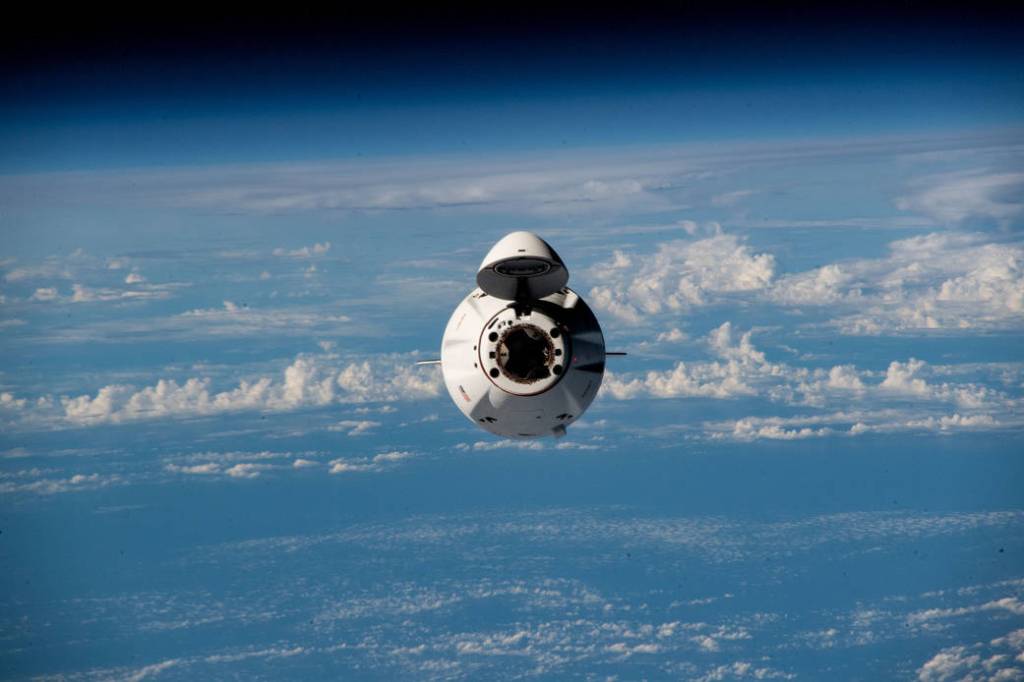
Image (Credit): SpaceX Dragon approaching the ISS. (NASA)

This week’s image comes from NASA showing a Dragon cargo ship approaching the International Space Station (ISS) earlier this month with supplies for the Expedition 68 crew. In this photo, the Dragon is above the Indian Ocean near Madagascar.

It is an amazing image each and every time. What a workplace and what a view. Telework just isn’t the same.

Space Stories: Possible Starship Launch, South Korean Rocket Test, and Massive Early Stars

Here are some recent stories of interest.

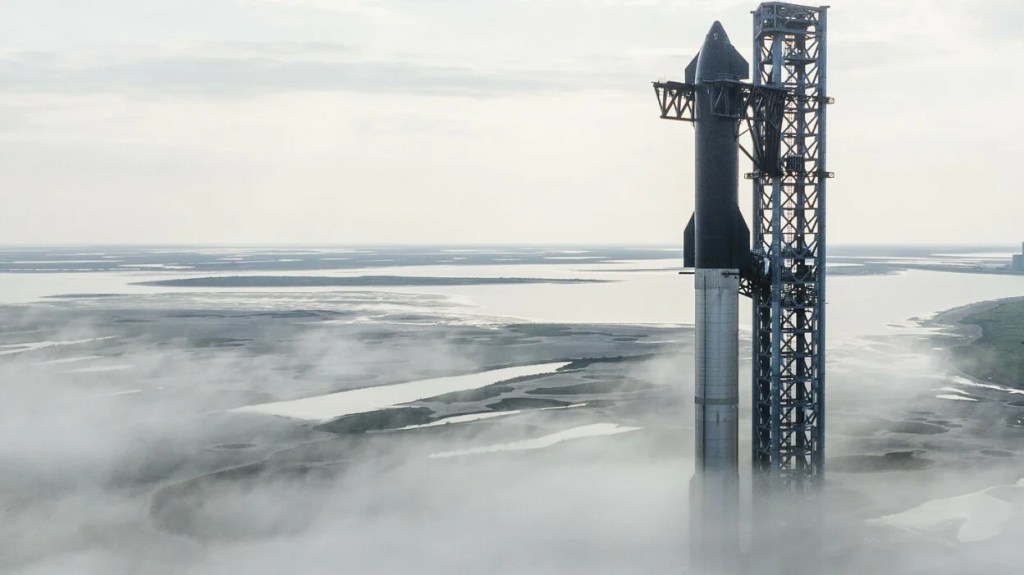
Forbes: “Elon Musk Gets More Specific About Starship’s First Rocket Launch to Space

We’ve been waiting for nearly two years to see Elon Musk’s big rocket blast off again, and now the SpaceX founder is starting to narrow the targeted time frame for Starship’s first orbital attempt. The controversial entrepreneur said on Twitter last week that the next generation vehicle destined to take astronauts to the moon and perhaps start a civilization on Mars “will be ready to launch… in a few weeks, then launch timing depends on FAA license approval.”

Space News: “South Korea’s Innospace Succeeds in Test Launch

South Korean rocket startup Innospace successfully launched a suborbital rocket from Brazil over the weekend, demonstrating a hybrid motor it plans to scale up into a small orbital launch vehicle. The launch of Innospace’s HANBIT-TLV suborbital rocket took place March 19 from the Alcântara Space Center, and the company called the flight a success, although it did not disclose the rocket’s peak altitude. 

Space.com: “The Early Universe was Crammed with Stars 10,000 Times the Size of our Sun, New Study Suggests

The first stars in the cosmos may have topped out at over 10,000 times the mass of the sun, roughly 1,000 times bigger than the biggest stars alive today, a new study has found. Nowadays, the biggest stars are 100 solar masses. But the early universe was a far more exotic place, filled with mega-giant stars that lived fast and died very, very young, the researchers found.

Prototype of the New NASA Space Suits

Image (Credit): New Axiom Extravehicular Mobility Unit spacesuit. (NASA)

It is called the Axiom Extravehicular Mobility Unit, or AxEMU, but you can call it a lunar spacesuit. The newly designed spacesuit was on display today at the Space Center Houston’s Moon 2 Mars Festival. While the final suit will be in white, you get the idea with the prototype on display.

Axiom Space, the maker of the spacesuit, noted:

Since a spacesuit worn on the Moon must be white to reflect heat and protect astronauts from extreme high temperatures, a cover layer is currently being used for display purposes only to conceal the suit’s proprietary design. Axiom Space collaborated with costume designer Esther Marquis from the Apple TV+ series, “For All Mankind” to create this custom cover layer using the Axiom Space logo and brand colors.

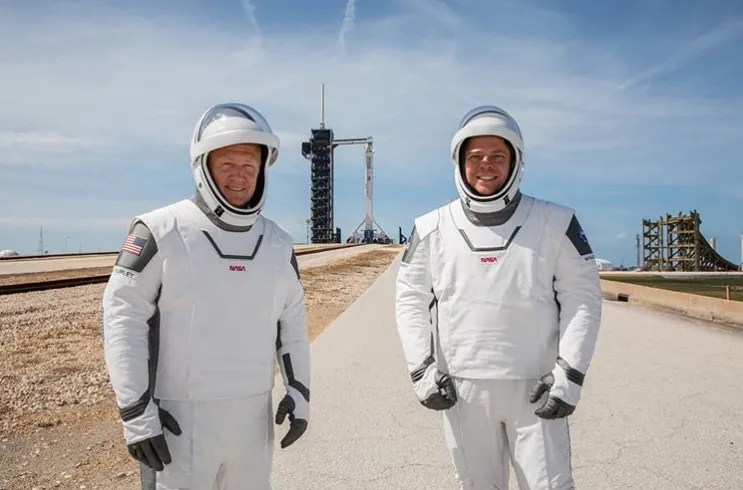
It makes it sound like something being designed for Hollywood fans rather than a NASA-procurement contract. Is Axiom Space competing with Elon Musk on his design (see below)? Or maybe the company is trying to match the spacesuits from Lost in Space (also below)?

Whatever the case, NASA hopes to use these new suits for the lunar exploration under Artemis III. Moreover, NASA states these suits can fit “…at least 90 percent of the US male and female population.” I think they mean 90 percent of the population qualifying for such a mission. We cannot even fit the average American into train seats made for Europeans, so either the qualifying population is limited or these suits have a LOT of stretch-room.

Image (Credit): SpaceX astronaut spacesuits for the Dragon capsule. (SpaceX)
Image (Credit): Spacesuits on Lost in Space. (Netflix)

Space Quote: UAE Celebrates its Role in ISS Mission

Image (Credit): The SpaceX Dragon with the Crew-6 team docking with the ISS. (NASA)

I join the nation in congratulating Sultan al-Neyadi as he begins his pioneering mission aboard the International Space Station. His inspiring achievement is a source of great pride to the UAE and another milestone in the journey of our nation and the ambitions of our people.

Statement by United Arab Emirates (UAE) President Sheikh Mohamed bin Zayed Al Nahyan after the launch of the Crew-6 mission to the International Space Station (ISS), which included UAE astronaut Sultan al-Neyadi. All four members of the Crew-6 mission arrived safely at the ISS earlier today.