Image (Credit): Test run of the Starship Booster on May 5, 2022. (SpaceX)
Earlier this week, SpaceX conducted another test of its Starship. However, the booster was damaged by an explosion during a pre-launch test and will now need to be inspected to determine whether it can be used in the inaugural launch of the Starship later this summer.
For more on the Starship, check out the Cool Worlds video titled “Why Starship Could Transform Astronomy.” It argues that reduced launch costs, reduced complexity, and heavier payloads would allow NASA to launch a fleet of telescopes within current budgets. For instance, the larger Starship payload would have allowed NASA to avoid all of the contortions necessary to fold the James Webb Space Telescope into a smaller rocket. The video also argues that SpaceX’s willingness to take risks is something NASA may want to emulate.
These are interesting times with NASA and SpaceX testing new rockets to place astronauts on distant objects. Even if Russia wants to sit this one out, we have a full blown space race underway domestically.
On this week’s podcast program Sway, you can re-listen to a September 2020 interview between host Kara Swisher and Elon Musk. This was long before all the Twitter nonsense, when Mr. Musk was still focused on cars and space (mostly). The discussion covers plenty of topics, including the need to settle Mars (Mr. Musk disagress with Jeff Bezos who he said believes a space station will be enough to save humanity from an existential crisis), neural implants, and a return to the Moon.
You can tell the program is dated because Mr. Musk complains that NASA cannot find a way to return to the Moon, whereas today we have the Artemis lunar program that includes SpaceX as one of its contractors. Nonetheless, it is good to hear from the old Musk when he was a little more focused.
Then again, the neural implants still seem odd. Neuralink, a company he co-founded, is focusing on those with disabilities at the moment, but the application is expected to be more widespread:
Neuralink is currently focused on making medical devices. These devices have the potential to help people with a wide range of injuries and neurological disorders, and we hope to develop treatments for many of these conditions in the coming years. We expect that as our devices continue scale, and as we learn to communicate with more areas of the brain, we will discover new, non-medical applications for our [brain-machine interface] BMIs. Neuralink’s long-term vision is to create BCIs that are sufficiently safe and powerful that the general population would want to have them.
Helping paraplegics walk and curing brain disorders are certainly noble goals. And, hey, ordering a pizza just by thinking about it sounds cool. But many experts are concerned that Musk is seriously overhyping what Neuralink’s implants will be able to accomplish.
Elon Musk overhyping an idea? Never!
Check it out. You can download the podcast at the New York Times, the Apple Store, and elsewhere.
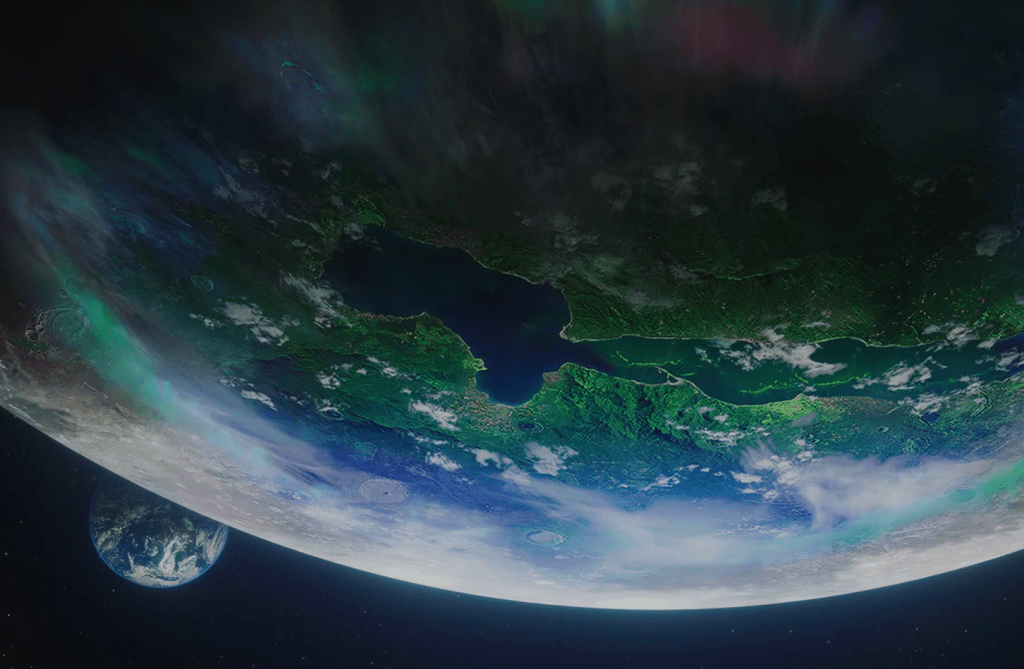
Image (Source): Moonhaven’s Garden of Eden on the Moon. (AMC+)
While NASA is working on the first permanent base on the Moon, the AMC+ television series set 100 years in the future already has a Garden of Eden on the lunar surface. Here is the general story from AMC+ on the new series Moonhaven, which premieres on July 7th:
Moonhaven focuses on Bella Sway (Emma McDonald), a lunar cargo pilot and smuggler 100 years in the future who finds herself accused of a crime and marooned on Moonhaven, a utopian community set on a 500 square mile Garden of Eden built on the Moon to find solutions to the problems that will soon end civilization on Mother Earth. A skeptic in Paradise, Bella is sucked into a conspiracy to gain control of the artificial intelligence responsible for Moonhaven’s miracles and teams with a local detective to stop the forces that want to destroy Earth’s last hope before they are destroyed themselves.
Yes, the Earth is a toxic waste (again) and it is easier to build a future on the dead Moon than get our act together here on Earth. But even that is too easy, because the Moon colony appears to be a cult. Could it be a SpaceX colony based on the principles of Musk. I hope NASA did not pay for that.
I do not have any high hopes, but that may be it for this summer outside of Star Wars and Star Trek series. I may just go back and rewatch The Expanse this summer.
Have you read about the Chinese car company with space ambitions? In a June 2 press release, we learn that a unit of the Chinese automaker Geely (owner of Volvo, Polestar, and Group Lotus) already sent 9 communications satellites into orbit this year, with plans for a total of 240 such satellites in a constellation that will assist car drivers with autonomous driving.
Of course, automaker Elon Musk is also launching satellites into space as part of the Starlink program, but that is about the end of the similarities for now. In addition to planning to launch fewer satellites with a more restricted mission, Geely will depend upon Chinese government rockets to launch these satellites. Mr. Musk has his own SpaceX rockets to assist Starlink.
That does not mean Geely lacks in ambition elsewhere. In the same press release, Geely stated:
With the successful launch and operation of Geespace’s first satellites, the company will become one of the world’s first providers of combined commercial Precise Point Positioning and Real-Time Kinematic services (PPP-RTK)…
Tony Wang, CEO and Chief Scientist of Geespace said: “Many favourable factors such as policy support and market demand is accelerating the growth of the commercial aerospace sector...new opportunities to develop have been opened in various sectors including smart mobility, consumer electronics, unmanned systems, smart cities, and environmental protection.”
And while Geely is not building rockets at this time, it is building satellites:
Early in September 2021, Geely’s Intelligent Satellite Production and Testing Centre began mass production of commercial satellites with an annual production capacity of 500 units. Through intelligent modular manufacturing, Geespace is able to produce high-quality, easily customizable satellites to meet the growing global demand for commercial satellites. The GeeSAT-1 is only the first of many new satellite models from Geespace and its successful launch into orbit is just the first of many to come.
Even though Tesla is having valuation issues these days as Mr. Musk pursues Twitter, SpaceX seems to be doing well. Nasdaq news reports that the company had no issues raising $1.5 billion in new funding. The valuation for the company is now $125 billion, up from $100 billion last year.
While the company is earning a good fee for its resupply missions to the International Space Station, it has other ventures to fund as well, including the Starship rocket for deep-space missions and the Starlink satellite system being used around the world (including Ukraine). SpaceX is able to build about 45 Starlink satellite per week.
The company has plenty of openings on its website, such as those listed below. Let’s hope SpaceX can stay out of the fray as Mr. Musk continues to kick up dust.





 Our Awesome Universe