
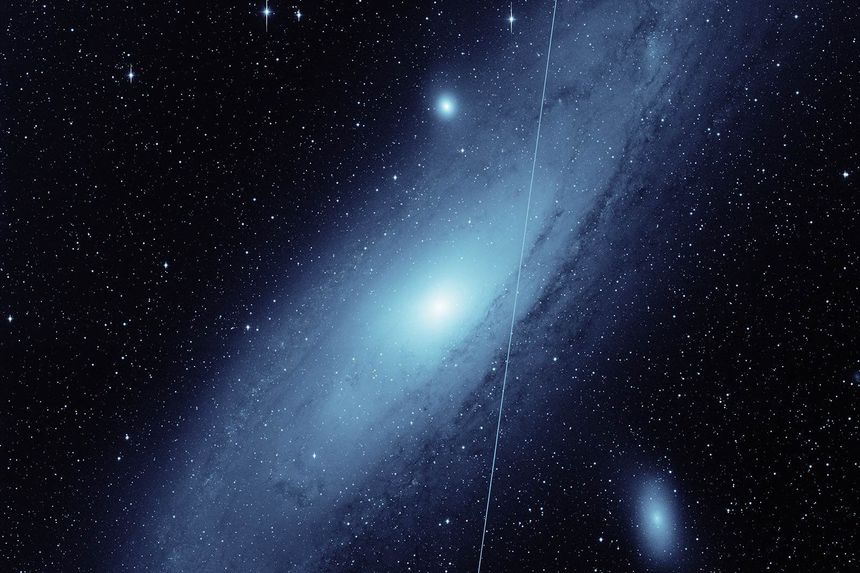
In an earlier post I discussed Elon Musk’s belief that low Earth orbit (LEO) can host billions of satellites, but don’t tell that to astronomers. The satellites already in orbit are corrupting telescope images, so the problem can only get worse. And should we really put up tens of thousands more (forget billions), we may not only find greater corruption, but even greater difficulties detecting dangerous asteroids threatening the Earth.
A Wall Street Journal article, “SpaceX Satellites Distort Astronomy Images, Study Finds,” highlights a January 14th study in the Astrophysical Journal Letters, “Impact of the SpaceX Starlink Satellites on the Zwicky Transient Facility Survey Observations” that found:
…researchers examined the effects of [SpaceX] Starlink satellites on about 300,000 images taken by an instrument at the Palomar Observatory in Southern California. Between November 2019 and September 2021, they noted a 35-fold increase in the number of corrupted images.
The Journal summary provided more details as well as a partial solution:
We find that the number of affected images is increasing with time as SpaceX deploys more satellites. Twilight observations are particularly affected—a fraction of streaked images taken during twilight has increased from less than 0.5% in late 2019 to 18% in 2021 August. We estimate that once the size of the Starlink constellation reaches 10,000, essentially all ZTF images taken during twilight may be affected. However, despite the increase in satellite streaks observed during the analyzed period, the current science operations of ZTF are not yet strongly affected. We also find that redesigning Starlink satellites (by installing visors intended to block sunlight from reaching the satellite antennas to prevent reflection) reduces their brightness by a factor of 4.6 ± 0.1 with respect to the original design in g, r, and i bands.
It appears SpaceX is aware of these issues and looking into the brightness of its satellites.
A separate paper from last September, “Visibility Predictions for Near-Future Satellite Megaconstellations: Latitudes near 50 Degrees will Experience the Worst Light Pollution,” stated the following concerns:
Megaconstellations of thousands to tens of thousands of artificial satellites (satcons) are rapidly being developed and launched. These satcons will have negative consequences for observational astronomy research, and are poised to drastically interfere with naked-eye stargazing worldwide should mitigation efforts be unsuccessful. Here we provide predictions for the optical brightnesses and on-sky distributions of several satcons, including Starlink, OneWeb, Kuiper, and StarNet/GW, for a total of 65,000 satellites on their filed or predicted orbits. We develop a simple model of satellite reflectivity, which is calibrated using published Starlink observations. We use this model to estimate the visible magnitudes and on-sky distributions for these satellites as seen from different places on Earth, in different seasons, and different times of night. For latitudes near 50 degrees North and South, satcon satellites make up a few percent of all visible point sources all night long near the summer solstice, as well as near sunrise and sunset on the equinoxes. Altering the satellites’ altitudes only changes the specific impacts of the problem. Without drastic reduction of the reflectivities, or significantly fewer total satellites in orbit, satcons will significantly change the night sky worldwide.
Again, without a satellite solution or fewer satellites, these craft will “significantly change the night sky worldwide.” And the scientists are now looking to the United Nations for help. So it may be in the interest of the satellite industry (four companies were named in the second study above) to come up with some quick solutions or face new restrictions. We should be able to solve this.

Update: SpaceX lost about 40 of the 49 Starlink satellites launched on February 3, 2022 due to a geomagnetic storm.

 Our Awesome Universe