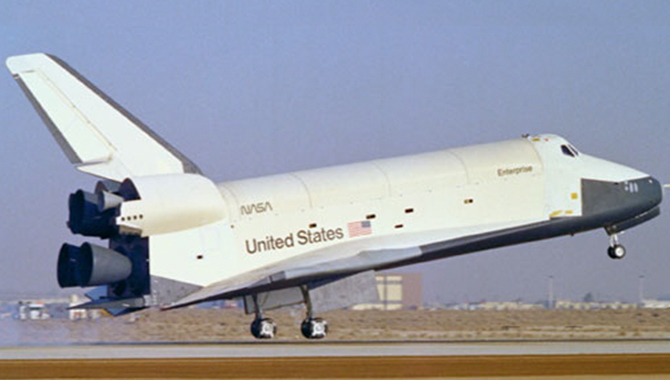
“NASA has received hundreds of thousands of letter from the space-oriented “Star Trek” group asking that the name “Enterprise” be given to the craft. This group comprises millions of individuals who are deeply interested in our space program.”
-Statement in a September 3, 1976 letter to President Richard Nixon from the Deputy Assistant to the President for Economic Affairs regarding the naming of the nation’s first space shuttle. If they space shuttle had been delayed until after 1977, maybe the “Millennium Falcon” would have been on the list of top names as well.
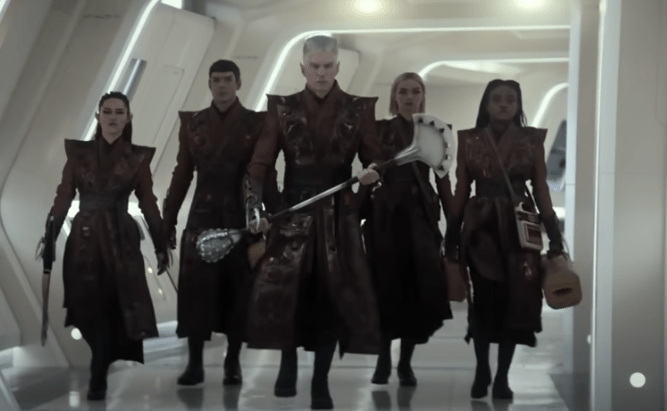
Image (Credit): Scene from season three of Star Trek: Strange New Worlds. (Paramount+)
I am eager for the third season of Star Trek: Strange New Worlds after season two ended back in August. In season two, we had a chance to meet Montgomery “Scotty” Scott, one more piece of the original Star Trek crew.
For a taste of what is to come, take a look at this preview clip of season three. Its shows a fun turn of events as members of the crew find themselves embracing the Vulcan ways for a mission. Of course, nothing is that easy. The interplay between human and Vulcan mindsets continues to entertain, much in the way The Next Generation enjoyed the interplay between human and android mindsets.
It is still unclear when season three will premiere in 2025, but the good news is that Paramount+ has already promised a fourth season, so the fun will continue. More importantly, Trekmovie.com reports that the series will eventually run into the first episode of the original series from 1966, so we can expect more original characters such as Scotty to populate the Strange New Worlds series.
With only one live action Star Trek series still on the air after the end of Star Trek: Discovery earlier this year, it is important for fans that the series continues to live long and prosper.
Fortunately, a few more Star Trek series are the in pipeline. More on that later.
Today we remember the beginning of the Star Trek phenomenon that started back on September 8, 1966 with the introduction of the Star Trek television series. Created by Gene Roddenberry, the series initiated books, movies, and more over the years that provided a positive vision of our future in space, though it came after some rough lessons (world war) and still posed constant challenges (Klingons, Borg, Cardassians, and others).
Star Trek was an attempt to say that humanity will reach maturity and wisdom on the day that it begins not just to tolerate, but take a special delight in differences in ideas and differences in life forms. […] If we cannot learn to actually enjoy those small differences, to take a positive delight in those small differences between our own kind, here on this planet, then we do not deserve to go out into space and meet the diversity that is almost certainly out there.
Wise words during the turmoil of the 1960s as well as the turmoil of today.
When you consider the weak showing of films this summer, particularly space-related films, its enough to make you give up and go online to revisit the classics. If you do so, you will probably bump into a number of great films that all appeared over eight weeks in the summer of 1982, including E.T. the Extra-Terrestrial, Star Trek: Wrath of Khan, and Blade Runner.
In the summer of 1982, eight science fiction films were released within six weeks of one another. E.T., Tron, Star Trek: Wrath of Khan, Conan the Barbarian, Blade Runner, Poltergeist, The Thing, and Mad Max: The Road Warrior changed the careers of some of Hollywood’s now biggest names—altering the art of movie-making to this day.
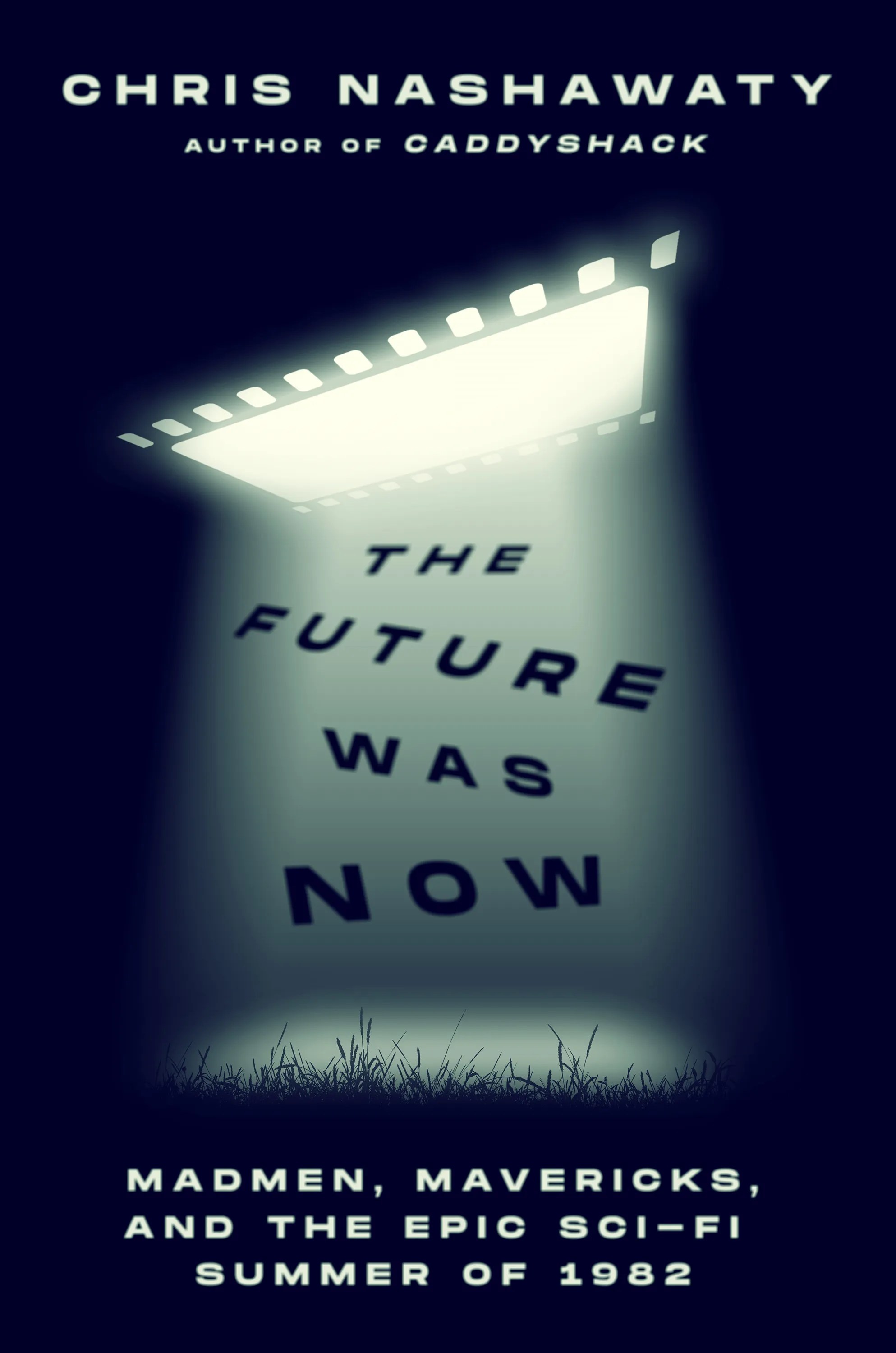
In The Future Was Now, Chris Nashawaty recounts the riotous genesis of these films, featuring an all-star cast of Hollywood luminaries and gadflies alike: Steven Spielberg, at the height of his powers, conceives E.T. as an unlikely family tale, and quietly takes over the troubled production of Poltergeist, a horror film he had been nurturing for years. Ridley Scott, fresh off the success of Alien, tries his hand at an odd Philip K. Dick story that becomes Blade Runner—a box office failure turned cult classic. Similar stories arise for films like Tron, Conan the Barbarian, and The Thing. Taken as a whole, these films show a precarious turning-point in Hollywood history, when baffled film executives finally began to understand the potential of high-concept films with a rabid fanbase, merchandising potential, and endless possible sequels.
Expertly researched, energetically told, and written with an unabashed love for the cinema, The Future Was Now is a chronicle of how the revolution sparked in a galaxy far, far away finally took root and changed Hollywood forever.
Of course, the book may simply depress you when you think of the current state of cinema more than 40 years later. Yes, we have Dune and the nth release of Aliens, but for the most part Hollywood is not offering today’s generation films that make them dream about a different future (and I don’t mean a future with men in spandex).
I just hope we have more up and coming Spielbergs, Scotts, and Dicks out there who read this book and take it as a challenge to make American cinema exciting again.
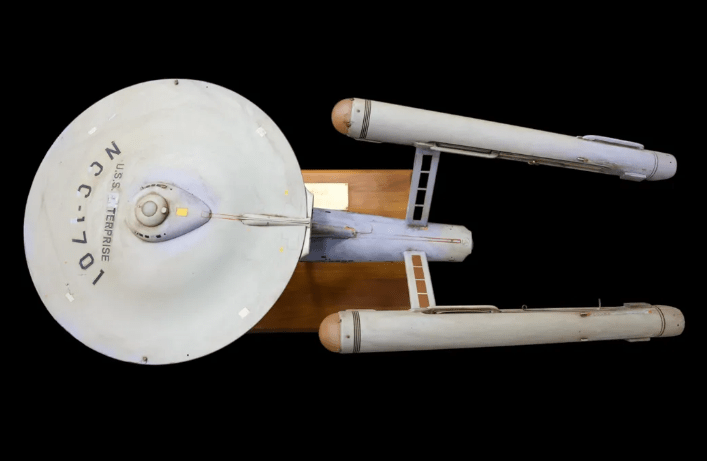
Image (Credit): The original Enterprise model, which is made from solid wood. (Heritage Auctions)
You may have thought the original USS Enterprise from the Star Trek series was at the Smithsonian Museum, and you are right. Mostly.
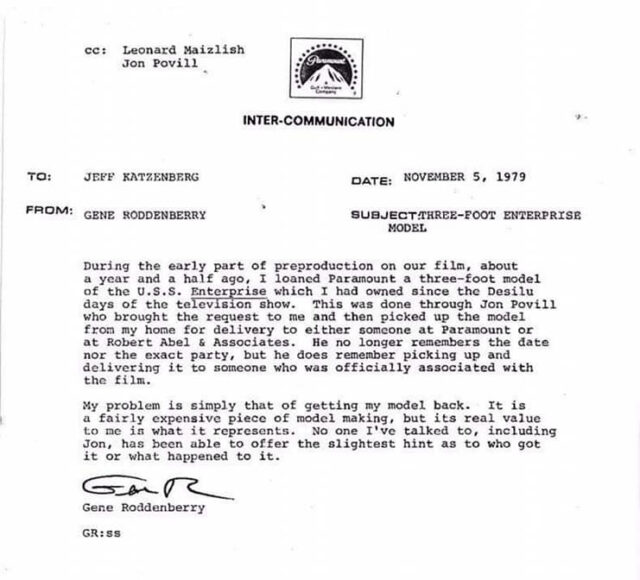
In 1974, the Smithsonian’s National Air and Space Museum became the proud owner of the 11-foot long USS Enterprise model used in the television series. However, there was another model that was used in the opening credits. This other model was only three feet long and made of wood. And, most importantly, it disappeared year’s ago when it was loaned to the studio making the first Star Trek movie (see letter below).
The smaller model then reappeared recently, but this time priced at $1,000 on eBay. After a lot of questions (the model was said to have been in a storage unit that was auctioned off) , it was eventually returned to Eugene “Rod” Roddenberry Jr., the son of the creator of Star Trek.
All is well that ends well. The USS Enterprise model is back with the Roddenberry family and a piece of science fiction history can be shared with public. Mr. Roddenberry said he plans to display this smaller model at the Smithsonian as well:
…I firmly believe that a piece of such importance should not be confined to any private collection. This iconic artifact should be enshrined along side the 12-foot shooting model at the Smithsonian’s National Air and Space Museum, where it can serve to help tell the story of television history, the history of space exploration and ultimately, a beacon of hope for the future.
Image (Credit): Letter from Gene Roddenberry to Paramount Studios regarding his lost USS Enterprise model (therpf.com)


 Our Awesome Universe