The European Space Agency is Staying Busy with Sunshine

Image (Credit): A radiance map of the sun’s south pole as recorded by the Solar Orbiter spacecraft. (ESA & NASA/Solar Orbiter/PHI Team, J. Hirzberger (MPS))

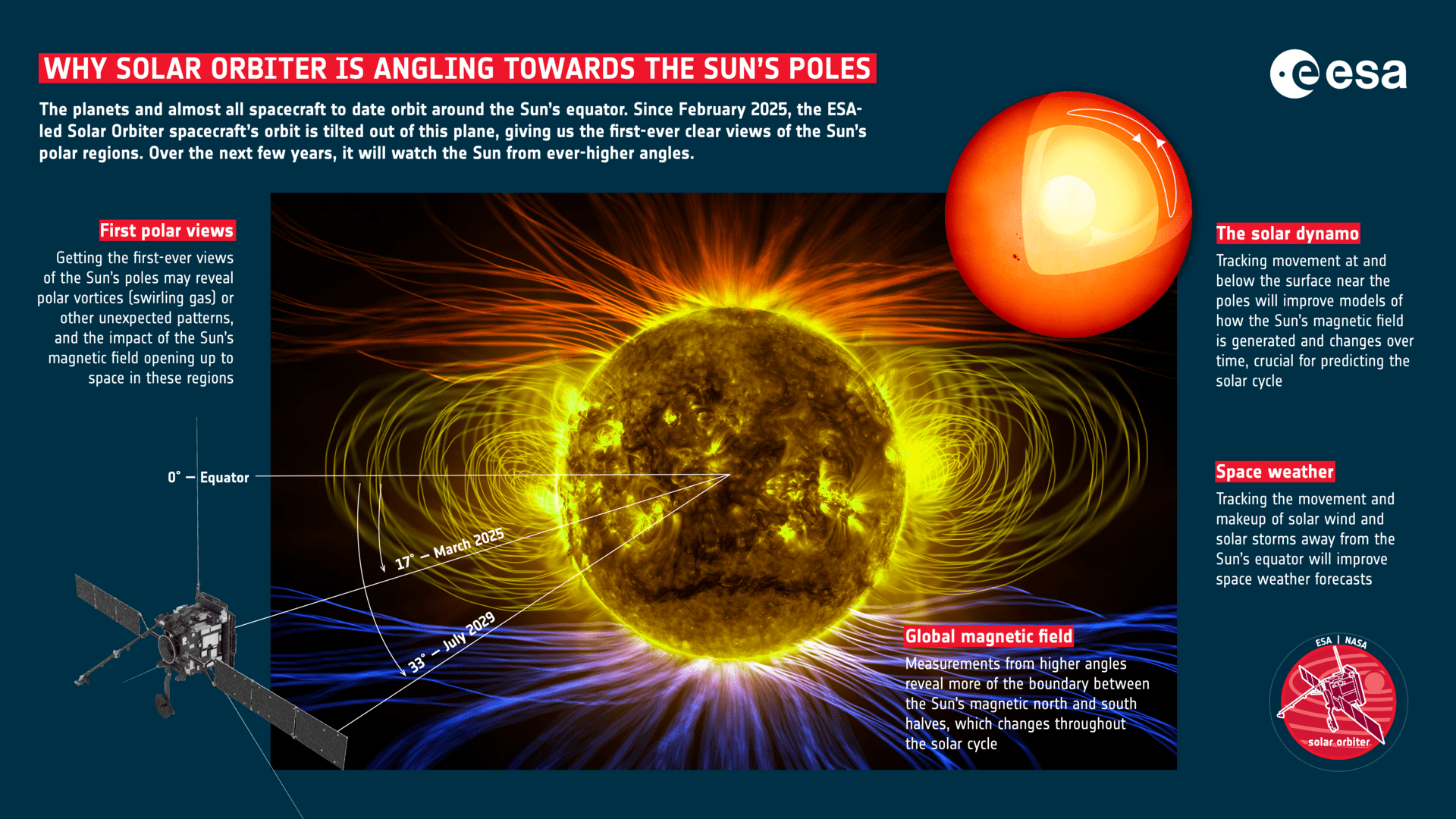
While NASA is going crazy over budget cuts, the European Space Agency (ESA) is focused on new images from the Solar Orbiter spacecraft showing the sun’s south pole from a distance of about 40 million miles (shown above).

Launched in February 2020, Solar Orbiter is an ESA-led cooperative mission with NASA designed to answer a number of questions:

  • What drives the Sun’s 11-year cycle of rising and subsiding magnetic activity?
  • What heats up the upper layer of its atmosphere, the corona, to millions of degrees Celsius?
  • How does solar wind form, and what accelerates it to speeds of hundreds of kilometres per second?
  • How does it all affect our planet?

Professor Carole Mundell, ESA’s Director of Science, stated:

Today we reveal humankind’s first-ever views of the Sun’s pole…The Sun is our nearest star, giver of life and potential disruptor of modern space and ground power systems, so it is imperative that we understand how it works and learn to predict its behaviour. These new unique views from our Solar Orbiter mission are the beginning of a new era of solar science.

We all need a diversion from the ongoing budget news, so it is good to read about ongoing science and a successful mission.

Pic of the Week: Here Comes the Sun

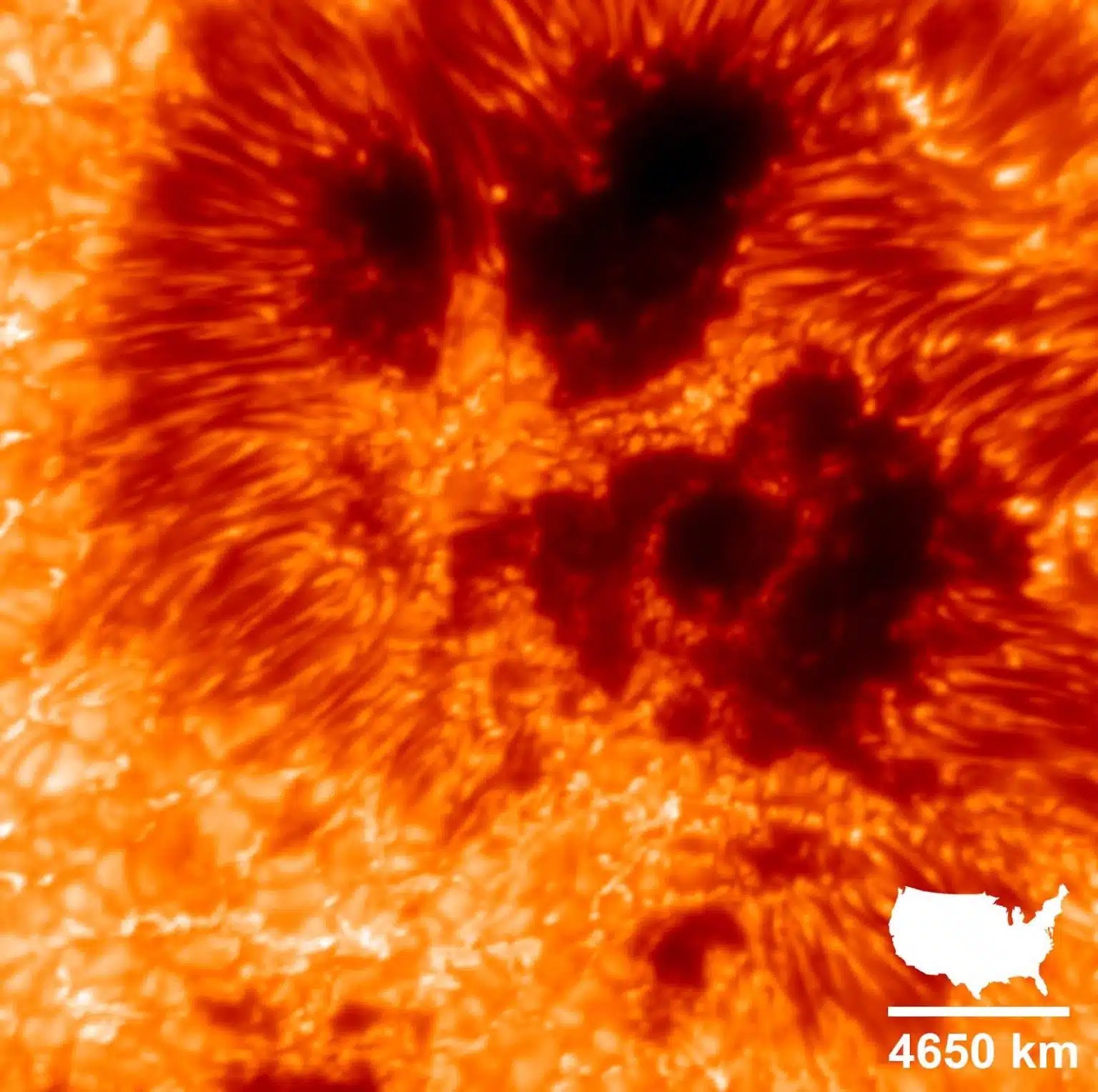
Image (Credit): Image of a sunspot on our Sun (with the United States in the corner for the purpose of comparison) captured by the Daniel K. Inouye Solar Telescope using its Visible Tunable Filter. (VTF/KIS/NSF/NSO/AURA)

This week’s image comes from the National Science Foundation’s (NSF) Daniel K. Inouye Solar Telescope. Using a newly developed Visible Tunable Filter, it is able to produce detailed images of the Sun’s surface.

Carrie Black, NSF program director for the NSF National Solar Observatory, stated:

When powerful solar storms hit Earth, they impact critical infrastructure across the globe and in space. High-resolution observations of the sun are necessary to improve predictions of such damaging storms…The NSF Inouye Solar Telescope puts the U.S. at the forefront of worldwide efforts to produce high-resolution solar observations and the Visible Tunable Filter will complete its initial arsenal of scientific instruments.

You can read much more about the telescope and its filter here.

Podcast: The Curious Universe

If you are looking for new podcast material, you may want to check out NASA’s Curious Universe podcast. It has been around for a while, but it is starting a new series celebrating Earth from April 15 to May 13.

The first episode in the new Earth series is titled “How NASA Sees Our Blue Marble.” In the episode, we hear from Karen St. Germain, the director of NASA’s Earth Science Division. It is a chance to learn about the planet that NASA spends the most time studying.

If you like this series, you can go back and listen to other episodes, such as:

-“Inside the Team That Keeps Hubble Flying” (March 14, 2025)
-“The Sun Series” (March 19 to May 3, 2024)
-“Defending the Planet from Asteroids” (February 21, 2023)
-“The Search For Life: Are We Alone?” (June 21, 2022)

SPHEREx and PUNCH Missions Delayed

Image (Credit): NASA’s SPHEREx and PUNCH satellites being prepared for launch inside the Astrotech Space Operations facility at Vandenberg Space Force Base in California, on Thursday, February 27, 2025. (NASA)

While NASA’s Spectro-Photometer for the History of the Universe, Epoch of Reionization and Ices Explorer (SPHEREx) and Polarimeter to Unify the Corona and Heliosphere (PUNCH) missions were expected to launch last weekend, they have been delayed until Thursday, March 6th. The launch will take place from the Vandenberg Space Force Base in California.

SPHEREx will spend two years collecting data on the origins of the universe by studying more than 450 million galaxies as well as more than 100 million stars in the Milky Way. You can learn more about the satellite’s mission by watching this Jet Propulsion Laboratory video.

PUNCH will be focused on events here in our own solar system. Consisting of four small satellites in low Earth orbit, the mission will study the entire inner heliosphere to learn how the Sun’s corona becomes the solar wind. You can learn more about the mission by watching this NASA video.

Thursday should be a busy day with these two satellites being launched and Intuitive Machines’ Athena lunar lander touching down on the Moon.

Space Stories: Solar Orbiter Encounters Venus, White Dwarf Exoplanets, and the End of Gaia

Credit: ESA

Here are some recent stories of interest..

European Space Agency: Solar Orbiter Ready for Close Encounter with Venus’“

The European Space Agency (ESA) is ready to guide the ESA/NASA Solar Orbiter spacecraft through its closest encounter with Venus so far. Today’s flyby will be the first to significantly ‘tilt’ the spacecraft’s orbit and allow it to see the Sun’s polar regions, which cannot be seen from Earth. Studying the Sun’s poles will improve our understanding of solar activity, space weather, and the Sun-Earth connection.

UC Irvine News: UC Irvine Astronomers Gauge Livability of Exoplanets Orbiting White Dwarf Stars’“

Among the roughly 10 billion white dwarf stars in the Milky Way galaxy, a greater number than previously expected could provide a stellar environment hospitable to life-supporting exoplanets, according to astronomers at the University of California, Irvine. In a paper published recently in The Astrophysical Journal, a research team led by Aomawa Shields, UC Irvine associate professor of physics and astronomy, share the results of a study comparing the climates of exoplanets at two different stars. One is a hypothetical white dwarf that’s passed through much of its life cycle and is on a slow path to stellar death. The other subject is Kepler-62, a “main sequence” star at a similar phase in its evolution as our sun.

Uppsala University: Mission Accomplished for Space Telescope Gaia’“

The space telescope Gaia has created the largest three-dimensional map of the Milky Way ever. On January 15, 2025, Gaia shut down after 11 years in space. But the research on data Gaia collected will continue for many years to come. Gaia is a space telescope onboard a satellite that has orbited the sun for 11 years. With the help of astrometry, which is a technique to measure the positions, distances and movements of stars and other heavenly bodies, Gaia has been able to measure distances and luminosities for up to 2 billion stars, which is about 1% of all stars in the Milky Way.