Pic of the Week: Stellar Birth in NGC 1333

Image (Credit): NGC 1333 as captured by the Hubble Space Telescope. (NASA, ESA, STScI)

This week’s image is from the Hubble Space Telescope. It captures the colorful, star-filled NGC 1333, which is about 960 light-years away. Quite a lot is going on in this image – both seen and unseen.

This explanations from the European Space Agency (ESA) will hopefully answer many of your questions regarding this image:

Hubble’s colourful view, showcasing its unique capability to obtain images in light from ultraviolet to near-infrared, unveils an effervescent cauldron of glowing gases and pitch-black dust stirred up and blown around by several hundred newly forming stars embedded within the dark cloud. Even then, Hubble just scratches the surface; most of the star-birthing firestorm is hidden behind clouds of fine dust — essentially soot — that are thicker toward the bottom of the image. The black areas of the image are not empty space, but are filled with obscuring dust.

To capture this image, Hubble peered through a veil of dust on the edge of a giant cloud of cold molecular hydrogen — the raw material for fabricating new stars and planets under the relentless pull of gravity. The image underscores the fact that star formation is a messy process in a rambunctious Universe.

Ferocious stellar winds, likely from the bright blue star at the top of the image, are blowing through a curtain of dust. The fine dust scatters the starlight at blue wavelengths.

Farther down, another bright super-hot star shines through filaments of obscuring dust, looking like the Sun shining through scattered clouds. A diagonal string of fainter accompanying stars looks reddish because the dust is filtering their starlight, allowing more of the red light to get through.

The bottom of the picture presents a keyhole peek deep into the dark nebula. Hubble captures the reddish glow of ionised hydrogen. It looks like the finale of a fireworks display, with several overlapping events. This is caused by pencil-thin jets shooting out from newly forming stars outside the frame of view. These stars are surrounded by circumstellar discs, which may eventually produce planetary systems, and powerful magnetic fields that direct two parallel beams of hot gas deep into space, like a double lightsaber from science fiction films. They sculpt patterns on the hydrogen cocoon, like laser lightshow tracings. The jets are a star’s birth announcement.

This view offers an example of the time when our own Sun and planets formed inside such a dusty molecular cloud, 4.6 billion years ago. Our Sun didn’t form in isolation but was instead embedded inside a mosh pit of frantic stellar birth, perhaps even more energetic and massive than NGC 1333.

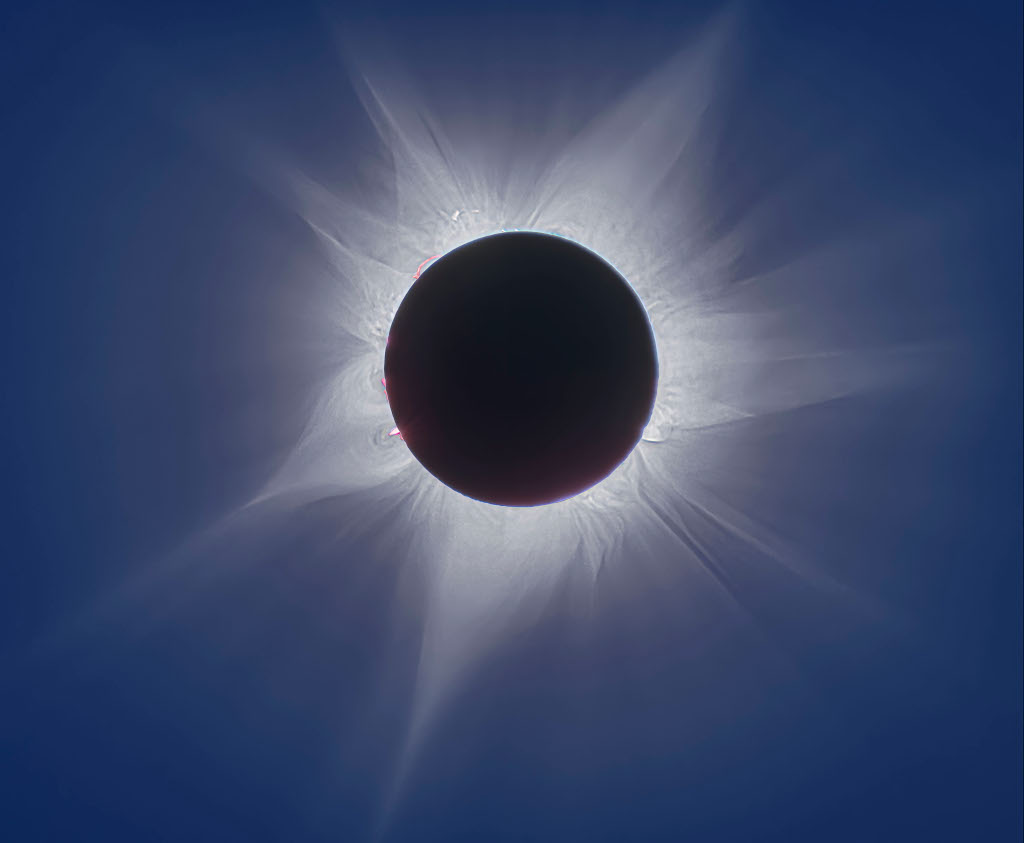
Pic of the Week: Solar Eclipse from a Ship

Image (Credit): Solar Eclipse from a Ship. (APOD/Fred Espenak)

This week’s image is from NASA’s Astronomy Picture of the Day (APOD). Here is the full story of the solar eclipse from the NASA site:

Along a narrow path that mostly avoided landfall, the shadow of the New Moon raced across planet Earth’s southern hemisphere on April 20 to create a rare annular-total or hybrid solar eclipse. From the Indian Ocean off the coast of western Australia, ship-borne eclipse chasers were able to witness 62 seconds of totality though while anchored near the centerline of the total eclipse track. This ship-borne image of the eclipse captures the active Sun’s magnificent outer atmosphere or solar corona streaming into space. A composite of 11 exposures ranging from 1/2000 to 1/2 second, it records an extended range of brightness to follow details of the corona not quite visible to the eye during the total eclipse phase. Of course eclipses tend to come in pairs. On May 5, the next Full Moon will just miss the dark inner part of Earth’s shadow in a penumbral lunar eclipse.

Space Stories: Possible Starship Launch, South Korean Rocket Test, and Massive Early Stars

Here are some recent stories of interest.

Forbes: “Elon Musk Gets More Specific About Starship’s First Rocket Launch to Space

We’ve been waiting for nearly two years to see Elon Musk’s big rocket blast off again, and now the SpaceX founder is starting to narrow the targeted time frame for Starship’s first orbital attempt. The controversial entrepreneur said on Twitter last week that the next generation vehicle destined to take astronauts to the moon and perhaps start a civilization on Mars “will be ready to launch… in a few weeks, then launch timing depends on FAA license approval.”

Space News: “South Korea’s Innospace Succeeds in Test Launch

South Korean rocket startup Innospace successfully launched a suborbital rocket from Brazil over the weekend, demonstrating a hybrid motor it plans to scale up into a small orbital launch vehicle. The launch of Innospace’s HANBIT-TLV suborbital rocket took place March 19 from the Alcântara Space Center, and the company called the flight a success, although it did not disclose the rocket’s peak altitude. 

Space.com: “The Early Universe was Crammed with Stars 10,000 Times the Size of our Sun, New Study Suggests

The first stars in the cosmos may have topped out at over 10,000 times the mass of the sun, roughly 1,000 times bigger than the biggest stars alive today, a new study has found. Nowadays, the biggest stars are 100 solar masses. But the early universe was a far more exotic place, filled with mega-giant stars that lived fast and died very, very young, the researchers found.

Space Stories: Ancient Water, Nearby Black Hole, and a Lunar Time Zone

Image (Credit): Illustration showing gaseous water in the planet-forming disc around the star V883 Orionis. (European Southern Observatory)

Here are some recent stories of interest.

European Southern Observatory: “Astronomers Find Missing Link for Water in the Solar System

Using the Atacama Large Millimeter/submillimeter Array (ALMA), astronomers have detected gaseous water in the planet-forming disc around the star V883 Orionis. This water carries a chemical signature that explains the journey of water from star-forming gas clouds to planets, and supports the idea that water on Earth is even older than our Sun.

“We can now trace the origins of water in our Solar System to before the formation of the Sun,” says John J. Tobin, an astronomer at the National Radio Astronomy Observatory, USA and lead author of the study published today in Nature. 

SciTech Daily: “Astronomers Uncover Black Hole Closer to Earth Than Ever Before

Astronomers have discovered the closest black hole to Earth, the first unambiguous detection of a dormant stellar-mass black hole in the Milky Way. Its close proximity to Earth, a mere 1,600 light-years away, offers an intriguing target of study to advance understanding of the evolution of binary systems.

New York Times: “The Moon May Get Its Own Time Zone

What time is it on the moon? Since the dawn of the space age, the answer has been: It depends. For decades, lunar missions have operated on the time of the country that launched them. But with several lunar explorations heading for the launchpad, the European Space Agency has deemed the current system unsustainable. The solution, the agency said last week, is a lunar time zone.

Pic of the Week: Solar Plasma Jet

Image (Credit): The Sun’s coronal mass ejection. (Andrew McCarthy/@cosmic_background)

This week’s image is from LiveScience’s 10 most jaw-dropping space images of 2022.” It is described as a “false-color composite image of a coronal mass ejection measuring around 1 million miles firing away from the sun.” The image, attributed to photographer Andrew McCarthy, was created from hundreds of thousands of individual shots taken over six hours.