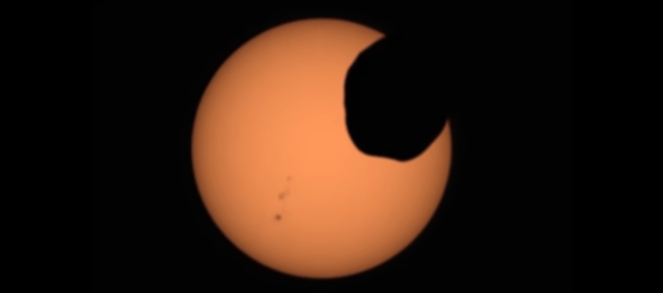
Image (Credit): Eclipse of the Sun by Phobos from the surface of Mars. (NASA/JPL-Caltech/ASU/MSSS/SSI)
This week’s pic is actually a video from NASA’s Perseverance Mars rover capturing Phobos as it partially blocks out the sun. You can see the video here and read more from NASA here.
It is certainly more dramatic than the two shots below from the Martian rover Opportunity in 2004. Deimos is just a speck within the image on the left.
Image (Credit): Eclipse of the Sun by Deimos (left) and Phobos (right) from the surface of Mars. (NASA/JPL/Cornell)
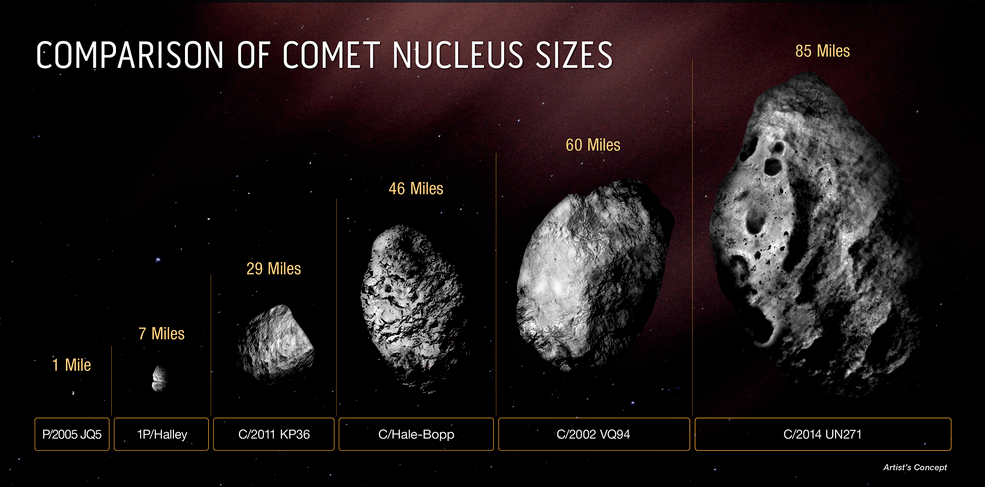
Image (Credit): Comparison of comet C/2014 UN271 (Bernardinelli-Bernstein) to several other comets. (NASA, ESA, Zena Levy (STScI))
A monster comet that takes 3 million years to circle the Sun is being closely analyzed by astronomers. The comet, C/2014 UN271 (Bernardinelli-Bernstein), will come closest to the Sun in 2031, but even then it will be about 1 billion miles away. At the most distant point in its orbit, the comet is about half a light year away from the Sun.
As shown in the graphic above, this is a large comet that could fully cover the state of Rhode Island. It was first detected by astronomers back in November 2010, when it was still 3 billion miles from the Sun. With the help of the Hubble Space Telescope, the astronomers were able to learn more about it this year.
The comet is believed to be a product of the Oort Cloud circling far outside our solar system. Of course, the Oort Cloud itself is a theory that has never been directly observed. But what about the Voyager spacecraft that left our solar system? Well, if you are willing to wait another 300 years, and the spacecraft are still working, you may have an answer.
You can read more about the comet at this NASA site.
Source: Graphic from NOIRLab showing where the Earth Trojan asteroid 2020 XL5 would appear in the sky from the SOAR Telescope in Chile as the asteroid orbits the Earth-Sun Lagrange point 4 (L4).
The National Science Foundation’s NSF’s National Optical-Infrared Astronomy Research Laboratory (NOIRLab) recently reported that the Southern Astrophysical Research (SOAR) Telescope in Chile confirmed asteroid 2020 XL5 is in fact a second and the largest Trojan asteroid accompanying the Earth. “Trojan” means that the asteroid orbits the Sun along the same path as the Earth. The first discovered Trojan asteroid is called 2010 TK7, which is about 400 meters in diameter. The new asteroid 2020 XL5 is about 1.2 kilometers in diameter.
The Earth may have more than just two of these Trojan asteroids, so stay tuned. But we are not unique. Jupiter has more than 5,000 of them. Trojan asteroids are found at Lagrange point 4 (L4) and L5 (see graphic below). Both the the Trojans asteroids mentioned above are located in L4.
These companion asteroids could also be useful in the future. Cesar Briceño of NOIRLab stated:
If we are able to discover more Earth Trojans, and if some of them can have orbits with lower inclinations, they might become cheaper to reach than our Moon…So they might become ideal bases for an advanced exploration of the Solar System, or they could even be a source of resources.
Source: Lagrange points pertaining to Earth and the Sun (not to scale) from NOIRLab.
Extra: To learn what else you can find at these Lagrange points, see my earlier post.




 Our Awesome Universe