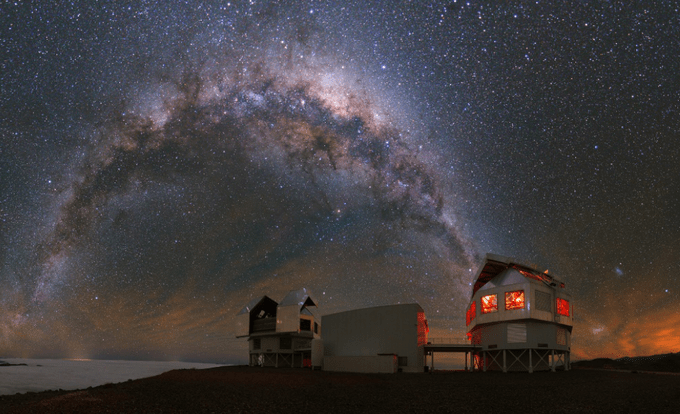
A Comet You Will Not See for Another Millennium

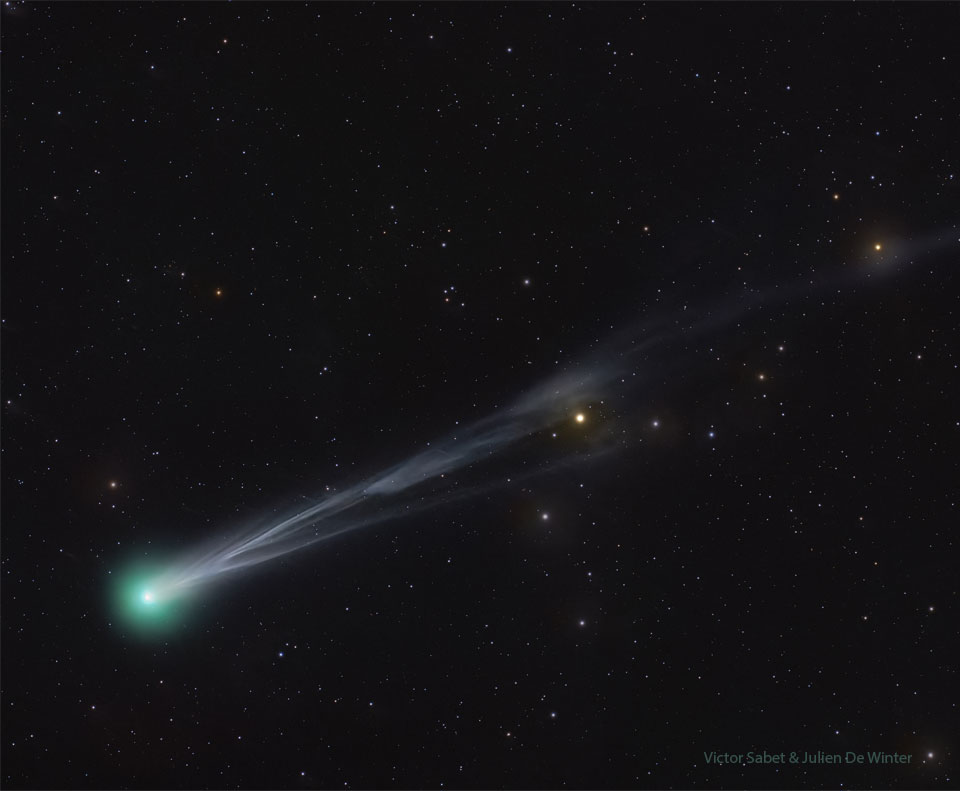
Image (Credit): Comet Lemmon shared via NASA’s Astronomy Picture of the Day. (Victor Sabet & Julien De Winter)

Now is your chance to view Comet Lemmon before it cycles its way though the solar system over the course of 1,350 years. You might even be able to view it over the next few weeks with the naked eye if you are lucky.

Wired magazine has a story about this comet that tells you all you need to know. It also provides some helpful guidance for spotting it in the night sky:

As of early October, Comet Lemmon can be found slightly below the handle in the Big Dipper (or the Plough, as it’s known in the UK), which forms part of the Ursa Major constellation. If you look up at the northern sky, you will be able to trace its path. In the northern hemisphere, it is predicted to appear in the northwestern-to-western sky after sunset from mid-October onward. It will be at a low altitude above the horizon and is expected to emit a faint glow in the twilight just after the sun has set.

Look up and observe this time capsule from 4.6 billion years ago.

Upcoming Conference: Space Settlement Summit

If you are interested in seeing humanity spread into space, you might want to attend the upcoming Space Settlement Summit hosted by the National Space Society (NSS) and scheduled for November 3 and 4 in Orlando, Florida.

The federal government may be backing out of conferences, and science in general, but that need not stop you from learning more. Do you want to know more about the difficulties of settling on Mars, the role of robotics and AI in space travel, or some of the approaches being pursued by the big space industry players?

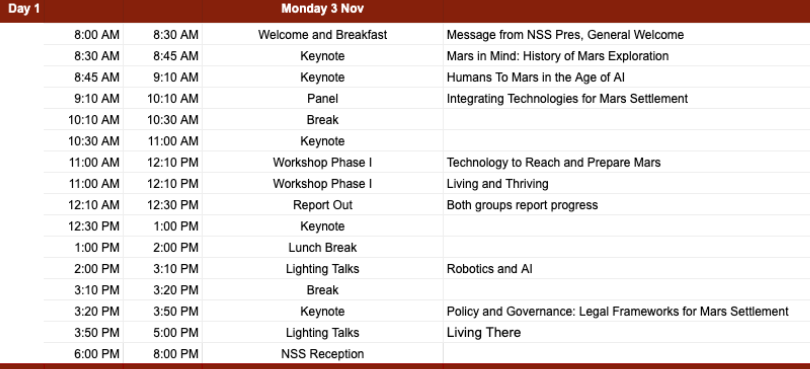
Some of the sessions already posted on the schedule for the first day are shown below:

You should also check out the range of presenters from industry, academia, and the non-profit center. It will take superior hardware, software, and brain power to eventually settle on Mars and elsewhere. You can be part of the discussion now.

The Early Bird prices end this coming Friday, so you need to make up your mind soon.

Credit: NSS

Upcoming International Space Development Conference

You may not like the idea of spending any part of the summer in hot and humid Florida, but the National Space Society has a good reason for you to go anyway. It is holding its 43rd annual International Space Development Conference from June 19 to 22 in Orlando, Florida.

Some of the guests during the week include Jared Isaacman, the future Administrator of NASA, as well as space experts and numerous current, former, and retired astronauts.

The various sessions, panels, and workshops will cover topics such as:

  • Moon and Mars exploration and settlement,
  • Deep space exploration,
  • Innovative technology,
  • Science fiction’s influence on the technology and commercialization of space,
  • Planetary defense,
  • Living in space,
  • Space solar power,
  • Space debris, and
  • Space law and policy.

For instance, on Thursday you can attend four related lectures in a session titled “Interplanetary Infrastructure“. Here is what the session will cover:

Infrastructure is the backbone of civilization. A multi-planetary civilization needs interplanetary infrastructure to support its expansion, facilitate trade, and keep its citizens and their societies connected. The Interplanetary Infrastructure session considers whether investments in infrastructure, especially two-way transportation infrastructure, can address some of the most pressing problems associated with humanity’s initial efforts to expand into the solar system. Historically, infrastructure has facilitated human expansion. It increased accessibility and reduced the personal sacrifices that adventurous settlers and their families had to make. Infrastructure projects tend to be somewhat conservative in nature. They generally use technologies and materials that have been applied in other industries and that are already well-understood and well-characterized by engineers. Successful infrastructure projects are economically viable because their long-term benefit to society exceeds their upfront cost, even when the upfront cost is significant. The speakers presenting concepts in this session adhere to these fundamental principles and can demonstrate that their proposals do indeed pencil out.

Take a look at the program and decide for yourself if you can handle the heat while learning more about future space adventures.

2025 International Mars Society Convention

It is time to mark your calendar for the Mars Society’s 2025 International Mars Society Convention scheduled for October 9–11 at the University of Southern California in Los Angeles. The theme this year is “Mars: The Time Has Come!”

If you want to learn more about past conventions to see if this is something for you, check out this link.

Some of the guests at last year’s convention included:

  • Tiffany M. Morgan, Deputy Director of the Mars Exploration Program in NASA’s Science Directorate, who will give an address about “Exploring Mars Together, DRAFT Plan for a Sustainable Future for Science at Mars.”
  • Howard Hu, the Orion Program Director at NASA, who will give an address about “NASA’s Artemis plans for returning to the Moon and beyond,”
  • Brig. General (Ret.) Dr. S. Pete Worden, Chairman of the Breakthrough Prize Foundation, who will give an address about “Life in the Universe and Private Sector Space Science Initiatives.”
  • Dr. Alan Stern, a renowned planetary scientist and commercial astronaut, who will give an address about “The Other Red Planet” focusing on Pluto.

If you are interested, you can register for this year’s convention here.

Also, if you have any ideas for the design of this promotional poster for the 2025 convention visit this site for more information.

Mark Your Calendar: Kennedy Center Earth to Space Festival

If you are looking for a different type of event, the Kennedy Center has an idea. Come for its Earth to Space Festival, being held from March 28 to April 20.

What is it, you ask? Here is what the Kennedy Center has shared:

For three weeks, EARTH to SPACE: Arts Breaking the Sky will fill the Center with musicians and astronauts, poets and researchers, visual artists and engineers, actors and environmentalists, architects and astronomers, dancers and scientists, film makers and space designers. It is our conviction that insights into the marvels of the universe can inspire action to protect our own planet, and that the arts can stimulate fresh thinking about the challenges that confront us.

Some of the speakers include astronaut Chris Hadfield, physicist Kip Thorne, and astrophysicist Mario Livio. The full list is available on the Kennedy Center site.

Starmus has been holding such festivals since 2011, with this one in Washington, DC being the eighth. Last year’s festival was held in Bratislava, Slovakia. Astronomy magazine called last year’s event “a smashing success all the way around.”

You may want to add the event to your calendar. It sounds like a fun way to combine astronomy and the arts.