NASA TV: Stay Tuned In

If you cannot find anything worthwhile on regular television, don’t forget that NASA continues to broadcast key events on its own television station, including this week’s meeting on UFOs, now called “unidentified anomalous phenomena,” or UAPs.

Here is the latest schedule for NASA TV:

Tuesday, May 30
9 a.m. – Coverage of hatch closure for the Axiom Mission 2 crew aboard the International Space Station. Hatch closure scheduled for approx. 9:10 a.m. 
10:45 a.m. – Coverage of the the Axiom Mission 2 crew undocking from the International Space Station. Undocking scheduled for 11:05 a.m.
12:30 p.m. – ISS Expedition 69 in-flight educational event with the New Mexico Museum of Space History in Alamogordo, NM, and NASA flight engineers Frank Rubio and Steve Bowen
2 p.m. — Media teleconference on the science bound for the International Space Station aboard SpaceX’s 28th commercial resupply services mission

Wednesday, May 31
10:30 a.m. – Coverage of the public meeting of the independent study team on categorizing and evaluating data of unidentified anomalous phenomena (UAP)
3 p.m. – Unidentified anomalous phenomena (UAP) post-meeting media teleconference

Thursday, June 1
12 p.m. – News conference for upcoming spacewalks to install new International Space Station Roll-Out Solar Arrays (IROSAs)
7 p.m. — NASA and U.S. Poet Laureate Ada Limón unveil her poem for Europa

Television: Stars on Mars

Image (Credit): Preview for the new television series Stars on Mars. (Fox)

The silly reality shows are now reaching for the stars, or at least a distant planet, with William Shatner leading the way. Fox’s new program Stars on Mars, premiering on June 5th, will feature numerous celebrities trying to survive in a “Mars-like” atmosphere. Planned guests include Lance Armstrong, Olympic figure skater Adam Rippon, professional football player Richard Sherman, and others.

I have no plans to watch this show, but I expect it may encourage support for space travel given that many of those who do watch the show will want to quickly leave this planet in the hopes of finding intelligent life somewhere.

NASA may be having funding problems, but bad TV always seems to find someone with deep pockets.

Image (Credit): Martian base for Stars on Mars. (Fox)

In Case You Missed It/Television: JWST on 60 Minutes

Image (Credit): Scott Pelley on 60 Minutes discussing JWST. (CBS)

Last month 60 Minutes had a piece on the James Webb Space Telescope (JWST), titled The Origin of Everything, that provided viewers with more amazing images. I recommend the episode. I also plan to watch a few more times myself.

For a taste of the episode, here is Matt Mountain, who heads up JWST’s operations as president of the Association of Universities for Research in Astronomy, discussing the speckled images captured at the very start as engineers used a star to align the telescope’s 18 mirrors.

Matt Mountain: These were not artifacts from the detector. These were not strange stars. The whole of the sky was filled with galaxies. There was no empty sky. And that’s when I went, “This telescope’s going to be phenomenal.”

Scott Pelley: No empty sky? What do you mean by that?

Matt Mountain: On almost every image we’re taking now, we see galaxies everywhere. I mean, we took a simple picture of a planet in our own system, Neptune. You know, it was this beautiful orb just sitting there and we saw some rings. In the background are galaxies again. It tells us that our universe is filled with galaxies. We knew this theoretically but when you go out to the night sky, we’re used to saying, “Well, look up at the night sky, we see those stars.” We can no longer say that. We now have to say, “Look up at the night sky and there are galaxies everywhere.”

Scott Pelley: We call it space because we thought there was nothing out there.

Matt Mountain: There is no empty sky with James Webb. That is what we have discovered.

You can watch the episode here.

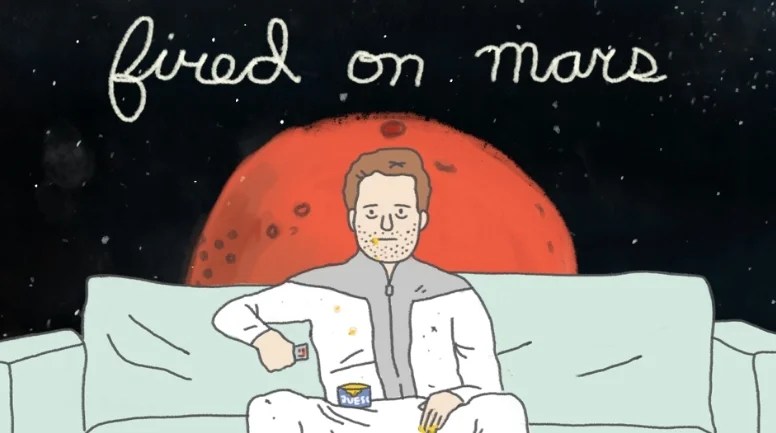
Television: Fired on Mars

Credit: WarnerMedia

A new series is coming to HBO Max on April 20th.

The series, Fired on Mars, is described as an “Existential workplace comedy set on the Martian campus of a modern tech company.” It stars Pete Davidson. It’s animated. And HBO Max seems to be doing the bare minimum to advertise it. Or, more to the point, it is doing nothing to advertise it.

Does that peek your interest of scare you away?

I am more in the latter category, but I will watch the first episode to see that I think.

Update: I watched the first few episodes and decided that was enough. It really has very little to do with Mars. The planet is just a backdrop to an office drama that is not very interesting. If you want a good science fiction office drama you would do better watching Severance on Apple TV+.

Television: The JWST on NOVA, Again

Credit: PBS

NOVA has a new episode this season on the James Webb Space Telescope (JWST). Unlike last season’s episode, Ultimate Space Telescope, which discussed the creation, launch, and early success of the space telescope, this episode, New Eye on the Universe, goes deeper into the goals of the space telescope as well as the findings since the first images appeared.

Here is a list of the topics covered in the latest episode (and their spot on the recording):

  • 00:00 Introduction
  • 04:11 The James Webb Space Telescope’s First Images
  • 05:47 Searching for Life on Exoplanets: Are We Alone in the Universe?
  • 14:40 Looking for Life in Our Own Solar System: Moons of Jupiter and Saturn
  • 18:52 Adjusting New Images from JWST: Science Meets Art
  • 23:55 Studying Supermassive Black Holes and Merging Galaxies
  • 30:25 Detecting the Oldest Galaxies with the JWST
  • 37:13 Troubleshooting the New Telescope’s Light Measurements
  • 42:12 Detecting the Atmosphere of a Rocky Exoplanet
  • 46:28 Results from the Team’s New Studies
  • 51:05 Conclusion

The section on adjusting the images is interesting in that we would not see these beautiful images as portrayed even if we could fly though space for an up-close look. Our eyes cannot see all of what the JWST can see in infrared. This is further explained in a Scientific American article, “Are the James Webb Space Telescope’s Pictures ‘Real’?

You can watch the latest episode on the PBS internet site, your local PBS station, or YouTube.