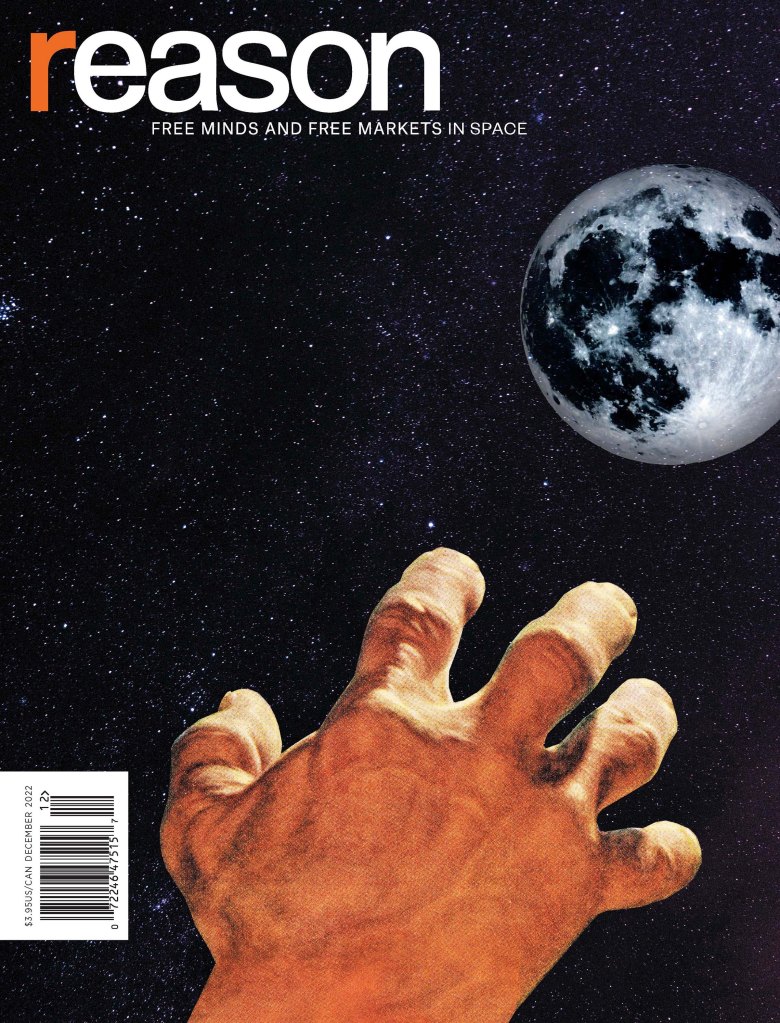
The December issue of Reason Magazine has plenty of fun articles on space travel, the ethics of terra-forming, science fiction books and films, and more. The magazine tends to favor privatization of just about everything, so expect some cheering for space billionaires like Elon Musk and Jeff Bezos, but overall it is a nice collection of thought-provoking articles.
Here is a sample of the articles:
We Are Going to the Moon: Thanks to the rise of private spaceflight companies, mankind will have a future off-Earth.
Why We Should Terraform the Galaxy: One critic calls it “arrogant vandalism,” but advocates say it might be a necessary form of self-preservation.
Tomorrow, Netflix will premiere a new science program that ties together life on Earth and the origin of the universe. The six-part program, Our Universe, is a BBC project narrated by Morgan Freeman. You can see a trailer of new show here.
We have already had a Blue Planet, a Green Planet, and even an Our Planet to highlight life here on Earth, so maybe this is more “Big Bang Planet” going back a little earlier than these other series.
You can expect similar BBC science series to follow, according to Variety. They include:
Life on Our Planet – Coming 2023: 8 episodes narrated by Morgan Freeman
Our Oceans – Coming 2024: 5 episodes narrated by Jonathan Smith
Our Living World – Coming 2024: 4 episodes narrated by Ben Roy
Our Water World – Coming 2025: 5 episodes narrated by Jackie Garbutt
But let’s not get ahead of ourselves. Just tune into tomorrow night’s series and enjoy the show.
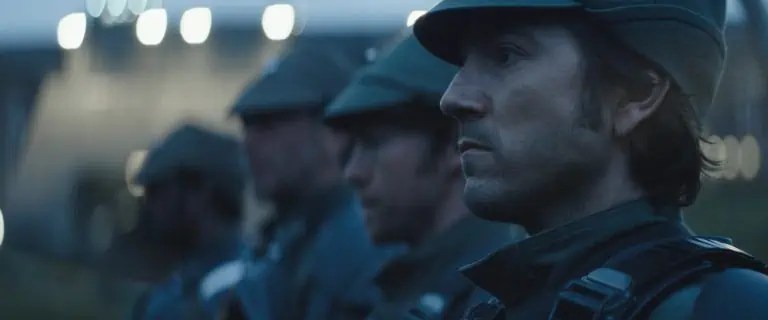
Image (Credit): Scene with Diego Luna from Star Wars: Andor. (Lucasfilm)
I am 10 episodes into Disney+’sStar Wars: Andor series and I love it. I am impressed that Disney+ finally dug a little deeper into the Star Wars material to find a new perspective, for now we get to see the Imperial bureaucracy in action.
This is the first of the four new live action Star Wars series that does not lean on the stars from the earlier movies – no Baby Yoda, Luke Skywalker, Princess Leia, Darth Vader, Tusken Raiders, or Jabba the Hutt. Instead, you get an original story, similar to how the Star Wars movie Rouge One took its own path.
Of course, the series has Storm Troopers, but they are there to lock down the period rather than becoming comic relief by allowing our “heroes” to blast away 50 of them at a time while coming away unharmed. Instead, the new series slowly kills off some of the heroes to demonstrate the true stakes involved.
The acting and dialogue is also much improved from earlier Star Wars iterations. Thankfully, Disney kept away from horrible Lucas-talk, never assuming that laser fights would cover over weak dialogue and a flimsy plot. Even the business side of Star Wars here is so much more interesting than the trade federation blather from The Phantom Menace. In Andor, the trade and smuggling is an important and believable thread carefully wound into the overall story.
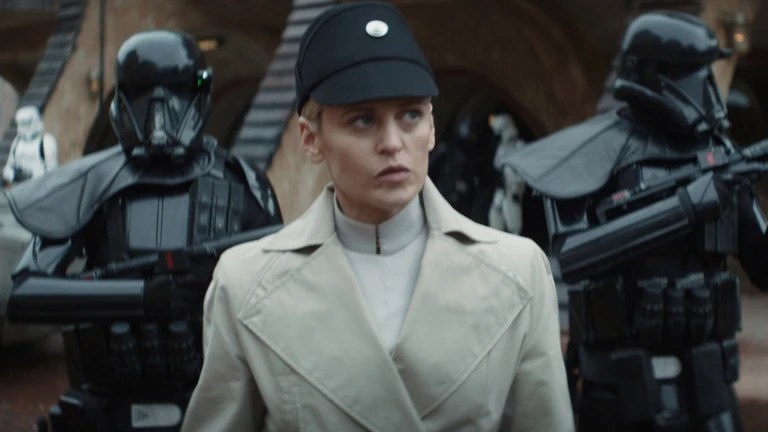
But best of all, Andor gives us an inside look at Imperial operations. Your massive, mind-numbing bureaucracy here represents a form of slavery within the machine doing the oppressing. The back-biting among the off-white-clad officers of the Imperial Security Bureau is fun to behold, even without a Darth Vader ending each meeting with someone being choked to death.
The Imperial “justice” system is another fascinating story line, showing how the Empire’s reaction to terrorist attacks leads to gang-pressing innocent citizens. It’s a perfect merging of Putin and a Tesla factory. All the while, political intrigue continues in the Senate and family dynamics are used as a poisonous glue.
This is not to say the series lacks action scenes. If you are looking for shootouts and space battles, they are in the story. But they assist the plot rather than being the main plot. Andor is about the people (software) behind the Empire more than the hardware.
I am not saying all of the spin-off series need to follow the Andor model. I’m just glad an Andor exists at all. It’s about time the adults had something to watch that meshes more with their reality – less flash, more angst. You can put Baby Yoda to bed with the kids and stay up late with Andor.
I look forward to watching the remaining two episodes of this season as well as the next and final season. I also ask Disney to keep the adults in mind as it develops more StarWars programs. You have an eager fan base.
Image (Credit): Scene with Denise Gough from Star Wars: Andor. (Lucasfilm)
Astrophysicist Neil deGrasse Tyson was a guest on HBO’s Real Time with Bill Maher last Friday. During the broadcast he discussed his new book, Starry Messenger: Cosmic Perspectives on Civilization, which I commented on in an earlier post.
The odd part of the discussion came when Mr. Tyson was trying to explain that hydrogen bombs are not as bad as atomic bombs because they give off less lethal radiation. Bill Maher had earlier expressed his concerns about Russia’s Putin using a nuclear weapon and was surprised to learn that a hydrogen bomb was less dangerous in terms of radiation. He asked about this again, but Mr. Tyson went onto a different topic about the power of conventional arms and never did get back to Mr. Maher’s main concern.
Sadly, Mr. Tyson missed a chance to inform the audience about the dangers of nuclear weapons, be they hydrogen or atomic. As I had noted in an earlier post about nuclear risks, scientists have found that even a limited nuclear exchange can do great damage to the world because of the soot it throws into the upper atmosphere. A Columbia Climate School study on this issue, “Even a Limited India-Pakistan Nuclear War Would Bring Global Famine, Says Study,” found that even 50 Hiroshima-size explosions, which are quite small by today’s standards, would “…launch some 5 million tons of soot toward the stratosphere.” This soot would “…cause production of the world’s four main cereal crops—maize, wheat, soybeans and rice—to plummet an average 11 percent over that period, with tapering effects lasting another five to 10 years.” The impact of famine would lead to the loss of countless lives around the world.
The real risk today is a nuclear winter, which Mr. Tyson never explained. Instead, the audience was left with the impression that a nuclear explosion is not all that serious. Apparently, he was more interested in sharing all of his knowledge about World War II than addressing the question on the table. Mr. Tyson is supposed to be a good science communicator, so he really needs to correct the record. This is no time to be sloppy about nuclear war.
Enough about Star Trek. It’s time to talk about Star Wars.
On September 21, Disney+ (the second Death Star of online content after the demise of Netflix) will be releasing its next Star Wars series called Andor. It’s a prequel to the movie Rogue One, starring Diego Luna as Cassian Andor five years before the events of the film. We learn more about how he went from a thief to a rebel against the evil Empire lead by Darth Vader and friends.
The trailer for Andor looks intriguing, with plenty of off planet action, something the series The Book ofBoba Fett really needed. My favorite to Star Wars series to date is still The Mandalorian, with Obi-Wan Kenobi a distant second. I am just glad they are not making an Endor series. I had enough of teddy bears taking down the Empire.
I will let Disney+ give you the plot for the show:
In Andor, audiences meet Cassian Andor five years before the attack on the Empire takes place. The prequel series will cover the five-year period in two 12-episode seasons, focusing on Cassian Andor’s journey towards discovering his full power. Rogue One: A Star Wars Story showed a loyal and ruthless Andor who spoke of his long-standing fight against the Empire — one that began when he was just six years old. This narrative left a lasting impression on Diego Luna, making it easy for him to sign on for this series. Referring to Andor’s statements in Rogue One, Luna wanted to know what it all meant, saying, “Why would a six-year-old give up his childhood to join a fight? When he talks about a dark past and doing terrible things for the Rebellion, what is he referring to? I think that story matters. There’s a lot of material there for us to play with, and I was excited to go into this journey and give these answers.” The series concentrates on Andor’s progression, looking back into his childhood, the fighter spirit that was always inside of him, and what he faced in his homeland that ultimately brings him to the Rebellion’s front lines. Luna explained that he wanted to tell this story to show “what needs to happen for a revolutionary to emerge.”
I have high hopes for this series compared to the last two. While HBO and Prime are battling it out over dragons versus elves, I am tuning into the Star Trek versus Star Wars battle. Luckily, there is something for everyone.




 Our Awesome Universe