The Latest on Exocomets

Image (Credit): Artist’s drawing of exocomets around the young Beta Pictoris. (NASA/FUSE/Lynette Cook)

We have all heard about exoplanets and exomoons, but what about exocomets? It appears the bodies we can observe outside of our solar system are getting even smaller. In a Scientific American article, “Ukrainian Astronomers Discover ‘Exocomets’ around Another Star,” we learn about Ukrainian astronomers who found five such comets using data from NASA’s Transiting Exoplanet Survey Satellite (TESS).

The comets in question orbit the young star Beta Pictoris, which is about 65 light-years from Earth. This is not the first time comments were detected in this distant solar system’s debris disk. The researchers confirmed those earlier sighting as well. The planet-forming debris surrounding the star presents plenty of opportunities for comet sightings.

Such findings, using information from both the Kepler Space Telescope and TESS, continue to expand our understanding of these objects. Once we focus the James Webb Space Telescope on these little bodies, it should get even more interesting.

Extra: You can find the 2019 Astronomy article on the exocomets around Beta Pictoris here.

Starlink Assists with Ukrainian Battles

Image (Credit):  A disabled Russian tank in Ukraine. (Wikimedia Commons)

SpaceX’s Starlink system, shared with Ukraine last month, is already proving to be a boost to Ukrainian fighters. While the focus of the new system was to keep Ukrainians connected to the Internet, it has also been used by drones attacking Russian military tanks and trucks. The NY Post quotes one Ukrainian source as stating, “If we use a drone with thermal vision at night, the drone must connect through Starlink to the artillery guy and create target acquisition.”

All of this will make the Starlink system within Ukraine a Russian target and Mr. Musk himself persona non grata, not that Mr. Musk really cares. However, he has warned Ukrainians to be cautious when using the system:

Important warning: Starlink is the only non-Russian communications system still working in some parts of Ukraine, so probability of being targeted is high. Please use with caution.

Let’s just hope that all of this doesn’t lead to anti-satellite actions in space. We have enough issues on the ground.

Cosmonauts Arrive at the International Space Station

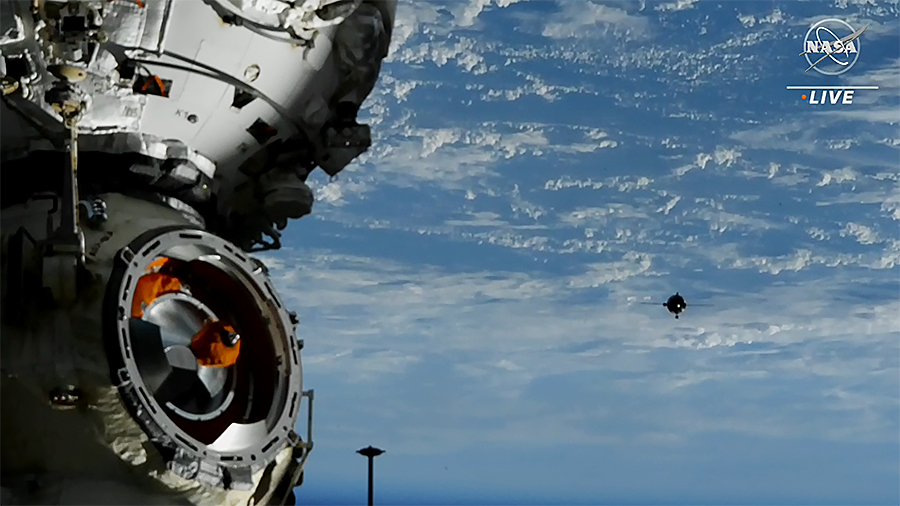
Image (Credit): The Soyuz MS-21 crew ship with three cosmonauts aboard approaches the International Space Station. (NASA)

On Friday, a Soyuz space capsule arrived at the International Space Station (ISS) with three Russian cosmonauts –  Oleg Artemyev, Denis Matveev, and Sergey Korsakov. This will bring the ISS crew to 10. On March 30th, three crew members will return to the surface of the Earth – NASA astronaut Mark Vande Hei and Russian cosmonauts Pyotr Dubrov and Anton Shkaplerov. You can read more about the mission here.

With the ongoing disagreements between the Russian and Western governments regarding Ukraine, it is good to see some normal operations related to the ISS. Let’s hope the science can continue in space while discussions continue back here on Earth to end the ongoing war.

Update: The media was abuzz regarding the blue and yellow outfits of the three astronauts arriving at the station. Was it support for Ukraine or their alma mater? One cosmonaut said there was simply an excess of yellow material. Another space mystery.

A Space Telescope Goes Dark

Image (Credit): Picture of the completely integrated mirrors and detectors before final packaging. (Max Planck Institute for Extraterrestrial Physics)

You may have heard of Germany’s black hole-hunting telescope called the extended ROentgen Survey with an Imaging Telescope Arraye (eROSITA). It was launched in 2019 as part of a larger Russian-German mission called the “Spectrum-Roentgen-Gamma” (SRG) observatory and placed in the L2 Lagrange Point.

The eROSITA has three primary goals:

  • to detect the hot intergalactic medium of 50-100 thousand galaxy clusters and groups and hot gas in filaments between clusters to map out the large scale structure in the Universe for the study of cosmic structure evolution,
  • to detect systematically all obscured accreting Black Holes in nearby galaxies and many (up to 3 Million) new, distant active galactic nuclei and
  • to study in detail the physics of galactic X-ray source populations, like pre-main sequence stars, supernova remnants and X-ray binaries.

Well, similar to other joint Russian space missions, the telescope’s work was put on hold because of continuing events in Ukraine. The German government had this to say:

[Deutsches Zentrum für Luft- und Raumfahrt (DLR)] and the German Space Agency at DLR have been cooperating with Russian institutions on a number of research projects, in some cases with the participation of other German research organisations and universities, and international partners.

Against the backdrop of the aggressive attack on Ukraine, the DLR Executive Board is taking the following measures:

  • All collaboration activities with Russian institutions on current projects or projects in the planning stage will be terminated.
  • There will be no new projects or initiatives with institutions in Russia.

Where necessary, DLR will enter into coordination with other national and international partners.

We are slowly blocking our view of the bigger universe because of the reckless actions of a few. Hopefully, we can open up our eyes again shortly.

More Angst Regarding the International Space Station

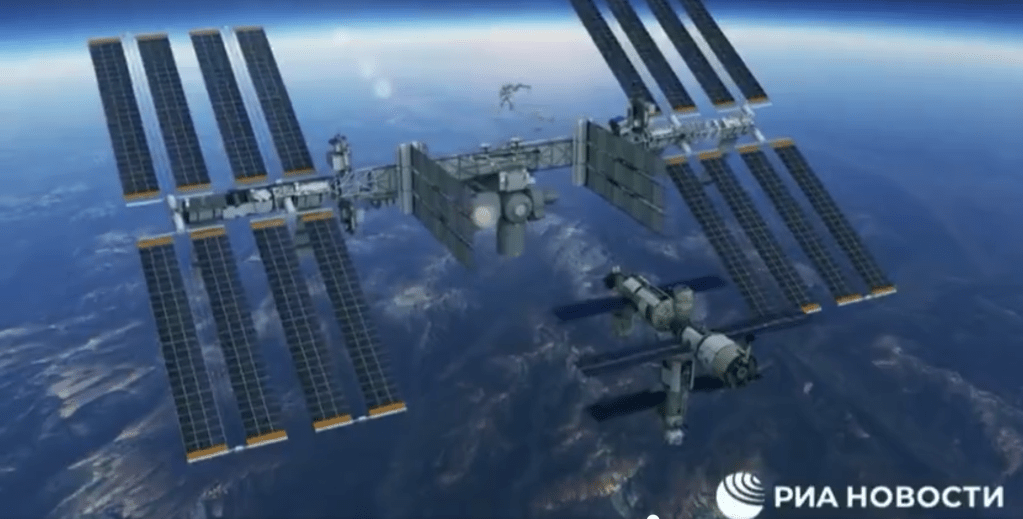
Source/Credit: Image of Russian section breaking away from the ISS from NASA Watch.

You may have already seen this ridiculous Russian video that NASA Watch shared with the world. It is very disturbing. Presumably created by the Russian space program Roscosmos, it shows the Russian portion of the International Space Station (ISS) breaking away as a result of the worldwide sanctions against the Russians for invading Ukraine. Here is the NASA Watch tweet and related video (an image of which is shown above):

Russian gov’t-controlled RIA Novosti @rianru posted a video on Telegram made by @Roscosmos where cosmonauts say goodbye to Mark Vande Hei on #ISS, depart, and then the Russian segment detaches from the rest of ISS. @Rogozin is clearly threatening the ISS program. #NASA#Ukraine

One person provided some hope among all this foolishness with this reply:

Basically all astro-/ cosmonauts said that after a couple of days in space they only see a fragile planet, and that nation states start to disappear in their minds.

And now we have former US astronaut Scott Kelly and SpaceX’s Elon Musk battling with Dmitry Rogozin, the head of Roscosmos. Scott Kelly was clear in his dislike of Rogozin’s comments about the ISS:

Maybe you could find yourself a job working at McDonalds if McDonalds still exists in Russia.

None of this is helpful when we have lives in space depending on a competent ground team. Let’s hope all these egos do not get in the way of the professionalism we expect from the US, Russia, and others with regards to the safe operation of the ISS.