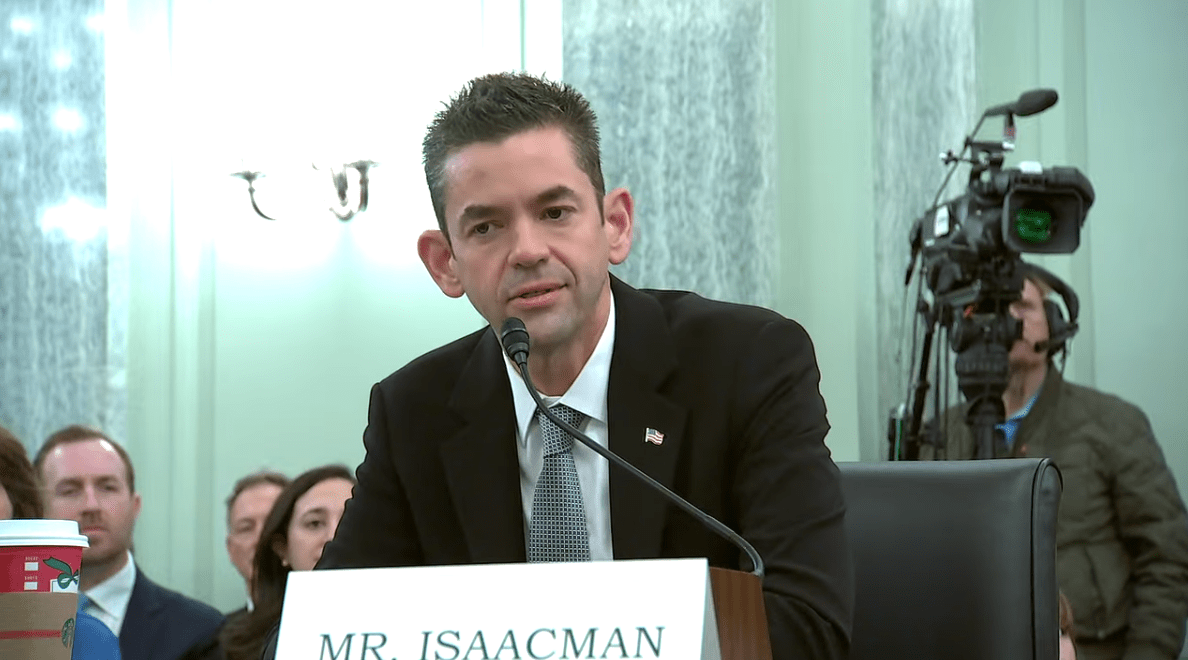
Image (Credit): Jared Isaacman answering questions at the December 3, 2025 Senate confirmation hearing. (Senate Committee on Commerce, Science, and Transportation)
Jared Isaacman appeared before the Senate Committee on Commerce, Science, and Transportation earlier today for his second confirmation hearing. Overall, everything went well and he should be ready for a full Senate vote next week that will make him NASA’s next administrator.
The success of the Artemis program that President Trump began during his first term. America will return to the Moon before our great rival, and we will establish an enduring presence to understand and realize the scientific, economic, and national security value on the lunar surface.
Along the way, we will pioneer the next ‘giant leap’ capabilities to extend America’sreach even further into space, including expanding and accelerating investments intonuclear propulsion and surface power programs. These efforts, in addition to industrypartners building reusable launch vehicles, we will set the stage for future missions toMars and beyond.
We will never accept a gap in capabilities again–not with our space station presence inlow Earth orbit or our ability to send American astronauts to the Moon.
We will strive to build an orbital and lunar economy that can fund the future we all wantto see in space and not rely exclusively on the taxpayer. We will begin making theinvestments now for the inevitable spacefaring future that is just on the horizon.
We will make the most efficient use of every dollar allocated–pushing for more xplanes, more rovers & telescopes, more exciting missions like Hubble, James Webb, and Dragonfly with the aim of enlightening the world through breakthrouh scientific discoveries–knowing that if NASA doesn’t do it, no one else will.
The third point about a “gap in capabilities” specifically addresses the hardware needed to get to the space station or the moon, but we are also facing a gap in our scientific capabilities given the loss of so much talent this year. The statement reads like a dime store space novel where all we need it a rocket and grit, but hardware can only get your to a location.
Living and thriving once we get to wherever we are going will depend upon many other factors that are outside the understanding of rocket engineers. Yet too many of the senior mission specialists with these needed skills are now sitting at home after being forced out or deciding to retire in the midst of recent chaos. This gap in this area only widened, and the full impact on the NASA’s space programs has yet to be realized. However, these personnel losses are likely to close the gap between the US and Chinese space programs to our detriment.
Maybe Mr. Isaacman needed to add a sixth goal to close this new gap in scientific capabilities created this year by the White House.
Image (Credit): Percival Lowell’s mausoleum just steps away from the Lowell Observatory in Flagstaff, AZ. (Atlas Obscura)
On this day in 1916, American astronomer Percival Lowell died at the age of 61 in Flagstaff, AZ. He will forever be remembered for his incorrect theory concerning canals on Mars as well as his better theory about a ninth planet, which contributed to the discovery of Pluto 14 years by Clyde Tombaugh, who was working at the Lowell Observatory in Flagstaff.
Some interesting facts about Mr. Lowell’s life includes:
After graduating from Harvard with a degree in mathematics yet spent six years running a cotton mill;
He traveled extensively to Asia and wrote numerous books about the region;
He was a dedicated pacifist; and
His greatest contribution to astronomy related to the preferred placement of observatories.
Speculation has been singularly fruitful as to what these markings on our next to nearest neighbor in space may mean. Each astronomer holds a different pet theory on the subject, and pooh-poohs those of all the others. Nevertheless, the most self-evident explanation from the markings themselves is probably the true one; namely, that in them we are looking upon the result of the work of some sort of intelligent beings. . . . The amazing blue network on Mars hints that one planet besides our own is actually inhabited now.
Now when we think that each of these stars is probably the centre of a solar system grander than our own, we cannot seriously take ourselves to be the only minds in it all.
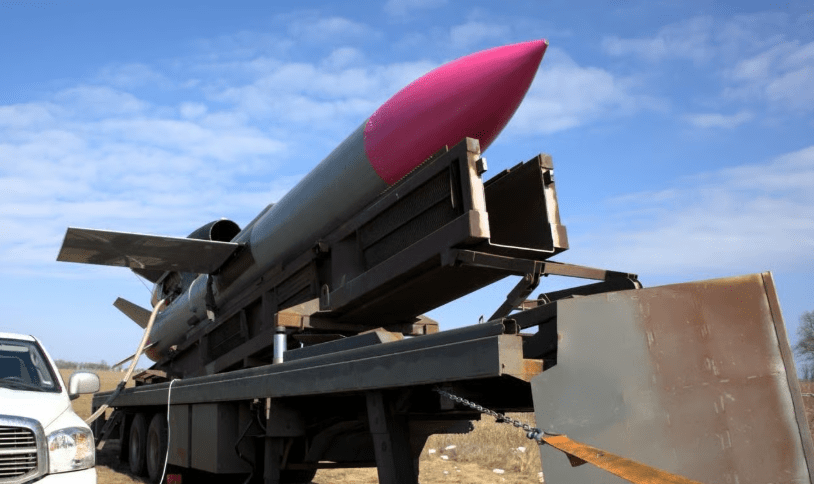
Image (Credit): The Ukrainian Flamingo cruise missile. (Fire Point)
It is a sad truth that war can create some useful items that propel mankind forward. Maybe these inventions would have occurred anyway, but the desire to survive can certainly stimulate the mind.
Ukraine is a perfect example. Recent stories about its Flamingo cruise missile indicate that the same Ukranian know-how that created the drones was also used to design a cruise missile that costs $500,000 a piece and can penetrate deep into Russian territory. Such quick innovation by Fire Point, the Ukrainian defense firm that created the new cruise missile, puts even Elon Musk to shame (remember, Musk tried to start SpaceX with old Russian rockets).
Just think if all of this ingenuity had been put towards a peaceful space program. Of course, this war too shall end, and Ukraine may have some promising industries that can be quickly retooled for a space program.
Ukraine had a strong space industry when it was part of the USSR, and these latest foolhardy efforts by Putin to reestablish that Soviet empire may instead only reestablish the Ukranian space industry.



 Our Awesome Universe