Study Findings: Feasibility of Keeping Mars Warm with Nanoparticles

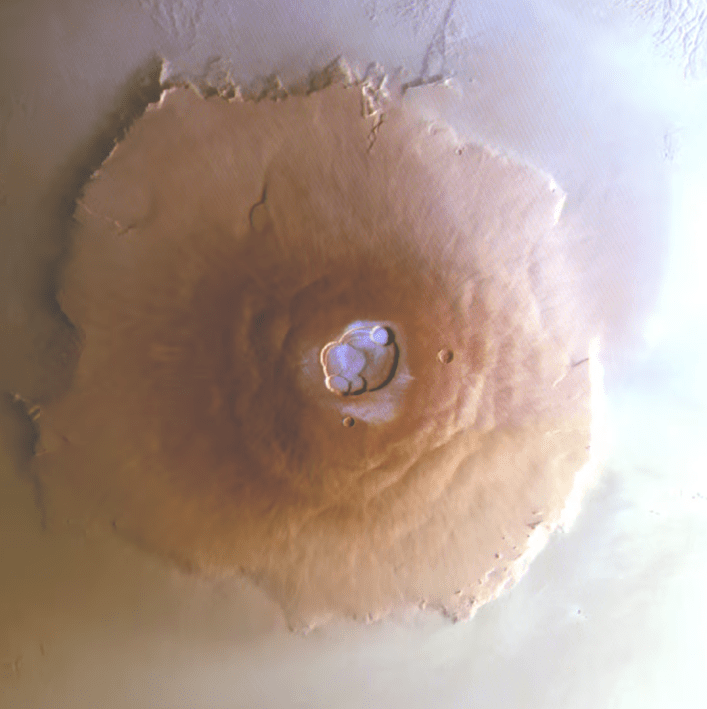
Image (Credit): Frost on Olympus Mons (,shaded in blue). (ESA/DLR/FU Berlin)

Science Advances abstract of the study findings:

One-third of Mars’ surface has shallow-buried H2O, but it is currently too cold for use by life. Proposals to warm Mars using greenhouse gases require a large mass of ingredients that are rare on Mars’ surface. However, we show here that artificial aerosols made from materials that are readily available at Mars—for example, conductive nanorods that are ~9 micrometers long—could warm Mars >5 × 10³ time smore effectively than the best gases. Such nanoparticles forward-scatter sunlight and efficiently block upwelling thermal infrared. Like the natural dust of Mars, they are swept high into Mars’ atmosphere, allowing delivery from the near-surface. For a 10-year particle lifetime, two climate models indicate that sustained release at 30 liters per second would globally warm Mars by ≳30 kelvin and start to melt the ice. Therefore, if nanoparticles can be made at scale on (or delivered to) Mars, then the barrier to warming of Mars appears to be less high than previously thought.

Citation: Ansari S, Kite ES, Ramirez R, Steele LJ, Mohseni H, Feasibility of keeping Mars warm with nanoparticles, Science Advances, (2024).
10.1126/sciadv.adn4650

Study-related stories:

Space.com

Universe Today

Northwestern University

Senate Bill to Assist Astronomers with the Night Sky

Credit: Qyulang from Pixabay

On August 1, Senators John W. Hickenlooper (D-CO) and Mike Crapo (R-ID) introduced a bill called The Dark and Quiet Skies Act (S.495) to assist astronomers with the night sky.

In a press release from Senator Hickenlooper’s office, we learn the Act would

create a Center of Excellence overseen by National Institute of Standards and Technology (NIST) to develop best practices to reduce light and noise interference. The Center would boost collaboration between the astronomical community, industry, and Federal agencies to protect federally-funded scientific research that observes the sky and celestial bodies.

Specifically, this center would:

  • Establish and circulate best practices to reduce unintentional optical and radio interference;
  • Conduct research and development on tracking, identifying, modeling, and characterizing satellite interference; and
  • Develop mitigation technology that includes satellite paint, film, orientation adjustments, cooling techniques, or fuselage design.

The bill may be a little late to the game, particularly if the press release is correct and the sky is really getting 10 percent brighter each year, but it is certainly welcome. We already know SpaceX, Amazon, and China have grand plans to fill up the sky with satellites, so this is the time to set some rules for the U.S. companies at least.

What is not clear is whether this supports or duplicates similar efforts by the International Astronomical Union (IAU), which has a Centre for the Protection of the Dark and Quiet Sky from Satellite Constellation Interference. While the bill above calls for the U.S. National Institute of Standards and Technology (NIST) to oversee this new Center of Excellence, the U.S. is also funding the IAU initiative via the National Science Foundation.

Let’s hope any and all such efforts in this area can be coordinated to bring the greatest pressure to bear on these satellite companies. The goal should be more than protecting the night sky for telescopes. If it is true that we will see hundreds of thousands of new satellites in orbit in the years to come, we need to make some sense of this booming industry before a few massive collisions make the space over our heads full of litter and unusable.

Have You Heard of Orbital Drug Factories?

Credit: Varda Space Industries

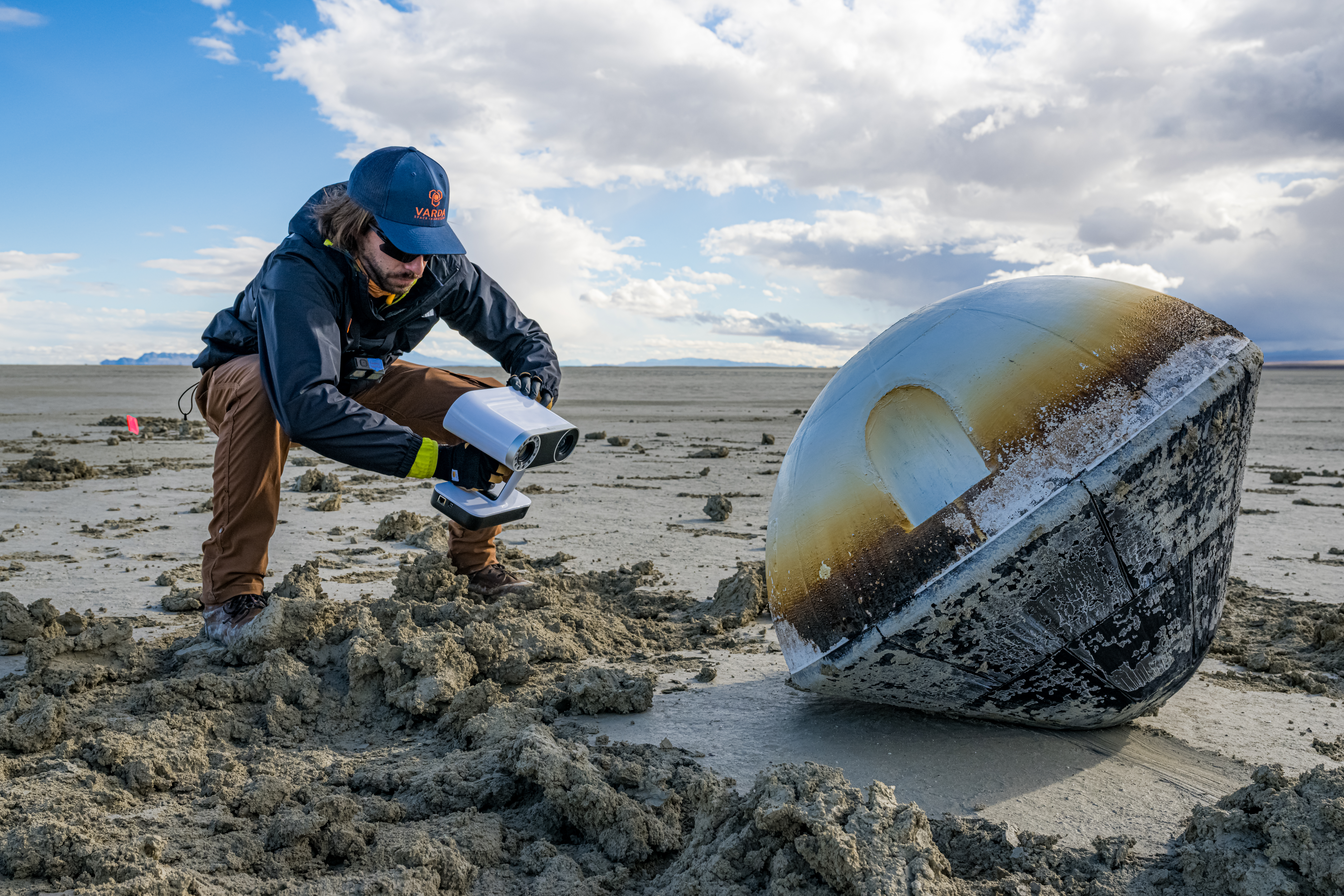
The International Space Station is not the only orbiting platform for experiments. Varda Space Industries has its own orbiting facility, or at least it had one in orbit for 10 months until it returned to Earth in February (shown below). And now the company has another $90 million in funding to continue to develop its capsules.

Varda, founded in 2020, represents the next phase of the space industry, where lower cost launches allow companies to be creative with their own spacecraft. In this case, biopharma is being asked to consider the advantages of a launches that remove gravity from the equation:

While gravitational forces do not directly impact thermodynamic properties of systems, they do significantly impact kinetic and hydrodynamic processes. Microgravity suppresses convection and sedimentation, resulting in more uniform supersaturation, as well as diffusion-driven transport. The resulting environment enables crystallization outcomes that lead to improvements in bioavailability, enhanced physicochemical properties, differentiated intellectual property, and new routes of administration — all realized by conducting research in microgravity.

While Varda is taking advantage of the lower launch costs made available by reusable rockets, it too wants to have reusable capsules down the line to reduce costs even further. Of course, it is not as glamorous as a permanently manned space station, but these crewless capsules should be sufficient for the needs of many if not most companies.

Note: Varda is also the name of a dwarf planet, which took its name from JRR Tolkien’s Middle Earth.

Image (Credit): The W-1 capsule after landing in the Utah desert. (Varda Space Industries/John Kraus)

Happy New Year!

Credit: Image by macrovector on Freepik

If you have any questions about the reason January 1 is the start to the year, Earthsky has a good explanation of the holiday’s Roman roots. Enjoy yourself, but please do not sacrifice any rams. You will understand after you read the Earthsky piece.