Space Stories: Water Found on Miranda, NASA Still Pondering VIPER Mission to Moon, and the ISS Has Been Leaking for Some Time

Image (Credit): Uranian moon Miranda as seen by Voyager 2 on January 24, 1986. (Jet Propulsion Laboratory)

Here are some recent stories of interest.

John Hopkins Applied Physics LaboratoryUranus’ Moon Miranda May Have an Ocean Beneath Its Surface, New Study Finds

A new study suggests Uranus’ moon Miranda may harbor a water ocean beneath its surface, a finding that would challenge many assumptions about the moon’s history and composition and could put it in the company of the few select worlds in our solar system with potentially life-sustaining environments. “To find evidence of an ocean inside a small object like Miranda is incredibly surprising,” said Tom Nordheim, a planetary scientist at the Johns Hopkins Applied Physics Laboratory (APL) in Laurel, Maryland, a study co-author, and the principal investigator on the project that funded the study. “It helps build on the story that some of these moons at Uranus may be really interesting — that there may be several ocean worlds around one of the most distant planets in our solar system, which is both exciting and bizarre.”

Space NewsNASA Evaluating “Next Steps” for VIPER Lunar Rover Mission

NASA expects to determine by early next year the next steps for a lunar rover mission it canceled in July amid some confusion over the timing of that decision. Speaking at an Oct. 28 meeting of the Lunar Exploration Analysis Group (LEAG), Joel Kearns, deputy associate administrator for exploration in NASA’s Science Mission Directorate, said the agency was reviewing responses to a request for information (RFI) the agency issued in August seeking alternative uses for its Volatiles Investigating Polar Exploration Rover (VIPER) spacecraft.

Scientific AmericanThe International Space Station Has Been Leaking for Five Years

In the hostile conditions beyond Earth, a spacecraft is all that stands between an astronaut and certain death. So having yearslong seemingly unfixable leaks on the International Space Station (ISS) sounds like a nightmare scenario. It’s also a reality, one that a recent agency report calls “a top safety risk.” Amid months of headlines about astronauts stranded by Boeing’s Starliner vehicle and NASA’s announcement of a contract with Elon Musk’s SpaceX to destroy the ISS early next decade, the ongoing concerns about the leaks come as another reminder that supporting a long-term population in space is a challenge that’s quite literally out of this world.

Space Stories: Oceans on Ariel, Dinosaur-Killer Asteroid from Beyond Jupiter, and the Launch of the Polaris Dawn Mission

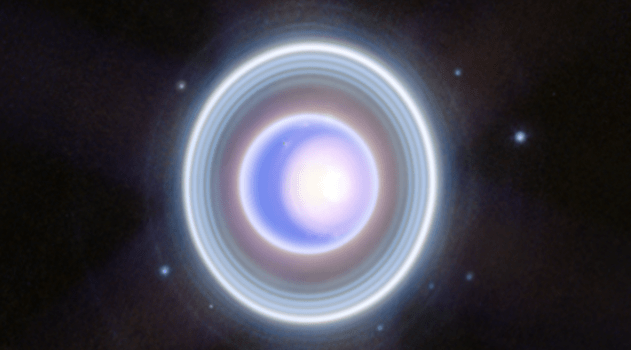
Image (Credit): Uranus and distant galaxies as seen by the James Webb Space Telescope. (NASA, ESA, CSA, STScI)

Here are some recent stories of interest.

ForbesNASA’s Webb Telescope Finds Evidence For An Ocean World Around Uranus

New observations by the James Webb Space Telescope suggest that an icy moon around Uranus may have an underground liquid ocean. Ariel is one of 27 moons around Uranus, the seventh planet from the sun and the third largest planet in the solar system. It’s one of four moons that scientists have long been interested in as part of a search for water across the solar system, the others being Umbriel, Titania and Oberon.

Nature: Dinosaur-killing Chicxulub Asteroid Formed in Solar System’s Outer Reaches

The object that smashed into Earth and kick-started the extinction that wiped out almost all dinosaurs 66 million years ago was an asteroid that originally formed beyond the orbit of Jupiter, according to geochemical evidence from the impact site in Chicxulub, Mexico. The findings, published on 15 August in Science, suggest that the mass extinction was the result of a train of events that began during the birth of the Solar System. Scientists had long suspected that the Chicxulub impactor, as it is known, was an asteroid from the outer Solar System, and these observations bolster the case.

Space DailyPolaris Dawn Mission Set for August 26 to Advance Commercial Space Exploration

The Polaris Program, focused on testing and developing new spaceflight technology, is preparing to launch its first mission, Polaris Dawn, aboard SpaceX’s Falcon 9 rocket on Monday, August 26, 2024. This mission marks a significant step forward in commercial space exploration. Key objectives include testing a next-generation spacesuit during the first commercial spacewalk, attempting to achieve the highest altitude for a human spaceflight since the Apollo missions, and evaluating a new communication system through Starlink.

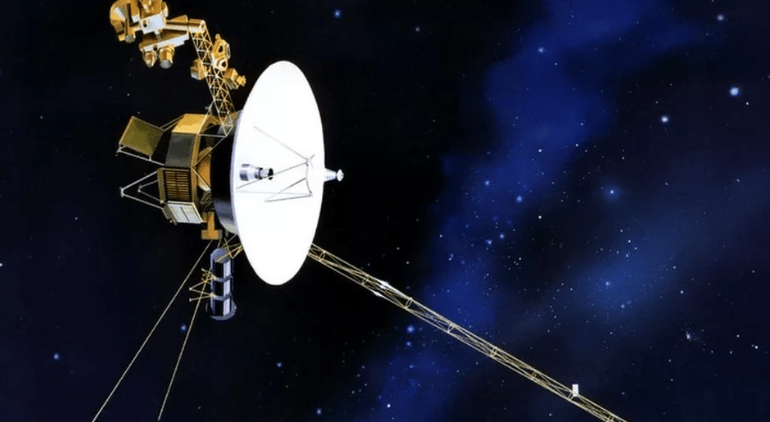
Voyager 2 is Still Talking to Us

After two weeks with no word, Voyager 2 is back to communicating with us as it continues its journey beyond our solar system. The whole incident started when NASA sent a bad command, but all is well.

Voyager 2 first left Earth back in August 1977 and exited the solar system in December 2018. Like Voyager 1, which is also outside the solar system now, Voyager 2 had the initial task of studying the planets. Voyager 2 focused on Jupiter, Saturn, Uranus and Neptune. It has shown it was capable of much more as it dragged the human race to the bleeding edge of space.

You can read all about Voyager 2’s accomplishments at this NASA site, including:

  • Voyager 2 is the only spacecraft to study all four of the solar system’s giant planets at close range.
  • Voyager 2 discovered a 14th moon at Jupiter.
  • Voyager 2 was the first human-made object to fly past Uranus.
  • At Uranus, Voyager 2 discovered 10 new moons and two new rings.
  • Voyager 2 was the first human-made object to fly by Neptune.
  • At Neptune, Voyager 2 discovered five moons, four rings, and a “Great Dark Spot.”

An impressive list of accomplishments, and the spacecraft is still ticking as it goes into the great unknown.

We need to keep these achievements in mind as we battle over this year’s NASA budget. We also need to remember that there was supposed to be four Voyager-like spacecraft rather than two, but budget cuts nixed the second set. Meaning we can still get some great things done even if we don’t have the budget to fund every piece of a grand vision.

More JWST Priorities

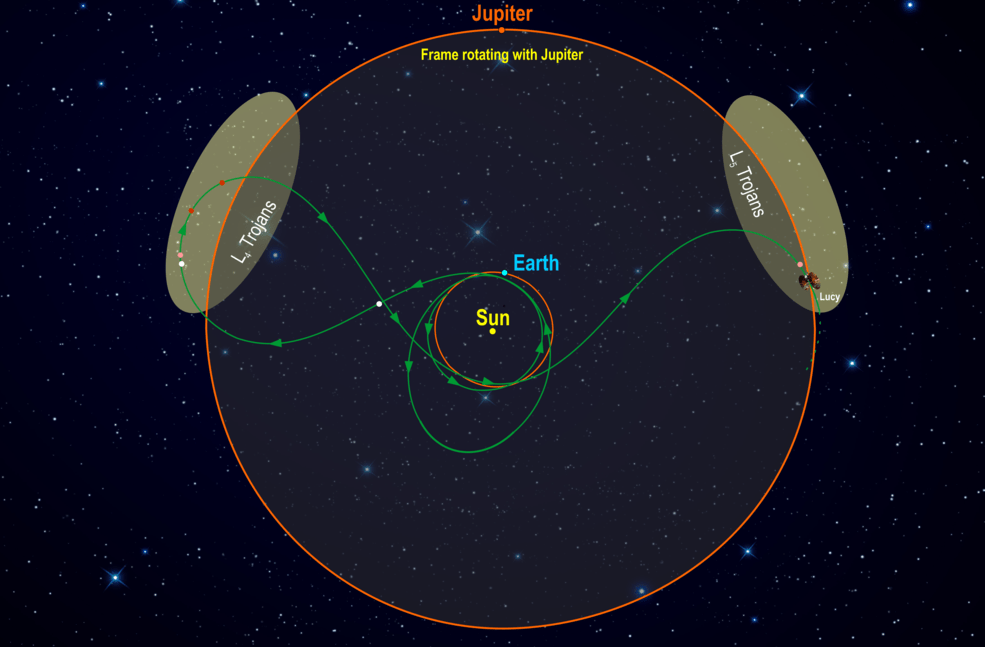
Image (Credit): This diagram shows Lucy’s orbital path in green after her October 2021 launch to visit the Trojan asteroids. (Southwest Research Institute)

Last week I noted some of the mission priorities in the James Webb Space Telescope’s (JWST) first year. Those priorities were listed under “Exoplanets and Disks.” I thought I would highlight a few more, this time from the “Solar System Astronomy” list. Here are five more priorities:

  • Pluto’s Climate System with JWST;
  • The Moons of Uranus: A NIRSpec Investigation of Their Origins, Organic Constituents, and Possible Ocean World Activity;
  • A Pure Parallel Survey of Water in the Asteroid Belt;
  • DiSCo-TNOs: Discovering the Composition of the Trans-Neptunian Objects, Icy Embryos for Planet Formation; and
  • JWST Observations of Lucy Mission Targets.

Each of these priorities come with an explanation of the mission. For example, here is a little more about NASA’s Lucy mission from the JWST proposal:

The Lucy spacecraft – to be launched at approximately the same time as JWST – will perform the first ever in situ exploration of the Jupiter Trojan asteroids. Trojans are the largest population of solar system bodies currently unvisited by spacecraft, and revealing their composition and formation history is the key to untangling disparate hypothesis for the early dynamical evolution of the entire solar system.

Understanding these enigmatic bodies requires not just the high spatial resolution imagery and spectroscopy that will be afforded by Lucy, but also the superb near- and mid-infrared spectroscopy of which JWST is uniquely capable. The high signal-to-noise, high spectral resolution, and extended wavelength coverage beyond the capabilities of Lucy will allow JWST to sensitively probe the organic, carbonate, and silicate components of the surfaces of the Trojans. Meanwhile, the Lucy spectra and images will place these observations into their geological and historical context, greatly extending the scientific utility of both the JWST observations and the Lucy visit. Together these observations will paint a rich picture of this population, allowing us to trace connections with other bodies studied remotely and in situ across the solar system.

Lucy was launched last October and is expected to encounter its first Trojan asteroid until August 2027. You can find the full mission timeline here.

Television: More Space Stories This Summer

Image (Credit): The eight plants of our solar system. (NOVA)

If you are looking for space series beyond the Moon, PBS has a few more shows for you. With the James Webb Space Telescope releasing the first photos next week, now is the time to brush up on the mission with a NOVA special. And check out the earlier NOVA piece on the planets as well. Dates and times may vary by region.

NOVA: Ultimate Space Telescope, July 13 at 9pm (28 minutes):

How did NASA engineers build and launch the most ambitious telescope of all time? Follow the dramatic story of the James Webb Space Telescope—the most complex machine ever launched into space. If it works, scientists believe that this new eye on the universe will peer deeper back in time and space than ever before to the birth of galaxies, and may even be able to “sniff” the atmospheres of exoplanets as we search for signs of life beyond Earth. But getting it to work is no easy task. The telescope is far bigger than its predecessor, the famous Hubble Space Telescope, and it needs to make its observations a million miles away from Earth—so there will be no chance to go out and fix it. That means there’s no room for error; the most ambitious telescope ever built needs to work perfectly. Meet the engineers making it happen and join them on their high stakes journey to uncover new secrets of the universe.

NOVA: The Planets, July 7 & 14 at 8pm (5 episodes)

Among the stars in the night sky wander the eight-plus worlds of our own solar system—each home to truly awe-inspiring sights. Volcanoes three times higher than Everest, geysers erupting with icy plumes, cyclones larger than Earth lasting hundreds of years. Each of our celestial neighbors has a distinct personality and a unique story. In this five-part series, NOVA will explore the awesome beauty of “The Planets,” including Saturn’s 175,000-mile-wide rings, Mars’ ancient waterfalls four times the size of any found on Earth, and Neptune’s winds—12 times stronger than any hurricane felt on our planet. Using unique special effects and extraordinary footage captured by orbiters, landers and rovers, we’ll treat viewers to an up-close look at these faraway worlds. We’ll stand on the dark side of Pluto, lit only by the reflected light of its moons, watch the sun set over an ancient Martian waterfall, and witness a storm twice the size of Earth from high above Saturn. And, we’ll reveal how each of them has affected our own planet: Earth.