The Europa Clipper Mission Has Begun

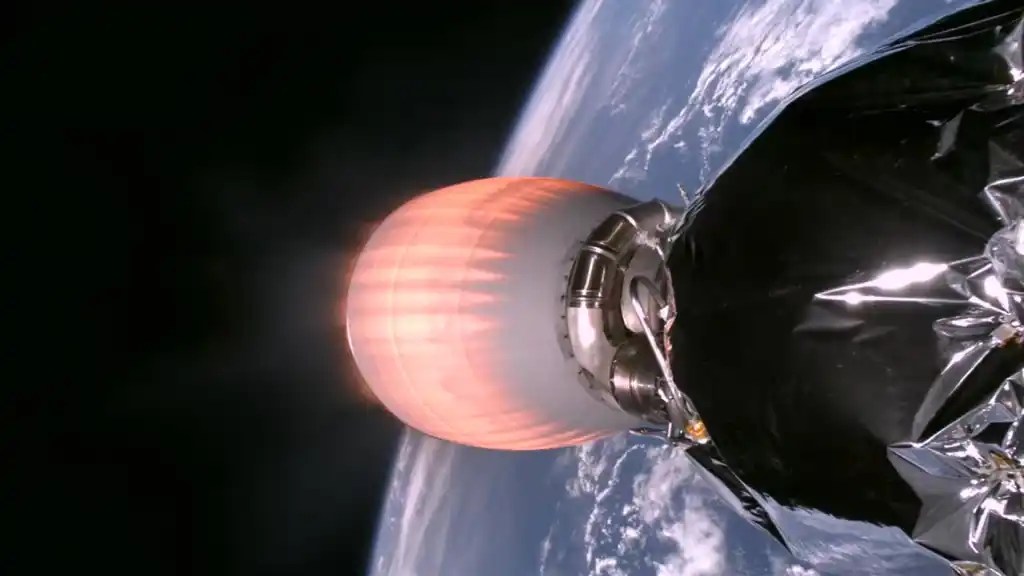
Image (Credit): View of SpaceX’s Falcon Heavy second stage engine as it completes its burn after launching the Europa Clipper spacecraft. (NASA)

Earlier today, the Europa Clipper spacecraft was launched from Kennedy Space Center for its 2030 rendezvous with the Jovian moon Europa. It can then begin to analyze the moon’s salt water ocean and look for any signs of life.

The mission is expected to last for three years, maybe longer should the spacecraft prove to be durable and ready for more scientific work. After that, it will plummet down into the Jovian moon Ganymede.

Scientists believe Europa may contain more water than is found here on Earth. That is interesting in terms of what may lie below the surface in terms of potential life. It also offers mankind a priceless resource should we ever find ourselves living in that region.

Europa Clipper Project Scientist Robert Pappalardo stated:

We know of our Earth as an ocean world, but Europa is representative of a new class of ocean worlds, icy worlds in the distant outer solar system where saltwater oceans might exist under their icy surfaces…In fact, icy ocean worlds could be the most common habitat for life, not just in our solar system, but throughout the universe.

You can follow the status of the mission here.

The Fifth Test of Starship Goes Well

Image (Credit): An image showing SpaceX’s Super Heavy booster being grabbed midair after the fifth flight test from Boca Chica, Texas. (Taken from a SpaceX video)

Earlier today, SpaceX conducted its fifth Starship test earlier today. It appears it was an overall success, with a new twist. This time the rocket’s Super Heavy booster returned to the launch pad to be captured midair by two metal arms. It seemed like an unnecessary risk to the landing site, but the stunt was successful.

The rocket itself “landed” without incident off Australia’s coast before falling into the sea and exploding.

All in all it went according to plan, which is a good sign for NASA and its future plans for the rocket.

While all the attention today related to the booster bravado, I just want to see a Starship that is ready for the upcoming Artemis mission. After all, all the fancy tricks related to the Starship will look pretty useless should the Chinese be the first to return to the Moon.

NASA Looks to Rocketlab on Mars Sample Return

Credit: Rocketlab.

NASA is moving forward with planned studies to address the Mars Sample Return. Earlier in the week, NASA awarded a contract to Rocketlab for this very purpose.

Rocketlab announced the following:

…the Company has been selected by NASA to complete a study for retrieving rock samples from the Martian surface and bringing them to Earth for the first time. The mission would fulfill some of the highest priority solar system exploration goals for the science community – to revolutionize humanity’s understanding of Mars, potentially answer whether life ever existed on the Martian surface, and help prepare for the first human explorers to the Red Planet.

NASA’s Rapid Mission Design Studies for Mars Sample Return solicits industry proposals to carry out rapid studies of mission designs and mission elements capable of delivering samples collected by the Mars Perseverance rover from the surface of Mars to Earth. The results of this study will inform a potential update to NASA’s Mars Sample Return Program and may result in future procurements with industry. Rocket Lab’s study will explore a simplified, end-to-end mission concept that would be delivered for a fraction of the current projected program cost and completed several years earlier than the current expected sample return date in 2040.

This is just one of many studies expected to be conducted to find the best method for interplanetary rock retrieval.

Good luck to Rocketlab and the other involved in this endeavor.

Good News: Hurricane Milton Had Little Impact on NASA Facilities

Image (Credit): View of the Kennedy Space Center following Hurricane Milton. (NASA)

NASA has reported that it has so far detected little damage from Hurricane Milton at the Kennedy Space Center.

Here is what NASA shared today via Twitter/X:

Kennedy is now OPEN!

The Damage Assessment and Recovery Team has completed their assessment of the center and its facilities, and determined that employees can safely return on-site to resume working.

The damage identified is manageable and in-line with the items the Ride Out Teams previously identified, including minor impacts such as ripped awning, and damage to doors and traffic lights.

It is interesting that NASA is using DART in a whole way here compared to yesterday’s story about the European Space Agency’s Hera mission. I just hope that the DART mission never leads to a DART event here on Earth.

Pic of the Week: The Launch of Hera

Image (Credit): Visitors at ESA’s control center in Germany watching the Hera launch. (ESA / J.Mai)

This week’s image shows a crowd in Germany watching the launch of the European Space Agency’s (ESA) Hera mission on October 7, 2024. The launch itself took place from Cape Canaveral Space Force Station in Florida via a SpaceX Falcon 9.

Hera’s goal is to study how binary asteroid systems like Didymos form and function to learn more about to defend the Earth from approaching asteroids. You may remember Didymos from the earlier NASA Double Asteroid Redirection Test (DART) mission.

Here is more from the ESA on the mission:

Hera’s first deep space manoeuvre will begin in late October and put the spacecraft on course for its next major milestone, a flyby of Mars in March 2025. During this flyby, Hera will use its instruments to study Deimos, the smaller and more enigmatic of Mars’s two moons. This will serve as an important test for many of the spacecraft’s instruments, ensuring they are fully operational before the spacecraft arrives at its final destination, Didymos.

Hera will perform a second deep space manoeuvre in February 2026. An ‘impulsive rendezvous’ in October 2026 will bring Hera into the vicinity of the Didymos asteroid system. The spacecraft will begin its detailed survey of the moonlet Dimorphos in 2027, which will turn the 151 m asteroid into one of the most studied objects in the Solar System.