Space Stories: Detailed Views of Mars, Plummeting ISS Space Junk, and Time Zones on the Moon

Image (Credit): Recent high-altitude view of Mars taken by Mars Express’s High Resolution Stereo Camera (HRSC). ( ESA)

Here are some recent stories of interest.

Astrobiology: Mars Express Celebrates 25,000 Orbits

ESA’s Mars Express recently looped around Mars for the 25,000th time – and the orbiter has captured yet another spectacular view of the Red Planet to mark the occasion. The new high-altitude view was taken by Mars Express’s High Resolution Stereo Camera (HRSC). It features many of Mars’s towering volcanoes and even includes a surprise appearance from the planet’s largest moon, Phobos.

Daily Mail: Piece of 5,800lb Battery Pallet Tossed from NASA’s ISS Crashes Through Florida Home – and Nearly Kills Homeowner’s Son

A piece of metal came crashing through a home in Florida that is believed to be from a 5,800-pound battery pallet discarded by the International Space Station (ISS). Naples homeowner Alejandro Otero was on vacation when he received a call from his son, saying he heard a ‘tremendous sound’ and there were gaping holes in the ceiling and floor – while explaining whatever fell almost hit him. The two-pound, cylinder object has since been recovered by NASA to determine its origin and if found to be space junk, the agency could be liable for damages.

Reuters: White House Directs NASA to Create Time Standard for the Moon

The White House on Tuesday directed NASA to establish a unified standard of time for the moon and other celestial bodies, as the United States aims to set international norms in space amid a growing lunar race among nations and private companies. The head of the White House Office of Science and Technology Policy (OSTP), according to a memo seen by Reuters, instructed the space agency to work with other parts of the U.S. government to devise a plan by the end of 2026 for setting what it called a Coordinated Lunar Time (LTC).
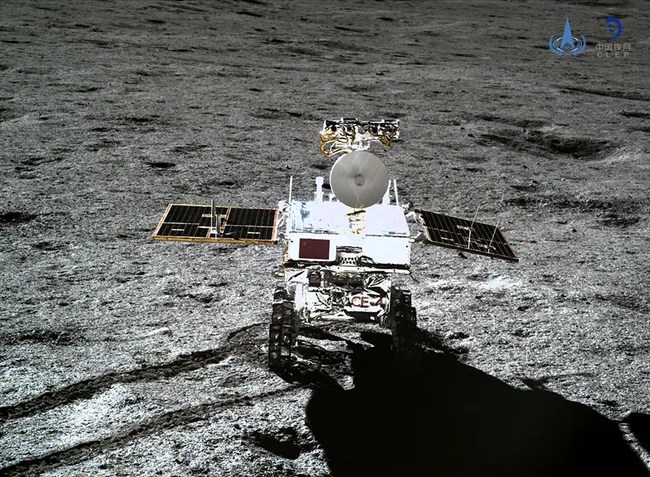
Space Quote: Maybe China Can Beat Us Back to the Moon

Image (Credit): China’s Yutu 2 rover, as seen by the Chang’e 4 lander, both of which landed on the lunar surface in January 2019. (CNSA)

“If the space agency holds to its notion of flying the Artemis II crew on a looping journey around the far side of the moon late next year, and landing the Artemis III crew in the south polar region in 2026 or 2027, the next boot prints on the moon will indeed be American. But don’t count on it.”

-Statement in a Time magazine article titled, “Why China Might Beat the U.S. Back to the Moon.” The article cites NASA’s delays and budget shortfall related to the Artemis mission. Interestingly, the article notes that the U.S. might have lacked the discipline to return to the Moon if China did not have similar plans. Finally, one key point to remember is that the U.S. beat the Chinese to the Moon by more than 50 years, so this is not really the same as the earlier space race with Russia. As a result, China is taking its time to do it right. We may need to keep that in mind as we face our own struggles.

Wallops Flight Facility to Launch Rockets to Study Eclipse

Image (Credit): NASA’s Wallops Flight Facility in Virginia. (Timmons Group)

While Virginia will not be in the direct path of the upcoming Total Solar Eclipse, it will be playing a role related to the eclipse that day.

NASA’s Wallops Flight Facility on the Virginia coast will be launch three rockets to study disturbances in the Earth’s ionosphere during the eclipse. The rockets will be launched 45 minutes before, during, and 45 minutes after the peak local eclipse.

These launches are part of NASA’s Atmospheric Perturbations around Eclipse Path (APEP) mission. Such launches during an eclipse are not unusual as NASA hopes to learn a few things from this study.

Aroh Barjatya, a professor of engineering physics at Florida’s Embry-Riddle Aeronautical University campus, stated:

Understanding the ionosphere and developing models to help us predict disturbances is crucial to making sure our increasingly communication-dependent world operates smoothly.

Podcast: Chinwag with Paul Giamatti

Credit: Treefort Media

If you saw the recent film The Holdovers, you witnessed Paul Giamatti at the top of his game as a private school instructor (which earned him an Oscar nomination).

But if you would like to learn about another side of Mr. Giamatti, then you may want to check out his podcast with Stephen Asma called Chinwag. It is by no means a science or an astronomy podcast, yet it is a fun collection of conversations that often touch on related topics and guests, be it topics such as UFOs and the Drake Equation, or guests including astronaut Mike Massimino, writer Ted Chiang, and actor William Shatner.

Yes, there is plenty here about the occult and mind-numbing drugs, but I recommend you sift though some of this to find the gems. Below are a few of the episodes you may want to try, but don’t expect William Shatner to talk about Captain Kirk and space travel. He is too busy sharing stories about spiritualism, drugs, and his early acting career.

Chinwag Mailbag: The Drake Equation

Paul and Stephen dig into our Chinwag mailbag for this SETI-inspired question (that’s Search for Extraterrestrial Intelligence to any novice listeners). The Drake Equation is explained and let’s just say there’s A LOT of math involved.

It’s been 60+ years since last estimates were made on the odds of finding intelligent life in the Milky Way, and Chinwag listener Rick B. wants to know, how long could a civilization broadcast its presence through technology, and what current factors might affect a civilization’s ability to remain detectable? Is there a ticking clock to our existence, and what’s Twinkie-lung got to do with all this?

A Different Kind of Ted (Chiang) Talk

In this Chinwag, Paul and Stephen are thrilled to be subject to fascinating thought experiments by award-winning fiction writer Ted Chiang. Up for the discussion?

The difference between fact and fiction when it comes to the existence of alien life, and whether Paul is indeed an assassin because he played one in an action film Ted once saw. Imaginations are running amok and people can’t differentiate between what’s real and what isn’t. Is social media to blame or was The National Enquirer the social media of yester-year? Online echo chambers and the dangerous speed of information may be a culprit for conspiracy theories. And is belief in aliens and monsters in pop culture a direct response to higher anxiety levels and an externalization of neuroses? Then, what is singularity and was it born with the invention of the wheel?

Paul and Stephen are happy to learn that Ted’s not afraid that AI will take over, but the natural desire to do less work may lead to more romances between humans and AI robots. So buckle up and plug in your lady-cyborg and get ready for an all new fascinating Chinwag!

Mooning with Mike Massimino

Paul and Stephen are obsessed with UFOs and life beyond earth–so who better to add to the conversation than a guy who’s been to space twice?

This week, our intrepid Chinwaggers are joined by former NASA astronaut Mike Massimino, a man who decided that a fear of heights would be best overcome by a trip to space. In this week’s classified file: space toilets, robot arms, and why there should never be more than one comedian per space shuttle.

Tripping with William Shatner

Stephen Asma and Paul Giamatti are giddy to speak with lifelong hero and Star Trek alum William Shatner on tequila tastings, space travel, bum drug trips, holding on to your inner child and that time he beat up an Australian Olympic swimmer on stage.