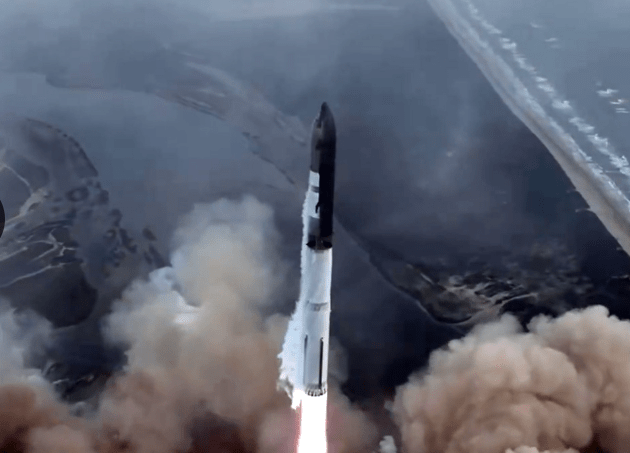
Image (Credit): Starship launch from Boca Chica, Texas on March 14, 2024. (SpaceX)
This week’s pic is from this morning’s launch of the SpaceX Starship from the facility in Boca Chica, Texas. The flight went well until the point of reentry, when SpaceX lost contact and the rocket was lost. The plan had been for both a successful launch and return of the Starship. The Starship’s rocket booster also experienced a malfunction, causing it to crash in the Gulf of Mexico.
Each launch provides more information as it inches towards greater success. We can only hope the progress aligns with NASA’s goals for a return to the Moon.
Image (Credit): One of the ships from Jodorowsky’s Dune drawings. (Sony Pictures Classics)
Now that Dune: Part Two is in theaters, it may be worth your time to revisit an earlier attempt to create a Dune movie by Chilean-French filmmaker Alejandro Jodorowsky Prullansky. The 2014 film, Jodorowsky’s Dune, discusses the filmmaker’s elaborate plans in the 1970s to create a 12-20 hour film covering the life of Paul Atreides. The planned combination of surrealistic art (Moebius), contemporary music (Pink Floyd), and stars (from Orson Welles to Dali) were being aligned to create something that might of been magical or just catastrophic. We will never know because the American film industry turned him down, even if they did use some of his ideas for future films such as Star Wars and Aliens.
When the film rights to Dune were sold again and Peter Lynch was given a green light to direct the film, we got the 1984 cultish mess that still haunts the streaming services. In the 2014 flim, Jodorowsky said he watched the Lynch film and was “happy because the picture was awful.’
In terms of the latest Dune films by Canadian filmaker Denis Villeneuve, in an interview Jodorowsky said he saw the trailer for the first Dune film and thought it was “well done” for standard industrial cinema, but noted that “industrial cinema is incompatible with auteur cinema.”
In my opinion, after a failure and then a flop, we are lucky to have the determination of Denis Villeneuve to finally give us a high-quality, memorable Dune. That said, it would have been fun to see Dali as the Emperor.
New research suggests there’s less oxygen on the icy surface of Jupiter’s moon Europa than thought — and that could affect what, if any, life might be lurking in the moon’s underground ocean. Even with little or no oxygen, microbes might still be bustling around in the ocean believed to exist miles beneath Europa’s frozen crust. As for what else, “who knows,” said NASA scientist Kevin Hand, who was not involved in the study published Monday in Nature Astronomy.
The best measurements from Hubble show the universe is now expanding faster than predicted based on observations of how it looked shortly after the big bang. These observations were made by the Planck satellite mapping of the cosmic microwave background radiation – sort of a blueprint for how the universe would evolve structure after it cooled down from the big bang. The simple solution to the dilemma is to say that maybe Hubble observations are wrong due to some creeping inaccuracy in its deep-space yardstick. Then along came the James Webb Space Telescope to crosscheck Hubble’s results. Webb’s sharp infrared views of Cepheids agreed with Hubble data. Webb confirmed that the Hubble telescope’s keen eye was right all along.
A trio of small rovers that will explore the Moon in sync with one another are rolling toward launch. Engineers at NASA’s Jet Propulsion Laboratory in Southern California recently finished assembling the robots, then subjected them to a punishing series of tests to ensure they’ll survive their jarring rocket ride into space and their travels in the unforgiving lunar environment.Part of a technology demonstration called CADRE (Cooperative Autonomous Distributed Robotic Exploration), each solar-powered rover is about the size of a carry-on suitcase.
Image (Credit): One side of the panel attached to the Europa Clipper showing “water” ” in 103 languages (explained below). (NASA/JPL-Caltech)
In past NASA missions to the outer planets of our solar system, we attached messages for any distant civilization that might be out there. Both the Pioneer and Voyager missions contained such messages.
So what about NASA’s Europa Clipper mission to Jupiter’s moon set to launch in October? It too will have some messages, but these appear to be for the inhabitants of the moon rather than some distant civilization.
A triangular 7″ x 11″ metal plate attached to the spacecraft destined for Europa will carry messages on both sides. The image above shows one of these sides containing features waveforms that are visual representations of the sound waves formed by the word “water” in 103 languages.
The other side of the plate (shown below) contains a variety of messages:
the Drake Equation, which estimate the possibility of finding advanced civilizations beyond Earth;
U.S. Poet Laureate Ada Limón’s handwritten “In Praise of Mystery: A Poem for Europa”;
a reference to the radio frequencies considered plausible for interstellar communication; and
a portrait Ron Greeley, whose early efforts laid the foundation for Europa Clipper.
The spacecraft will also carry a silicon microchip containing more than 2.6 million names that were submitted by the public as part of NASA’s “Message in a Bottle” campaign.
This is all interesting in itself, but not really a message to others. I expect it is not intended for anyone else but ourselves because the Europa Clipper is not expected to leave the solar system but instead crash into another of Jupiter’s moons – Ganymede.
Note: You may wonder about the message on the New Horizons spacecraft that is also travelling to the edges of our solar system. That message is somewhat controversial. I will let you read about that one in this Slate article, “Ashes and Small Change.”
Image (Credit): One side of the panel attached to the Europa Clipper showing a poem, portrait, and more (explained above). (NASA/JPL-Caltech)
Take a look at the image above. Can you determine where this image originated? Take a guess and then check your answer by going to the “Where is This? The Answer Sheet” page.



 Our Awesome Universe