Space Stories: A Test of Space Suits, Water Detected on Asteroids, and China’s Growing Space Program

Image (Credit): Recent test of the space suit being built by Collins Aerospace. (Collins Aerospace)

Here are some recent stories of interest.

The Verge: One of NASA’s New Spacesuits Passes Microgravity Test

Collins Aerospace, a private company hired to create spacesuits for use outside the International Space Station (ISS), has tested its suit aboard a commercial microgravity flight, passing a milestone that lets engineers move forward toward critical design review…During the test, the plane executed “roller-coaster-like maneuvers” to induce weightlessness and allow someone wearing a prototype to see if it actually lets someone move around in it under those conditions.

Newsweek: NASA Data Detects Water on Asteroids for the First Time Ever

Water has been found on the surface of two asteroids for the first time, scientists said in a new paper. Two silicate-rich asteroids were detected by the retired Stratospheric Observatory for Infrared Astronomy (SOFIA) that were giving off a specific wavelength of light that indicated the presence of molecules of water, according to research published in The Planetary Science Journal. The discovery may have major implications for theories about how water initially made its way to our own planet. It could have been delivered via asteroid impact.

Astronomy.com: China is Embarking on a Science and Exploration Program of Staggering Scale

When China’s first lunar lander, Chang’e 3, touched down in Mare Imbrium on the Moon in 2013, it was the pinnacle of the country’s space endeavors. The robotic lander and its small Yutu rover companion were the first spacecraft to operate on the Moon since the 1970s, and provided new insights into our planet’s natural satellite…Since then, China’s space activities have exploded in range, frequency, and ambition. The country now rivals the U.S. for the most launches per year, with around 80 missions having been planned for 2023. The nation has its own modular space station, named Tiangong, which is expected to be continuously occupied by a rotating crew of three astronauts for at least a decade.

The Goldilocks Zone Turned Awfully Cold for Earth

Image (Credit): Artist’s rendering of a “Snowball Earth.” (NASA)

We point of telescopes at distant solar systems searching for exoplanets in the “Goldilocks Zone,” it being defined as the habitable zone around a star where water can remain in liquid form. But that was not always the case for planet Earth, even if we are the model for this zone.

A recent New York Times article, “How Earth Might Have Turned Into a Snowball,” discusses how the Earth became a frozen ball about 717 million years ago. And it remained in this deep freeze for approximately 56 million years.

While the article goes on to discuss the reasons for this freeze, I am more interested in the idea of what this may mean for our own plans to someday travel to a distant star.

If a civilization on another planet was viewing our solar system from afar 750 million years ago, they too may have mistaken our Earth as a perfectly place planet to support life on its surface. However, they would have needed to wait another 23 million years for our planet to revert back to having a liquid surface.

It appears timing is everything, and the inner workings of a planet can be just as important as its placement in the solar system. I expect our telescopes will be able to tease our more information about each exoplanet in the future, though it also makes sense to send robotic probes before ever attempting to send a human that far.

In the meantime, we have a few moons here in our own solar system with frozen oceans. We can start to learn more about the potential for life in such places and our ability to survive in such climates. NASA’s Europa Clipper, set to launch later this year, is part of that learning process.

Study Findings: A Recently Formed Ocean Inside Saturn’s Moon Mimas

Image (Credit): Saturn’s moon Mimas and its large Herschel Crater. The moon is also referred to as the “Death Star” from Star Wars. (NASA/JPL-Caltech/Space Science Institute)

Nature  abstract of the study findings:

Moons potentially harbouring a global ocean are tending to become relatively common objects in the Solar System. The presence of these long-lived global oceans is generally betrayed by surface modification owing to internal dynamics. Hence, Mimas would be the most unlikely place to look for the presence of a global ocean. Here, from detailed analysis of Mimas’s orbital motion based on Cassini data, with a particular focus on Mimas’s periapsis drift, we show that its heavily cratered icy shell hides a global ocean, at a depth of 20–30 kilometres. Eccentricity damping implies that the ocean is likely to be less than 25 million years old and still evolving. Our simulations show that the ocean–ice interface reached a depth of less than 30 kilometres only recently (less than 2–3 million years ago), a time span too short for signs of activity at Mimas’s surface to have appeared.

Citation: Lainey, V., Rambaux, N., Tobie, G. et al. A recently formed ocean inside Saturn’s moon Mimas. Nature 626, 280–282 (2024).
https://doi.org/10.1038/s41586-023-06975-9

Study-related stories:

Movie: Rebel Moon on Netflix

Image (Credit): Movie advertisement for Rebel Moon. (Nexflix)

In an earlier post, I mentioned those movies you don’t need to see until they come to your television. What is even easier is when they start on the television, as is the case with Netflix’s Rebel Moon.

Released in mid-December, and labeled as “Part One: A Child of Fire,” you may be witnessing the start of an interesting new series or the creation of content for it’s own sake. I have yet to decide myself.

Here is the trailer, which tells you a good part of the story. That, and this teaser from Netflix:

When the ruthless forces of the Motherworld threaten a quiet farming village on a distant moon, a mysterious outsider becomes its best hope for survival.

The movie has some decent special effects to go along with the usual well-worn tropes:

  • An empire with troublesome planets at the edges, similar to Star Wars and Foundation? Check.
  • Desert planet hosting an individual important to the empire, similar to Star Wars? Check.
  • Desert planet with wild saloons where you battle bounty hunters and hire rogue ships and pilots, similar to Star Wars? Check.
  • Confused robot not sure about its path, similar to Lost in Space? Check.
  • Ragtag band fighting evil, similar to Guardians of the Galaxy? Check.

The list could go on and on, with elements of Conan the Barbarian, Star Trek’s Borg Queen, Vikings: Valhalla, and Firefly thrown in as well. Oh yeah, and an evil empire where the officers where Nazi SS uniforms and are followed by masked religious figures similar to the ones you see in Dune.

The only redeeming portion of this film comes after the first half when the battle scenes and reincarnation of a key character provide some interesting twists. It may not save the entire effort, but it did add to the fun.

Part Two: The Scargiver will be released on April 19th. It is supposed to be the second and final episode of Rebel Moon.

Will I watch it? Probably. Am I recommending you watch it yourself? Not really, unless you need to kill a few hours. It can be interesting, if only to create your own list of well-worn tropes.

Upcoming Exhibits at the Smithsonian National Air and Space Museum

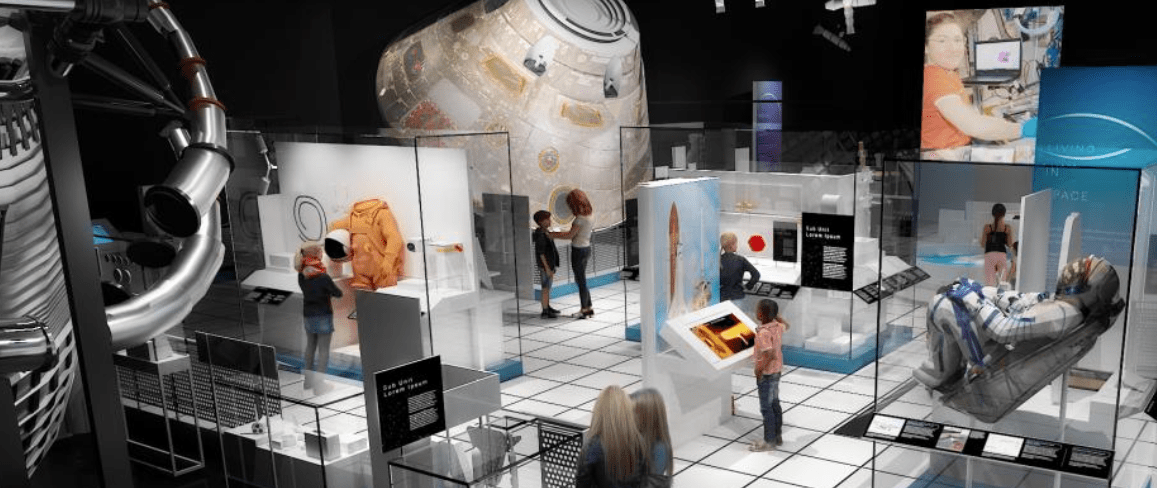
Image (Credit): Artist’s rendering of the planned At Home in Space exhibit. (National Air and Space Museum)

If you are planning your next vacation, keep the Smithsonian Museums in Washington, DC in mind, particularly the National Air and Space Museum. The updated museum has plenty of impressive exhibits to keep you and your family busy and informed. You can also travel to the Steven F. Udvar-Hazy Center in Chantilly, Virginia for even more great exhibits.

Here is a list some of the upcoming exhibits related to the space program:

  • Boeing Milestones of Flight Hall: The Boeing Milestones of Flight Hall will showcase some of the museum’s most iconic objects. With artifacts arrayed along walls and suspended from the ceiling—and interpretive displays that provide background and context—this central gallery of the National Mall building will invite visitors to explore the diverse and rich collections that make up the rest of the Museum’s exhibits, both in Washington, D.C., and at the Steven F. Udvar-Hazy Center in Chantilly, Virginia. Banners featuring important individuals in aviation and spaceflight, as well as a large media screen, will help bring these historic figures to life. (Opening in Spring 2024)

  • At Home in Space: An immersive, highly interactive exhibition, At Home in Space takes visitors along a 40+ year journey of learning how humans can live and work in space continuously and venture beyond Earth orbit. (Opening by 2026)

  • Futures in Space: The Futures in Space exhibition will explore the potential near- and long-term futures that may emerge with advances in space exploration technology and enterprise. The gallery will feature developing technologies that bring down the cost of space, aim to inaugurate the era of commercial and tourist spaceflight, expand robotic planetary exploration and resource extraction, and keep humans alive in new environments. Futures in Space will also explore the as-yet unanswered social, political, and economic questions that emerge along with these new activities: Who decides who goes to space? Why do we go? And what will we do when we get there? (Opening by 2026)

  • National Science Foundation Discovering Our Universe: Discover the history of modern astronomy and where the field is headed. Explore how we find answers in astronomy, how that process has changed over time, and how those answers tend to raise deeper questions. (Opening by 2026)

  • RTX Living in the Space Age Hall: The RTX Living in the Space Age Hall will provide insight into space technologies and infrastructure that are largely invisible to the public but have a profound impact on our daily lives. The exhibition will cover topics from the beginning of the Space Age in the mid-20th century to the present and beyond. Visitors can explore these stories through Space Age objects and the people who build, maintain, and use them. The content will include the development of rocket technology that has enabled access to space, missile development, space systems for Earth observation, communication, and navigation, and the threats to these systems. (Opening by 2026)