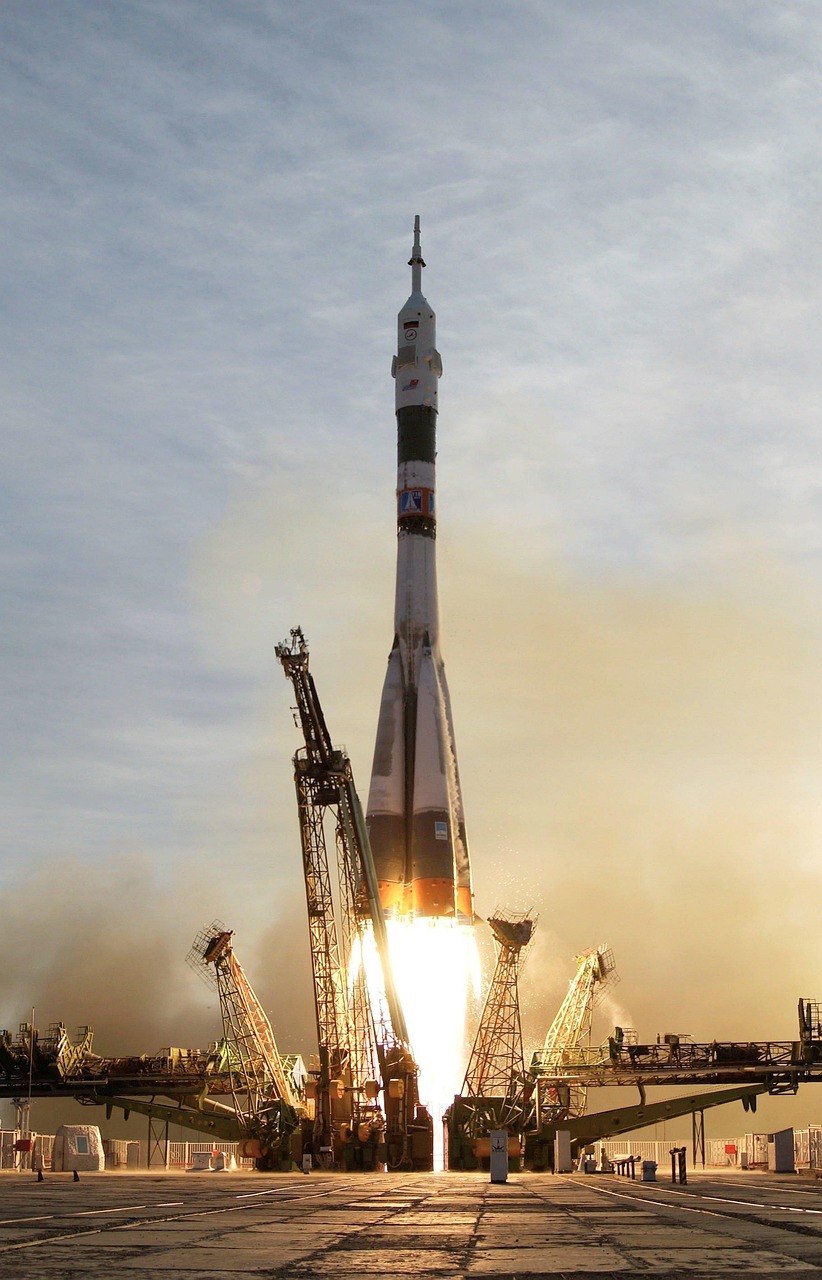
Pic of the Week: The New Glenn Rocket Booster Returns

Image (Credit): The New Glenn booster after it landed on a platform in the Atlantic Ocean. (Blue Origin)

Today’s image comes from Blue Origin, which successfully completed it second launch of it New Glenn rockets, sending two NASA Martian probes into orbit. The image shows the reusable rocket booster right after it landed on a platform in the Atlantic Ocean.

Acting NASA Administrator Sean Duffy stated:

Congratulations to Blue Origin, Rocket Lab, UC Berkeley, and all of our partners on the successful launch of ESCAPADE…This heliophysics mission will help reveal how Mars became a desert planet, and how solar eruptions affect the Martian surface. Every launch of New Glenn provides data that will be essential when we launch MK-1 through Artemis. All of this information will be critical to protect future NASA explorers and invaluable as we evaluate how to deliver on President Trump’s vision of planting the Stars and Stripes on Mars.

SpaceX now has another competitor for military and space missions, which is good for everyone (including SpaceX since it will keep them focused).

A Day in Astronomy: The Death of Percival Lowell

Image (Credit): Percival Lowell’s mausoleum just steps away from the Lowell Observatory in Flagstaff, AZ. (Atlas Obscura)

On this day in 1916, American astronomer Percival Lowell died at the age of 61 in Flagstaff, AZ. He will forever be remembered for his incorrect theory concerning canals on Mars as well as his better theory about a ninth planet, which contributed to the discovery of Pluto 14 years by Clyde Tombaugh, who was working at the Lowell Observatory in Flagstaff.

Some interesting facts about Mr. Lowell’s life includes:

  • After graduating from Harvard with a degree in mathematics yet spent six years running a cotton mill;
  • He traveled extensively to Asia and wrote numerous books about the region;
  • He was a dedicated pacifist; and
  • His greatest contribution to astronomy related to the preferred placement of observatories.

Mr. Lowell was far from the mark when he said this about Mars:

Speculation has been singularly fruitful as to what these markings on our next to nearest neighbor in space may mean. Each astronomer holds a different pet theory on the subject, and pooh-poohs those of all the others. Nevertheless, the most self-evident explanation from the markings themselves is probably the true one; namely, that in them we are looking upon the result of the work of some sort of intelligent beings. . . . The amazing blue network on Mars hints that one planet besides our own is actually inhabited now.

Yet it is too early to say he was also dreaming when he made this comment:

Now when we think that each of these stars is probably the centre of a solar system grander than our own, we cannot seriously take ourselves to be the only minds in it all.

Space Stories: Damaged Space Antenna, Dark Matter as Weighty Matter, and a Stable Ocean on Enceladus

Credit: Image by Clker-Free-Vector-Images from Pixabay

Here are some recent space-related stories of interest.

SpaceNews.com: Key Antenna in NASA’s Deep Space Network Damaged

One of the largest antennas in NASA’s Deep Space Network was damaged in September and may be out of service for an extended period, further straining the system. NASA’s Jet Propulsion Laboratory confirmed Nov. 10 that the 70-meter antenna at the Deep Space Network (DSN) site in Goldstone, California, has been offline since Sept. 16, with no timetable for its return to service.

University of Geneva: Dark Matter Does Not Defy Gravity, Study Suggests

Does dark matter follow the same laws as ordinary matter? The mystery of this invisible and hypothetical component of our universe—which neither emits nor reflects light—remains unsolved. A team involving members from the University of Geneva (UNIGE) set out to determine whether, on a cosmological scale, this matter behaves like ordinary matter or whether other forces come into play. Their findings, published in Nature Communications, suggest a similar behavior, while leaving open the possibility of an as-yet-unknown interaction. This breakthrough sheds a little more light on the properties of this elusive matter, which is five times more abundant than ordinary matter.

University of Oxford: Saturn’s Icy Moon May Host a Stable Ocean Fit for Life, New Study Finds

A new study led by researchers from Oxford University and Southwest Research Institute and the Planetary Science Institute in Tucson, Arizona has provided the first evidence of significant heat flow at Enceladus’ north pole, overturning previous assumptions that heat loss was confined to its active south pole. This finding confirms that the icy moon is emitting far more heat than would be expected if it were simply a passive body, strengthening the case that it could support life.

Bookshelf: The Giant Leap by Caleb Scharf

Credit: Basic Books

If you are looking for a new book to read, you might want to check out The Giant Leap by Caleb Scharf, who is director of astrobiology at Columbia University and the senior scientist for astrobiology at NASA’s Ames Research Center.

Here is a quick blurb from the publisher:

The story of life has always been one of great transitions, of crossing new frontiers. The dawn of life itself is one; so, too, is the first time two cells stuck together rather than drifting apart. And perhaps most dramatic were the moves from the sea to land, land to air. Each transition has witnessed wild storms of innovation, opportunity, and hazard. It might seem that there are no more realms for life to venture. But there is one: space.

In The Giant Leap, astrobiologist Caleb Scharf argues that our journey into space isn’t simply a giant leap for humankind—it’s life’s next great transition, an evolution of evolution itself. Humans and our technology are catalysts for an interplanetary transformation, marking a disruption in the story of life as fundamental as life’s movement from sea to land, and land to sky.

Inspired by Darwin’s account of his journey on the Beagle, and packed with stories from the past, present, and future of space travel, The Giant Leap thrills at both life’s creativity and the marvels of technology that have propelled us into the cosmos. And it offers an awesome glimpse of the grander vistas that wait in the great beyond.

Scientific American magazine interviewed the author to learn more about his views. One of the questions related to settling on Mars, which the author did not view as a best option for expanding outward into our Solar System:

We definitely need to study Mars and the moon, and maybe some of us should even try to live there. I mean, there’s all sorts of genuine reasons for doing that. But in the long term, it’s far better to engineer what you really need—to create environments that place fewer stressors on life that evolved on Earth over four billion years. Even if you build fabulous habitats on the moon or Mars, you’ll never have Earth-normal gravity in those places, for example.

Whether you make use of a natural object such as an asteroid or just construct an entirely artificial habitat out there, both would give you far more options than a planetary surface. You can spin your habitat to get Earth-like artificial gravity; you can engineer a lovely atmosphere that precisely fits our biological needs. You can set up seasons, choose where to orbit and have robust protection from cosmic radiation.

The interview covers a range of questions that delve into parts of the book. You may want to start with the interview before deciding to go further. It is a great launching point.

Space Quote: The New Galileo, or Just a Dreamer?

Credit: Mariner Books.

“This is an example from the modern world of what the Vatican did at the time of Galileo…People have their own prejudices. I don’t have any problem with that…The whole idea of doing science is to maintain an agnostic point of view, be curious, wonder over the possibilities…It’s what makes science exciting.”

-Statement by Israel-born Harvard astronomer Avi Loeb to The Times of Israel. He was referring to his submission of an academic paper about the 3I/ATLAS comet where the last sentence in the paper noted that the comet could be targeting our solar system. He was asked to remove this sentence if he wanted his paper to be published. Astronomer Loeb has made a number of controversial comments about this new comet as well as an earlier comet named ‘Oumuamua, which was the subject of his book Extraterrestrial:
The First Sign of Intelligent Life Beyond Earth
.