
Take a look at the image above. Can you determine where this image originated? Take a guess and then check your answer by going to the “Where is This? The Answer Sheet” page.

Take a look at the image above. Can you determine where this image originated? Take a guess and then check your answer by going to the “Where is This? The Answer Sheet” page.

“AARO found no evidence that any USG investigation, academic-sponsored research, or official review panel has confirmed that any sighting of a UAP represented extraterrestrial technology.“
-Conclusion of the Pentagon’s All-Domain Anomaly Resolution Office (AARO) February 2024 report, Report on the Historical Record of U.S. Government Involvement with Unidentified Anomalous Phenomena (UAP), covering claims of UAP dating from 1945 through October 2023. Some of the other conclusions in this report include:

With the recent glitches related to the two commercial Moon missions, an earlier NASA video on the Artemis program became all too relevant. In the video, “Farther and Faster: NASA’s Journey to the Moon with Artemis,” we hear that the stakes are high as we attempt to return to the Moon, and how we could be the generation that loses the Moon if we don’t get it right.
In addition to the risks, the video also highlights the great successes already with the Artemis I mission, as you may recall from back in 2022:
Over the course of 25.5 days, Orion performed two lunar flybys, coming within 80 miles (129 kilometers) of the lunar surface. At its farthest distance during the mission, Orion traveled nearly 270,000 miles (435,000 kilometers) from our home planet. On Dec. 11, 2022, NASA’s Orion spacecraft successfully completed a parachute-assisted splashdown in the Pacific Ocean at 9:40 a.m. PST (12:40 p.m. EST) as the final major milestone of the Artemis I mission.
Artemis I set new performance records, exceeded efficiency expectations, and established new safety baselines for humans in deep space. This is a prelude to what comes next—following the success of Artemis I, human beings will fly around the Moon on Artemis II.
It is worth pondering what we have ahead of us. NASA may be having a few issues with its commercial partners, but the main mission has done well. We cannot be discouraged with a few delays as long as we keep the course. We have done it before and there is no reason we cannot do it again. I say slow and steady.
Mars is the goal, but we need to prove ourselves with the Moon. Check out the video and determine for yourself if we have already made a fair amount of progress.
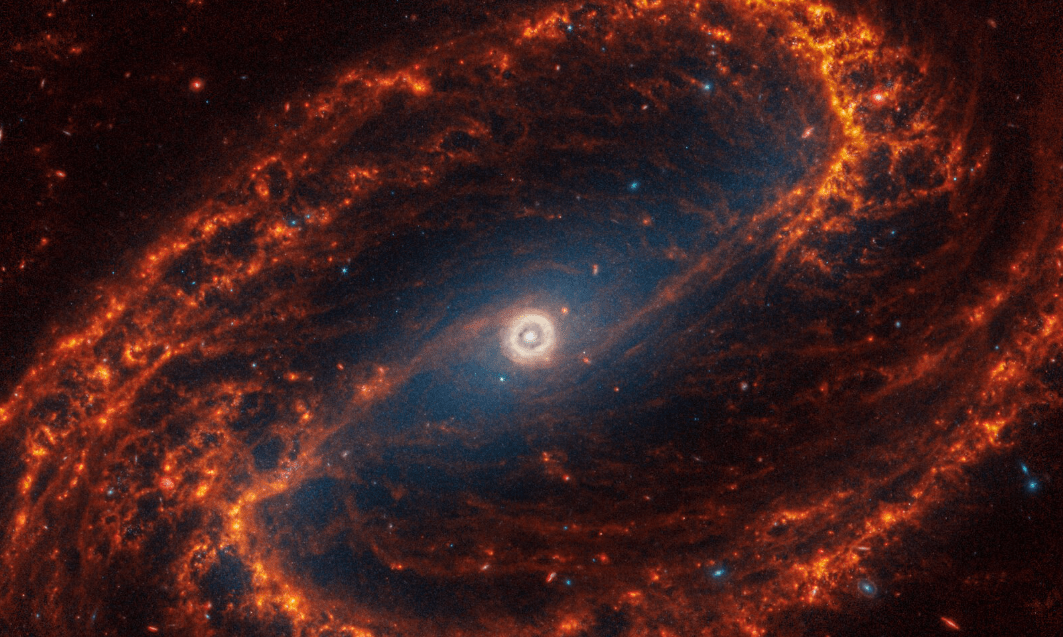
This week’s image is from the James Webb Space Telescope (JWST). It shows a face-on view of spiral galaxy NGC 1300, which is 69 million light-years away.
Here is more about the image from NASA:
Webb’s image of NGC 1300 shows a face-on barred spiral galaxy anchored by its central region, which is circular and shows a bright white point at the center with a light yellow circle around it. The central core is tiny compared to the rest of the galaxy. The core extends into the galaxy’s prominent diagonal bar structure, which is filled with a blue haze of stars. Orange dust filaments cross the bar, extending diagonally to the top and bottom, connecting the yellow circle in the central core to the galaxy’s spiral arms. There are two distinct orange spiral arms made of stars, gas, and dust that start at the edges of the bar and rotate counterclockwise. Together, the arm and bars form a backward S shape. The spiral arms are largely orange, ranging from dark to bright orange. Scattered across the packed scene are very few bright blue pinpoints of light. There are vast areas between where the orange spiral arms wrap that appear black. The top left and bottom right edges are dark black and there are some larger red and blue points of light, some that appear like disks seen from the side.
Here are some recent stories of interest.
—Tohoku University: “Biomolecules from Formaldehyde on Ancient Mars“
Organic materials discovered on Mars may have originated from atmospheric formaldehyde, according to new research, marking a step forward in our understanding of the possibility of past life on the Red Planet. Scientists from Tohoku University have investigated whether the early atmospheric conditions on Mars had the potential to foster the formation of biomolecules – organic compounds essential for biological processes. Their findings, published in Scientific Reports, offer intriguing insights into the plausibility of Mars harboring life in its distant past.
—University of Cambridge: “Astronomers Spot Oldest “Dead” Galaxy Yet Observed“
A galaxy that suddenly stopped forming new stars more than 13 billion years ago has been observed by astronomers. Using the James Webb Space Telescope, an international team of astronomers led by the University of Cambridge has spotted a ‘dead’ galaxy when the universe was just 700 million years old, the oldest such galaxy ever observed. This galaxy appears to have lived fast and died young: star formation happened quickly and stopped almost as quickly, which is unexpected for so early in the universe’s evolution. However, it is unclear whether this galaxy’s ‘quenched’ state is temporary or permanent, and what caused it to stop forming new stars.
—Webbtelescope.org: “Webb Unlocks Secrets of One of the Most Distant Galaxies Ever Seen“
Delivering on its promise to transform our understanding of the early universe, the James Webb Space Telescope is probing galaxies near the dawn of time. One of these is the exceptionally luminous galaxy GN-z11, which existed when the universe was just a tiny fraction of its current age. One of the youngest and most distant galaxies ever observed, it is also one of the most enigmatic. Why is it so bright? Webb appears to have found the answer. Scientists using Webb to study GN-z11 have also uncovered some tantalizing evidence for the existence of Population III stars nestled in the outskirts of this remote galaxy. These elusive stars — the first to bring light to the universe — are purely made of hydrogen and helium. No definitive detection of such stars has ever been made, but scientists know they must exist. Now, with Webb, their discovery seems closer than ever before.
 Our Awesome Universe