“This is an example from the modern world of what the Vatican did at the time of Galileo…People have their own prejudices. I don’t have any problem with that…The whole idea of doing science is to maintain an agnostic point of view, be curious, wonder over the possibilities…It’s what makes science exciting.”
-Statement by Israel-born Harvard astronomer Avi Loeb to The Times of Israel. He was referring to his submission of an academic paper about the 3I/ATLAS comet where the last sentence in the paper noted that the comet could be targeting our solar system. He was asked to remove this sentence if he wanted his paper to be published. Astronomer Loeb has made a number of controversial comments about this new comet as well as an earlier comet named ‘Oumuamua, which was the subject of his book Extraterrestrial: The First Sign of Intelligent Life Beyond Earth.
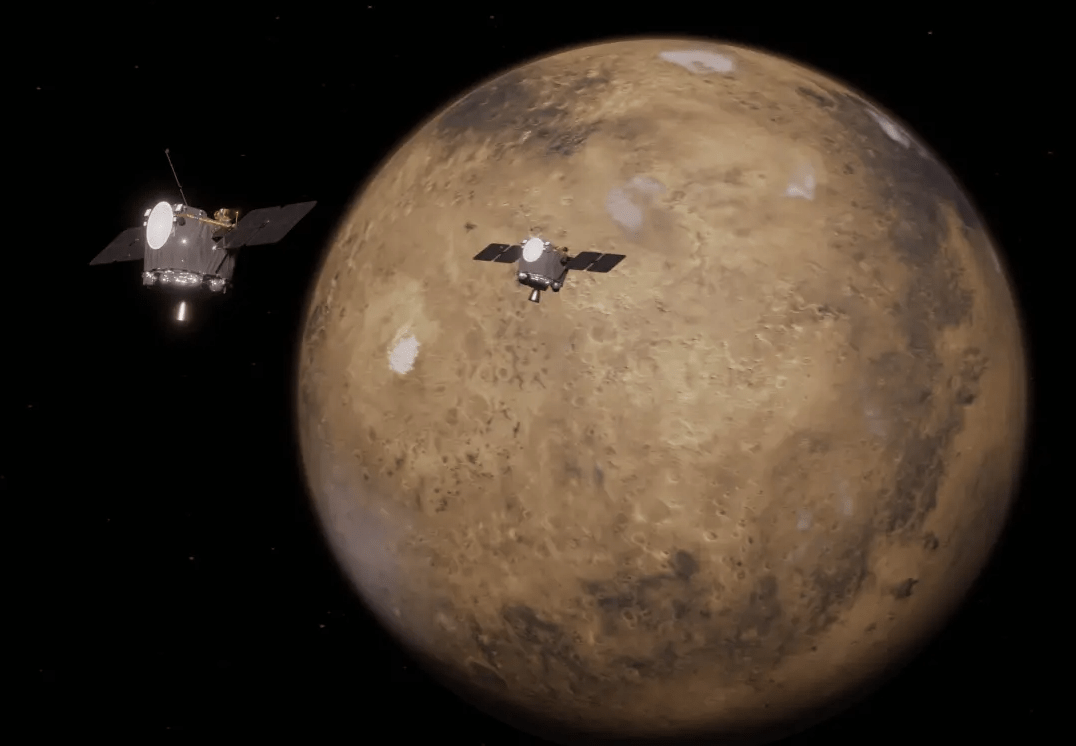
Image (Credit): Artist’s rending of the two EscaPADE probems approaching Mars. (NASA)
Blue Origin’s New Glenn rocket is scheduled to be launched tomorrow afternoon with two Martian probes on board. A lot is riding on tomorrow’s launch. The mission is important for Blue Origin, as it tests its new rocket with its first real mission. It is also important to NASA, which is using the probes to better understand the Martian atmosphere.
Blue Origin’s reusable New Glenn rocket will put it in direct competition with SpaceX for future NASA missions. This redundancy is needed, particularly with SpaceX seeming to struggle with its projects related to the Atemis lunar mission.
The $100 million Martian mission, called Escape and Plasma Acceleration and Dynamics Explorers (EscaPADE), involves a pair of identical spacecraft with a the goal of analyzing:
how Mars’ magnetic field guides particle flows around the planet,
how energy and momentum are transported from the solar wind through the magnetosphere, and
what processes control the flow of energy and matter into and out of the Martian atmosphere.
The two probes will be launched towards Lagrange Point 2, where they will sit for more than a year before making an approach towards Mars. The probes are expected to go into orbit around Mars in September 2027.
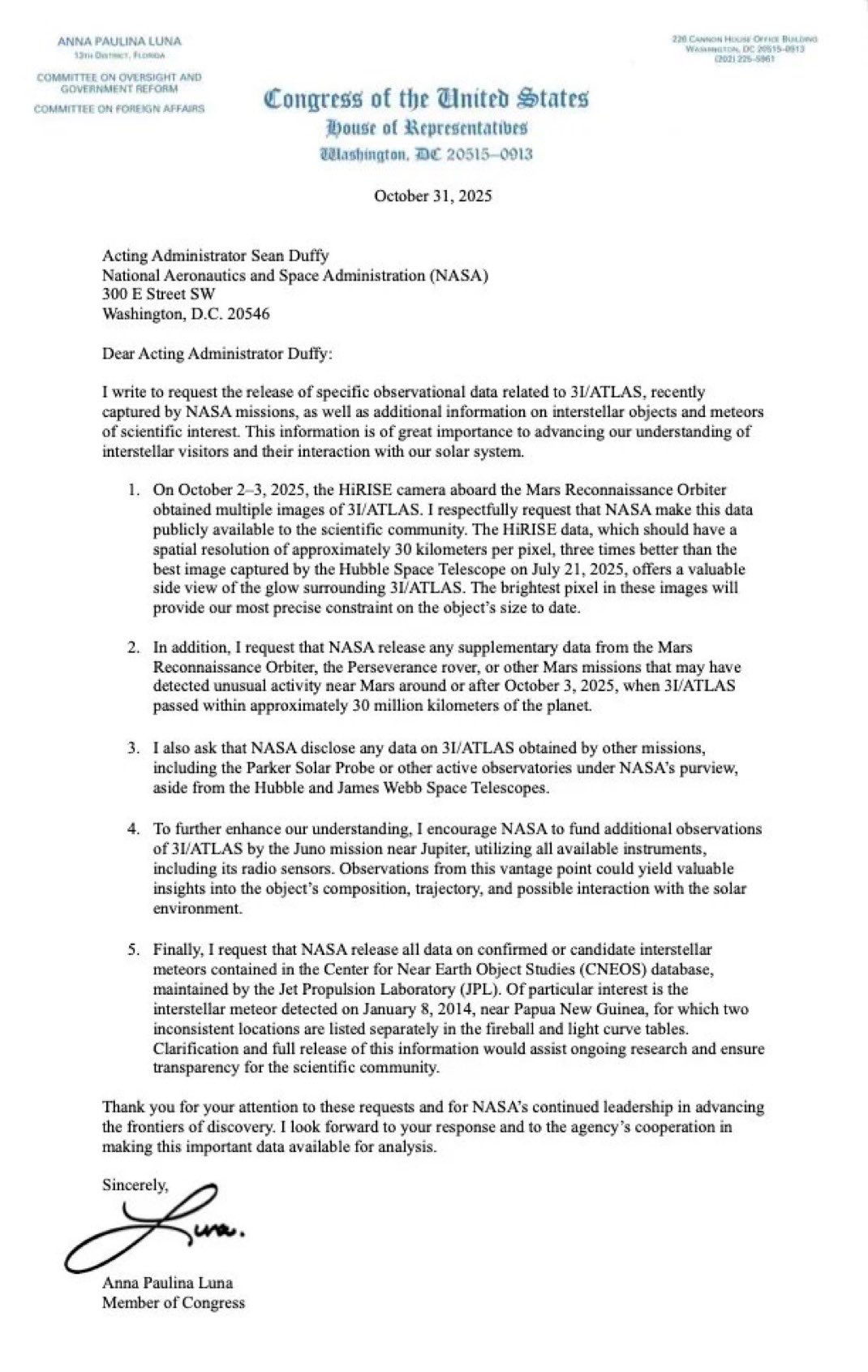
Congresswoman Anna Paulina Luna (R-FL) is very interested in obtaining some additional observational data from NASA regarding the interstellar comet known as 3I/ATLAS. In her letter to NASA (shown below), she said the information is “…of great importance to advancing our understanding of interstellar visitors and their interaction with our solar system.”
It appears this interest follows comments from Harvard scientist Avi Loeb about the object possibly being an alien spaceship.
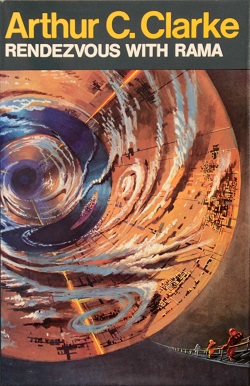
All of this is starting to sound the plot in Arthur C. Clark’s book Rendezvous with Rama.
Image (Credit): The Pismis 24 star cluster as captured by the JWST. (NASA, ESA, CSA, and STScI, A. Pagan (STScI))
This week’s amazingly vibrant image was captured by the James Webb Space Telescope (JWST). It shows a young star cluster, called Pismis 24, which is approximately 5,500 light-years away.
What appears to be a craggy, starlit mountaintop kissed by wispy clouds is actually a cosmic dust-scape being eaten away by the blistering winds and radiation of nearby, massive, infant stars.Home to a vibrant stellar nursery and one of the closest sites of massive star birth, Pismis 24 provides rare insight into large and massive stars. This region is one of the best places to explore the properties of hot young stars and how they evolve.
If you have questions about UFOs, now fashionable called Unidentified Anomalous Phenomena (UAP) to presumably add some seriousness and move it away from the kooky crowd, you might want to check out the upcoming film The Age of Disclosure. It will be available on November 21 on Amazon Prime as well as at select theaters.
Here is the trailer, which might entice you. It has the draw of many entertainment thrillers, and reminds me of the endless videos on YouTube and even Netflix describing secrets only a few know. It comes across as an updated version of the search for Bigfoot and the Arch of the Covenant rolled into one.
The film description states:
The Age of Disclosure is an unprecedented and revelatory film –featuring 34 senior members of the U.S. Government, military, and intelligence community– revealing a cover-up of the existence of non-human intelligent life and a secret war to reverse engineer technology of non-human origin.
The film exposes the profound impact the situation has on the future of humanity, while providing a look behind-the-scenes with those at the forefront of the bi-partisan disclosure effort.
An explosive documentary that reveals an 80-year global cover-up of non-human intelligent life and a secret war among major nations to reverse-engineer advanced technology of non-human origin. Featuring testimony from 34 U.S. Government, military, and intelligence community insiders, the film exposes the profound stakes for the future of humanity.
One of the officials in the trailer is Senator Marco Rubio, now Secretary of State Rubio. If there is any bit of truth to all of this, we should be asking for these UAP files instead of the Epstein files.
The films creator, Dan Farah, was on Real Time with Bill Maher last week discussing the film. You can find the podcast here. Mr. Farah discusses how these non-human actors live in the sea and seem to have appeared right around the time the nuclear age started. Of course, this is also after World War II when new forms of flight and related spying was underway, but why mess up the story.
Mr. Farah also seems surprised they are seen around our military facilities, as if this would not be a prime target for any outside party, human or otherwise. He then states:
…there’s been a few events where UAP activity over nuclear weapon sites has activated the missiles in some case and then turned them off in some cases. And it’s obviously a display of power of some sort. You know, your guess is as good as mine of what the intention is, but it’s concerning.
All of this sounds pretty amazing, yet I think it is more an amazing paste job of various quotes that are then repurposed to create a more dramatic story. For that reason, it may be better for the uninitiated, or just the regular newspaper readers who do not get their news from social media, to first go through the material from the very group set up to study all of this, the All-domain Anomaly Resolution Office, as well as various congressional hearings on this matter. Then you can make up your own mind.
Here are a few congressional hearings to get you started on your search:
We already have too many conspiracies upsetting the public and breeding mistrust of all government entities. Its time to breath and read up on this material yourself.
Science arouses a soaring sense of wonder. But so does pseudoscience. Sparse and poor popularizations of science abandon ecological niches that pseudoscience promptly fills. If it were widely understood that claims to knowledge require adequate evidence before they can be accepted, there would be no room for pseudoscience. But a kind of Gresham’s Law prevails in popular culture by which bad science drives out good.




 Our Awesome Universe