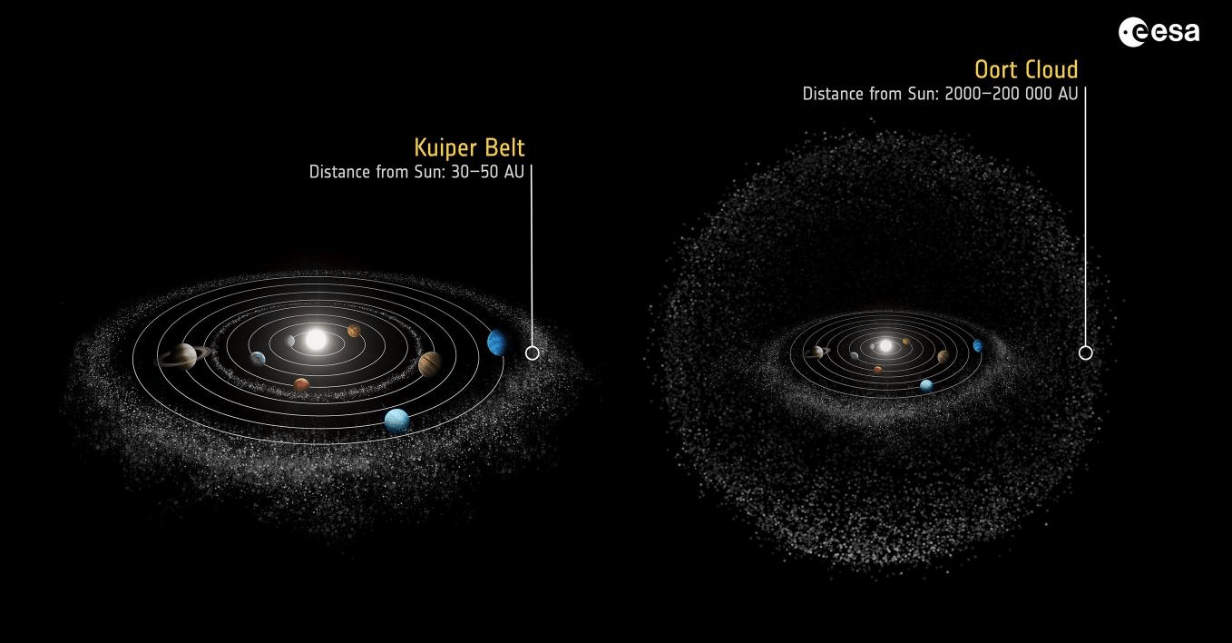
Image (Credit): Illustrations of the Kuiper Belt and the Oort Cloud. (European Space Agency)
“One explanation is the presence of an unseen planet, probably smaller than the Earth and probably bigger than Mercury, orbiting in the deep outer solar system…This paper is not a discovery of a planet, but it’s certainly the discovery of a puzzle for which a planet is a likely solution.”
-Statement by lead author Amir Siraj, an astrophysicist and a doctoral candidate in the department of astrophysical sciences at Princeton University, as quoted by CNN News. The presence of a new, distant planet attempts to address the tilted orbits of some distant objects in the Kuiper Belt. The issue is discussed in a recent paper by Siraj and his fellow authors titled Measuring the Mean Plane of the Distant Kuiper Belt and found in the journal Monthly Notices of the Royal Astronomical Society: Letters.
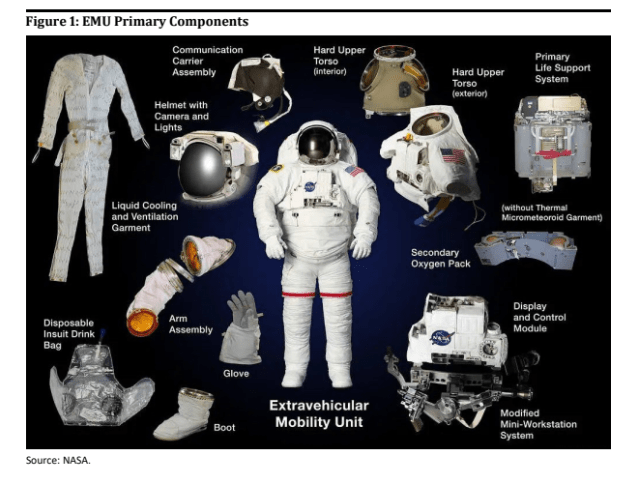
Image (Credit): Figure from the NASA OIG audit report, NASA’s Management of ISS Extravehicular Activity Spacesuits. (NASA OIG)
NASA has spent a significant amount of money on the Extravehicular Mobility Unit (EMU) spacesuits used during spacewalks on the International Space Station (ISS). Even so, these suits have ongoing problems that need to be resolved given that they will be critical to the ISS mission until the decommissioning of the station in 2030.
The NASA Office of Inspector General (OIG) has reported on issues with these spacesuits in the past and recently issued a new report on the status of the spacesuits. In its September 30th report, NASA’s Management of ISS Extravehicular Activity Spacesuit, the auditors noted that the contractor maintaining the spacesuits, Collins Aerospace, is having problems, including:
…considerable schedule delays, cost overruns, and quality issues that significantly increase the risk to maintaining NASA’s spacewalking capability.
The auditors stated that lack of competition for these spacesuit services as well as ineffective contract incentives are making the problems a permanent part of the program. While NASA has promoted competition for many years, these spacesuits designed 50 years ago have not benefited from this new approach, in part because the companies that feed into the supply line are slowly disappearing.
It seems dual-use rockets are much more in demand than antique spacesuits, potentially making spacesuits one of the weaker links in the space industry.
Note: Collins Aerospace ended a separate contract with NASA last year to develop a new ISS EMU. Collins continues with its contract to maintain the current EMU.
The processes driving the formation and distribution of lunar water (OH/H2O), particularly in the subsurface, remain poorly understood. An opportunity to study subsurface water comes from lander plumes, which can displace and expose millimetre- to centimetre-sized regolith during the descent of the lander. Here we analyse data from the Chang’e-6 landing site and find that plume-disturbed areas exhibit distinct temperature and water-content patterns, which are driven by the redistribution of fine regolith. The average water content of the exposed fine regolith of the shallow subsurface is ~76 ppm, which is lower than the surface abundance of ~105 ppm measured at the surface. The Chang’e-6 landing site also contains on average approximately twice the water content than the Chang’e-5 one. Temporal variations of water content are observed at identical locations but different local times, exhibiting a minimum at local noon. We suggest that the differences in water content are correlated with the regolith glass abundance, particle sizes, depths and local times, reinforcing the hypothesis that solar wind implantation and impact gardening govern lunar water formation and distribution.
Citation: Liu, B., Zeng, X., Xu, R. et al. Lunar surface and subsurface water revealed by Chang’e-6. Nat Astron (2025).
Image (Credit): Sagittarius B2 as captured by the JWST. (NASA, ESA, CSA, STScI, Adam Ginsburg (University of Florida), Nazar Budaiev (University of Florida), Taehwa Yoo (University of Florida); Image Processing: Alyssa Pagan (STScI))
This week’s busy image from the James Webb Space Telescope (JWST) shows the Sagittarius B2 molecular cloud, which is about 26,000 light-years away.
Stars, gas and cosmic dust in the Sagittarius B2 molecular cloud glow in near-infrared light, captured by Webb’s NIRCam (Near-Infrared Camera). In this light, astronomers see more of the region’s diverse, colorful stars, but less of its gas and dust structure. Webb’s instruments each provide astronomers with important information that help build a more complete picture of what is happening in this intriguing portion of the center of our galaxy.
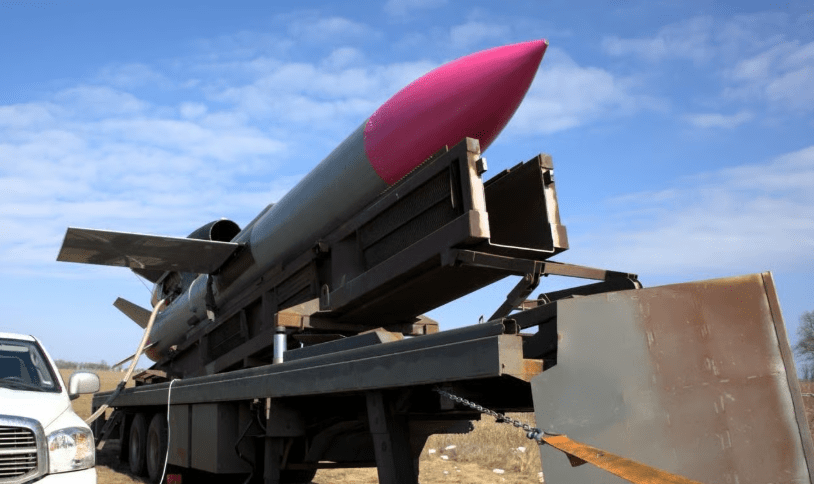
Image (Credit): The Ukrainian Flamingo cruise missile. (Fire Point)
It is a sad truth that war can create some useful items that propel mankind forward. Maybe these inventions would have occurred anyway, but the desire to survive can certainly stimulate the mind.
Ukraine is a perfect example. Recent stories about its Flamingo cruise missile indicate that the same Ukranian know-how that created the drones was also used to design a cruise missile that costs $500,000 a piece and can penetrate deep into Russian territory. Such quick innovation by Fire Point, the Ukrainian defense firm that created the new cruise missile, puts even Elon Musk to shame (remember, Musk tried to start SpaceX with old Russian rockets).
Just think if all of this ingenuity had been put towards a peaceful space program. Of course, this war too shall end, and Ukraine may have some promising industries that can be quickly retooled for a space program.
Ukraine had a strong space industry when it was part of the USSR, and these latest foolhardy efforts by Putin to reestablish that Soviet empire may instead only reestablish the Ukranian space industry.



 Our Awesome Universe