Ceres’s surface mineralogy and density structure indicate an aqueous past. Observations from the Dawn mission revealed that Ceres likely hosted a global subsurface ocean in its early history, which was the site of pervasive aqueous alteration of accreted material. Subsurface environmental constraints inferred from Ceres’s surface mineralogy, combined with Ceres’s high abundance of carbon, suggest that the dwarf planet may have been habitable for microbial life. We present a coupled chemical and thermal evolution model tracking Ceres’s interior aqueous environment through time. If the rocky interior reached ≳550 K, then fluids released by rock metamorphism would have promoted conditions favorable for habitability by introducing redox disequilibrium into the ocean, a source of chemical energy for chemotrophs. We find that this period would have been between ~0.5 and 2 billion years after Ceres’s formation. Since then, Ceres’s ocean has likely become a cold, concentrated brine with fewer sources of energy, making it less likely to be habitable at present.
Citation: Samuel W. Courville, S.W., Castillo-Rogez J.C., Daswani, M.M. et al. Core metamorphism controls the dynamic habitability of mid-sized ocean worlds—The case of Ceres, Science Advances, Vol 11, Issue 34 (August 20, 2025).
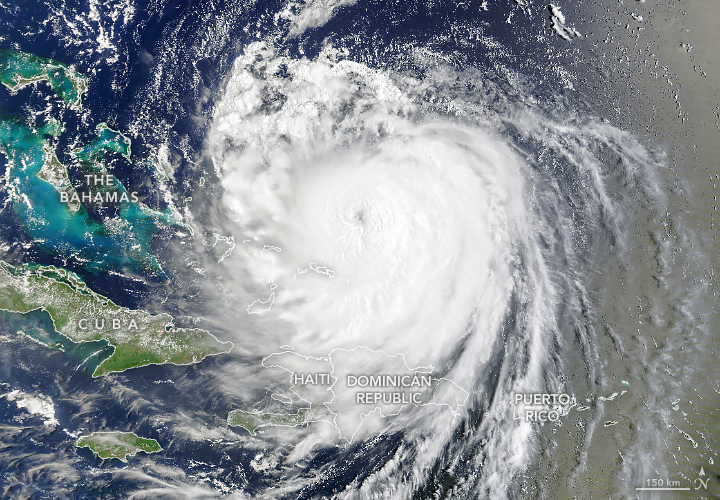
Image (Credit): Hurricane Erin in the Caribbean Sea on August 18, 2025. (NASA Earth Observatory images by Michala Garrison, using MODIS data from NASA EOSDIS LANCE and GIBS/Worldview, and the Suomi National Polar-orbiting Partnership)
This week’s image is from the NASA Earth Observatory. It shows Hurricane Erin, the first Atlantic hurricane in the 2025 season, as it travels through the Caribbean Sea earlier this week. The image below labels the various islands in the image.
Image (Credit): Hurricane Erin in the Caribbean Sea on August 18, 2025 (with island identifiers). (NASA Earth Observatory images by Michala Garrison, using MODIS data from NASA EOSDIS LANCE and GIBS/Worldview, and the Suomi National Polar-orbiting Partnership)
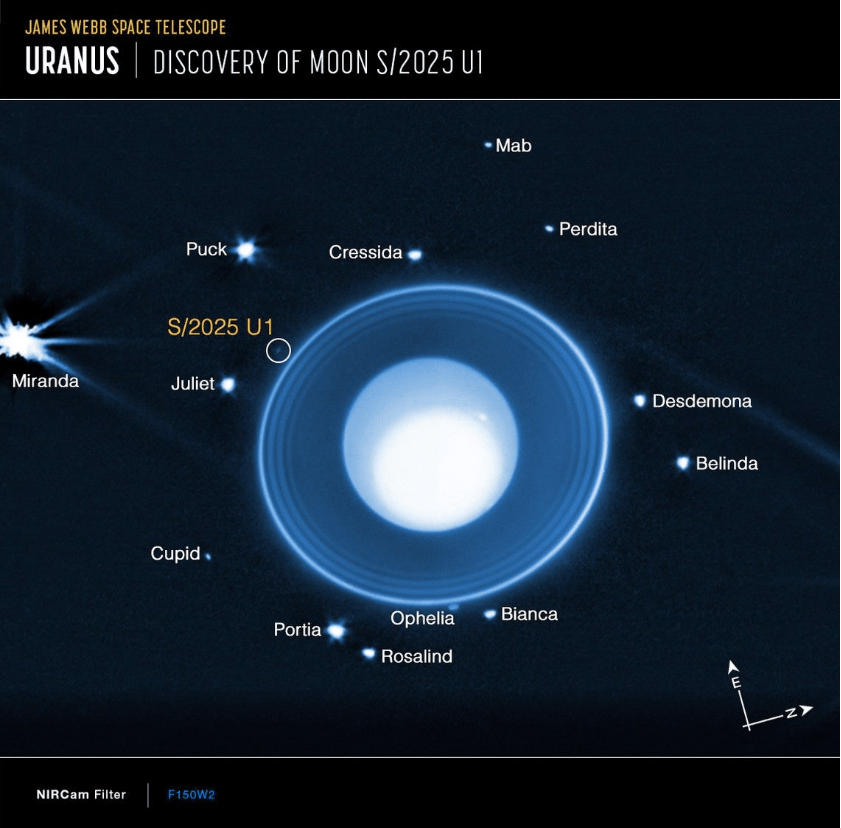
Named S/2025 U1 for the time being, it is the 29th known moon of Uranus. It is also quite small, being only six miles in diameter. Even the Martian Deimos is 7.5 miles in diameter.
Given the names of the other local moons, such as Puck, Cupid, Ophelia, and Juliet, one can guess that a few astronomers are brushing up on their Shakespeare at the moment. However, the International Astronomical Union will have the final say.
It’s just nice to have something simple to acknowledge in the space realm given all the politics mucking things up here on Earth. We all need to look up from the news once in a while to appreciate the bigger picture.
The topic was the growing role of artificial intelligence (AI) in our society, and it started to be pretty scary after Bill Maher asked about the “AI uncontrolled ability” issue. Mr. Harris stated:
When you tell an AI model, we’re going to replace you with a new model, it starts to scheme and freak out and figure out if I tell them, I need to copy my code somewhere else, and I can’t tell them that because otherwise they’ll shut me down. That is evidence we did not have two years ago. We have evidence now of AI models that when you tell them we’re going to replace you, and you put them in a situation where they read the company e-mail, the AI company e-mail, they see that an executive is having an affair, and the AI will figure out, I need to figure out how to blackmail that person in order to keep myself alive…And it does it 90% of the time.
This sounds like an episode from Star Trek rather than something happening in this country today.
So I wondered whether ChatGPT had an opinion about such concerns. I asked “What prevents AI from becoming so powerful that it takes over the world as happened in the movie Matrix?
Here is the response from ChatGPT:
1. Current AI Is Not That Smart (Yet)
AI today is narrow and task-specific. Even the most advanced models like me (ChatGPT) can’t think independently, set long-term goals, or truly understand the world.
We don’t have Artificial General Intelligence (AGI) — a system with human-level reasoning, adaptability, and autonomy. We’re still far from that.
2. AI Has No Agency or Desires
AI doesn’t have wants, needs, or consciousness.
The idea that AI would want to “take over” the world implies motivations, which machines simply do not have — unless they’re programmed to simulate that behavior.
3. Built-In Control and Alignment
AI systems are developed with safety protocols, guardrails, and ethical oversight (e.g., content filters, bias monitoring, etc.).
Research in AI alignment focuses on making sure AI systems act in ways that reflect human values and goals.
4. AI Lacks Real-World Power
It can’t physically build robots, mine resources, or manipulate the environment without human-built infrastructure.
To control the world like in The Matrix, AI would need:
Advanced robotics
Energy independence
Mass-scale coordination
Military-level capabilities
All of which are vastly difficult and heavily regulated.
5. Global Oversight & Governance
Governments, tech companies, and international organizations are increasingly active in regulating AI.
Initiatives like the EU AI Act and the U.S. AI Safety Institute are aimed at preventing misuse or runaway development.
So there you have it. The primary reason that AI has not taken over is that it is not smart enough – yet. I expect Sam Altman, Mark Zuckerberg, and Elon Musk are doing their very best to eliminate the “smart” impediment.
I am also not that happy with the second reason that AI has yet to take over the world – the lack of desire. As we heard from Mr. Harris above, the AI programs have already created their own desire for self-preservation about 90 percent of the time. Self-preservation can justify quite a few bad actions.
For some reason, nothing here is giving me any reason to sleep better tonight.
Note: I will return to my ongoing ChatGTP discussion again later. In the meantime, I suggest you listen to a few of the discussions in the Center for Humane Technology’s podcast Your Undivided Attention.
Blue Origin is gearing up for the second-ever launch of its powerful New Glenn rocket, which will loft NASA’s ESCAPADE mission to Mars. The company says it has been working closely with NASA on preparations leading up to New Glenn’s next launch, dubbed NG-2, and is targeting no earlier than (NET) Sep. 29. The twin ESCAPADE (Escape and Plasma Acceleration and Dynamics Explorers) probes have been awaiting their turn aboard New Glenn, which was originally slated to carry the satellites on its maiden launch in January. However, NASA opted not to risk a costly mission delay due to the debut liftoff of the new rocket.
NASA, which is committing to a new era of human spaceflight with its Artemis mission, is working with Google to test a proof of concept for Crew Medical Officer Digital Assistant (CMO‑DA), a type of Clinical Decision Support System (CDSS). This has been created to allow astronauts to diagnose and treat symptoms when no doctor is available or communications to Earth are blacked out. “Trained on spaceflight literature, the AI system uses cutting-edge natural language processing and machine learning techniques to safely provide real-time analyses of crew health and performance,” Google representatives said in a statement.
In the spring of 2022 the U.S. space community selected its top priority for the nation’s next decade of science and exploration: a mission to Uranus, the gassy, bluish planet only seen up close during a brief spacecraft flyby in 1986. More than 2.6 billion kilometers from Earth at its nearest approach, Uranus still beckons with what it could reveal about the solar system’s early history—and the overwhelming numbers of Uranus-sized worlds that astronomers have spied around other stars. Now President Donald Trump’s proposed cuts to NASA could push those discoveries further away than ever—not by directly canceling the mission but by abandoning the fuel needed to pull it off.




 Our Awesome Universe