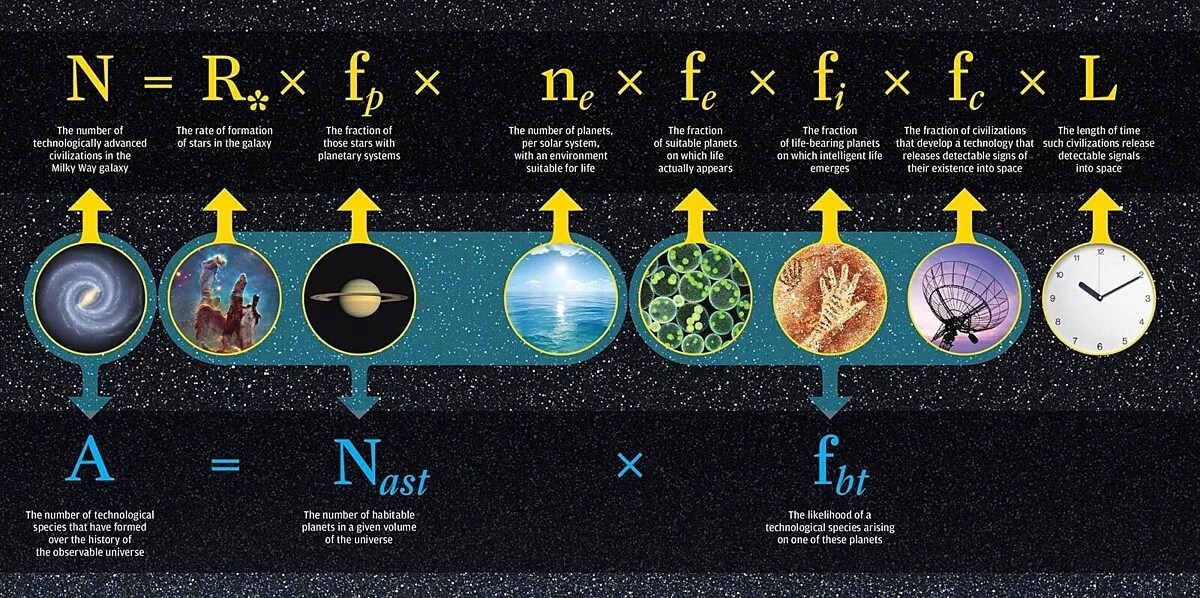
Image (Credit): Illustration of the Drake Equation. (University of Rochester)
“My inner eight-year-old, my inner Star Trek nerd, started putting this together that we should use the data that we have and try to figure out how to pull the knowledge from 60 years of radio astronomy and apply it into this optical, visible-light astronomy. My hope in pushing this from the radio into the visible light, into the infrared, and other domains of astronomy that are so active is that we can actually push this from a hot tub to maybe an Olympic swimming pool.”
-Comment by James Davenport, an astronomer from the University of Washington, discussing the ongoing search for intelligent life (SETI) with Regina Barber, host of NPR’s Short Wave podcast. They were discussing how the SETI efforts to date equate to searching a hot-tub worth of water compared to the entire ocean. You can hear more in the episode titled “The Serious Hunt for Alien Life.”
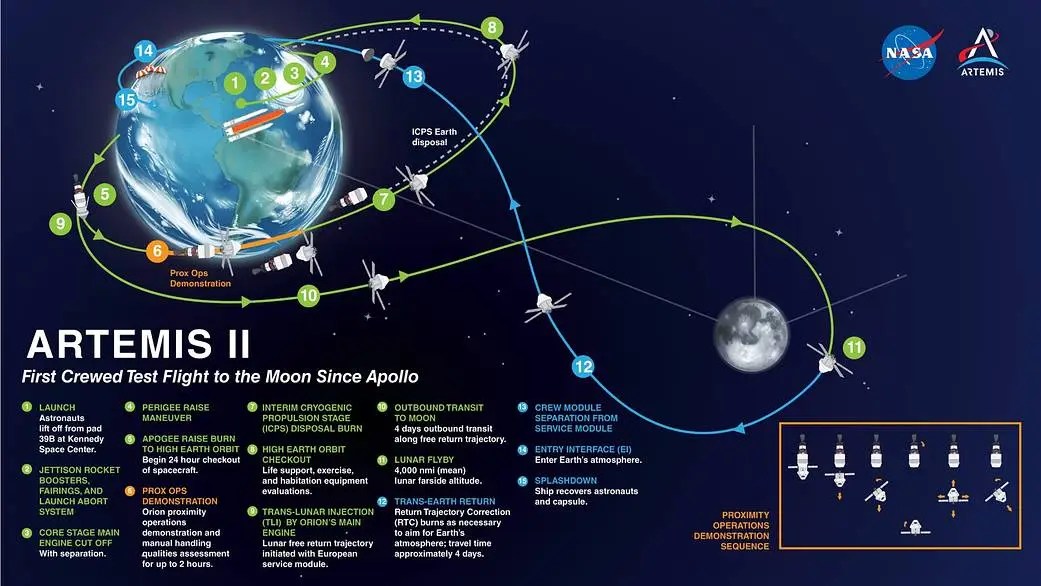
Just one day after NASA said it was eyeing a potential March 6 launch date for the Artemis II lunar mission, the space agency said Saturday that complications with the rocket could delay all launch attempts in March from the Kennedy Space Center in Florida...In a blog post, NASA said it is “taking steps to potentially roll back the Artemis II rocket and Orion spacecraft to the Vehicle Assembly Building,” after technicians observed an “interrupted flow of helium” to the rocket system. NASA says its teams are “actively reviewing data” and taking steps to “address the issue as soon as possible while engineers determine the best path forward.”
On Thursday, NASA released sobering results from an independent investigation into the 2024 crewed Boeing Starliner test flight that left two astronauts stranded in space for months, placing blame not only on hardware failures, but the agency’s own leadership and culture. In a press conference, NASA Administrator Jared Isaacman said the agency had now categorized the incident as a type A mishap — the same classification applied to the Columbia and Challenger shuttle disasters — something he believes should have happened from the start.
For the first time, an international team of astronomers have mapped the vertical structure of Uranus’s upper atmosphere, uncovering how temperature and charged particles vary with height across the planet. Using NASA/ESA/CSA James Webb Space Telescope’s NIRSpec instrument, the team observed Uranus for nearly a full rotation, detecting the faint glow from molecules high above the clouds. The results offer a new window into how ice-giant planets distribute energy in their upper layers.
The latest Harper’s Index from Harper’s magazine had a few interesting statistics related to space travel and alien encounters (something discussed in Friday’s post).
Here are the two stastistics:
Portion of Americans in 1998 who believed that space travel would be common for ordinary Americans by 2025: 3/10
Portion of Americans in 1998 who believed that humans would make contact with extraterrestrial life by 2025: 1/4
Both come from a Gallup poll conducted back in 1998. You can read more about the various survey results in this Gallup story.
Given that the Artemis II mission is still struggling to get to the Moon, and the only new life we seem to have encountered was created in a laboratory by OpenAI and others, I would say we are far from this mark. However, Americans were a little better at predicting some of the social trends, including the 69 percent who expected the country would elect a Black president by 2025.
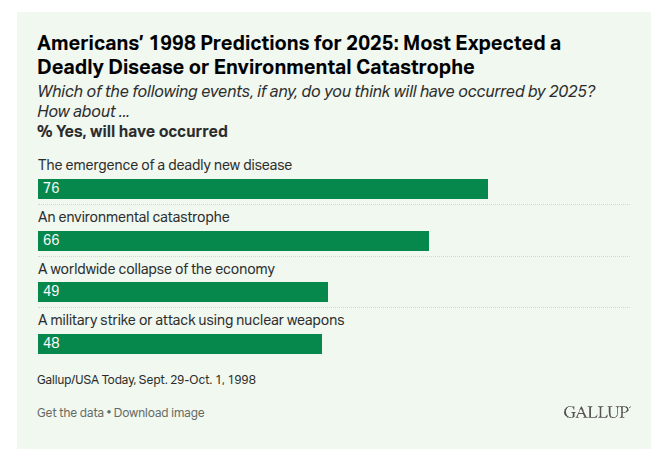
It is also good that some of the predictions were off, particularly those related to disease, disaster, and war (shown below). Then again, the respondents (76 percent) who predicted the emergence of a deadly new disease were spot on regarding COVID.
Close-in transiting sub-Neptunes are abundant in our Galaxy. Planetary interior models based on their observed radius–mass relationship suggest that sub-Neptunes contain a discernible amount of either hydrogen (dry planets) or water (wet planets) blanketing a core composed of rocks and metal. Water-rich sub-Neptunes have been believed to form farther from the star and then migrate inwards to their present orbits. Here we report experimental evidence of reactions between warm, dense hydrogen fluid and silicate melt that release silicon from the magma to form alloys and hydrides at high pressures. We found that oxygen liberated from the silicate melt reacts with hydrogen, producing an appreciable amount of water up to a few tens of weight per cent, which is much greater than previously predicted based on low-pressure ideal gas extrapolation. Consequently, these reactions can generate a spectrum of water contents in hydrogen-rich planets, with the potential to reach water-rich compositions for some sub-Neptunes, implying an evolutionary relationship between hydrogen-rich and water-rich planets. Therefore, detection of a large amount of water in exoplanet atmospheres may not be the optimal evidence for planet migration in the protoplanetary disk, calling into question the assumed link between composition and planet formation location.
Citation: Horn, H.W., Vazan, A., Chariton, S. et al. Building wet planets through high-pressure magma–hydrogen reactions. Nature646, 1069–1074 (2025).
Not to be outdone by former president Obama, who let it slip that he believes in UFOs, President Trump is now promising to release all of those hidden UFO files. Of course, this is likely just another distraction from the Epstein files, which are currently causing the defenestration of top political and corporate officials.
Someone may want to tell the president that the federal government is already releasing this type of UFO, or should I say Unidentified Anomalous Phenomena (UAP), information for years. The office doing this work is called the All-domain Anomaly Resolution Office.
If this UFO release is anything like the release of the Epstein files, it will involve years of false promises, followed by a horrendous battle with Congress over the actual release of this information to the public, and finally the slow dribble of incomplete files that only further enrage the public.
This should be a mess, just like everything in Washington these days.