NASA may face problems getting Martian rocks back to Earth, but the rocks that already made it this far are being sold to the highest bidder.
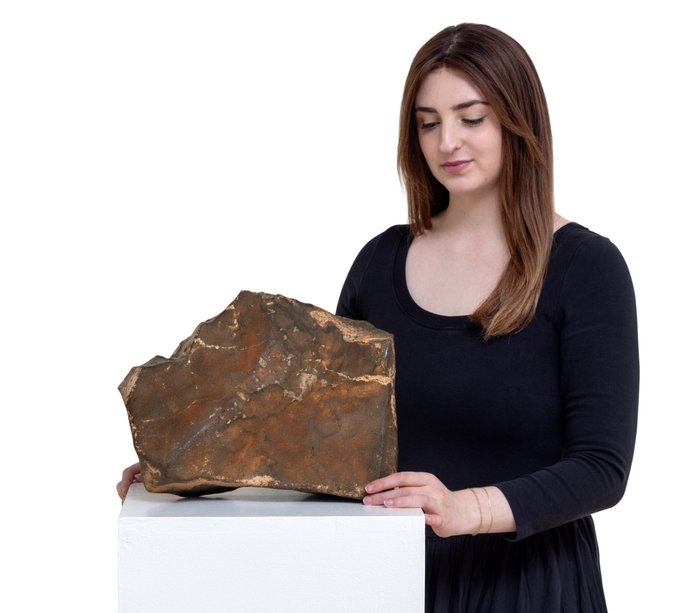
Earlier this week a rock from Mars sold for $5.3 million at a Sotheby’s New York auction. Officially named NWA 16788, the meteorite weighs 54 pounds.Located in the Sahara Desert in 2023, it is believed to have traveled to Earth after being blasted off the Martian surface by an incoming asteroid.
So who bought it? That information has not been shared, but if Elon Musk bought it I would consider that cheating. He needs to get to Mars on his own and fulfill his destiny (while giving the rest of us a break).
Image (Credit): View of the Sun’s solar winds as captured by the Parker Solar Probe’s WISPR instrument during its record-breaking flyby of the sun on December 25, 2024. (NASA/Johns Hopkins APL/Naval Research Lab)
This week’s image is from the Wide-Field Imager for Solar Probe (WISPR) aboard NASA’s Parker Solar Probe, which was launched in 2018 to observe the Sun. It shows the solar winds in the Sun’s outer atmosphere, or corona. The probe was about 3.8 million miles away from the Sun’s surface.
The new WISPR images reveal the corona and solar wind, a constant stream of electrically charged particles from the Sun that rage across the solar system. The solar wind expands throughout of the solar system with wide-ranging effects. Together with outbursts of material and magnetic currents from the Sun, it helps generate auroras, strip planetary atmospheres, and induce electric currents that can overwhelm power grids and affect communications at Earth. Understanding the impact of solar wind starts with understanding its origins at the Sun.
The WISPR images give scientists a closer look at what happens to the solar wind shortly after it is released from the corona. The images show the important boundary where the Sun’s magnetic field direction switches from northward to southward, called the heliospheric current sheet. It also captures the collision of multiple coronal mass ejections, or CMEs — large outbursts of charged particles that are a key driver of space weather — for the first time in high resolution.
Check out this helpful video from NASA describing the mission of the Parker Solar Probe.
“They simply don’t want the public to see the meticulously assembled and scientifically validated information about what climate change is already doing to our farms, forests, and fisheries, as well as to storms, floods, wildfires, and coast property — and about how all those damages will grow in the absence of concerted remedial action.”
–Statement by climate scientist Katharine Hayhoe, chief scientist at The Nature Conservancy, regarding NASA’s removal of national climate assessments from its website. Of course, the daily news about floods and fires will continue to keep us aware of ongoing terra-forming here on planet Earth. You can also find information about the last National Climate Assessment at this USDA site, for now at least.
Image (Credit): Shan Shan (left) and Xiao Bao. (South China Morning Post)
On this day in 1966, China launched a male puppy named Xiao Bao (meaning Little Leopard) into space. He was used to test the effects of space and was safely recovered after the flight.
Thirteen days later a female puppy named Shan Shan (meaning Coral) was also launched into space. She too was safely recovered.
This is a much better tale than that of Laika, the dog that the USSR sent into orbit in 1957. As stray dog from the streets of Moscow, she only lasted a few hours after the launch, eventually dying of hyperthermia.
Image (Credit): Laika in a training capsule before her mission to space. (Sputnik / Alamy)
In response to recent flooding near Kerrville, Texas, NASA deployed two aircraft to assist state and local authorities in ongoing recovery operations. The aircraft are part of the response from NASA’s Disasters Response Coordination System, which is activated to support emergency response for the flooding and is working closely with the Texas Division of Emergency Management, the Federal Emergency Management Agency (FEMA), and the humanitarian groups Save the Children and GiveDirectly.
Two remote-controlled Chinese satellites appear to have docked in high orbit to allow refueling and servicing for the first time. The achievement, which has yet to be matched by the U.S, involved autonomous spacecraft Shijian-21 and Shijian-25, completing the task in geostationary orbit earlier this month. Geostationary orbits occur at 22,236 miles above the surface, and are typically used for communications satellites so that they can move with the rotation of the Earth. However, the high orbit and need for satellites to maintain speeds with the Earth’s rotation makes docking extremely difficult.
The answer to whether tiny bacterial lifeforms really do exist in the clouds of Venus could be revealed once-and-for-all by a UK-backed mission. Over the past five years researchers have detected the presence of two potential biomarkers – the gases phosphine and ammonia – which on Earth can only be produced by biological activity and industrial processes. Their existence in the Venusian clouds cannot easily be explained by known atmospheric or geological phenomena, so Cardiff University’s Professor Jane Greaves and her team are plotting a way to get to the bottom of it. Revealing a new mission concept at the Royal Astronomical Society’s National Astronomy Meeting 2025 in Durham, they plan to search and map phosphine, ammonia, and other gases rich in hydrogen that shouldn’t be on Venus.



 Our Awesome Universe