Even if you cannot attend the protest on Monday, the site notes:
If you would rather not join this protest then there are still ways you can help. Please absolutely flood your representatives in Congress with pleas to save NASA. When you do, drive home the point that the cuts are happening now! Most of Congress seems to think that they will save NASA if they work out a budget for the coming fiscal year that funds NASA at previous levels. They don’t realize that NASA’s acting administrator, under pressure from the White House, OMB, and DOGE, are enacting “realignments” and cuts now. So please please please tell Congress that every day our nation is losing dedicated and brilliant career civil servants, contractors, and programs, that NASA is being fed into the woodchipper now. Congress must act immediately to save NASA, not wait for October 1!
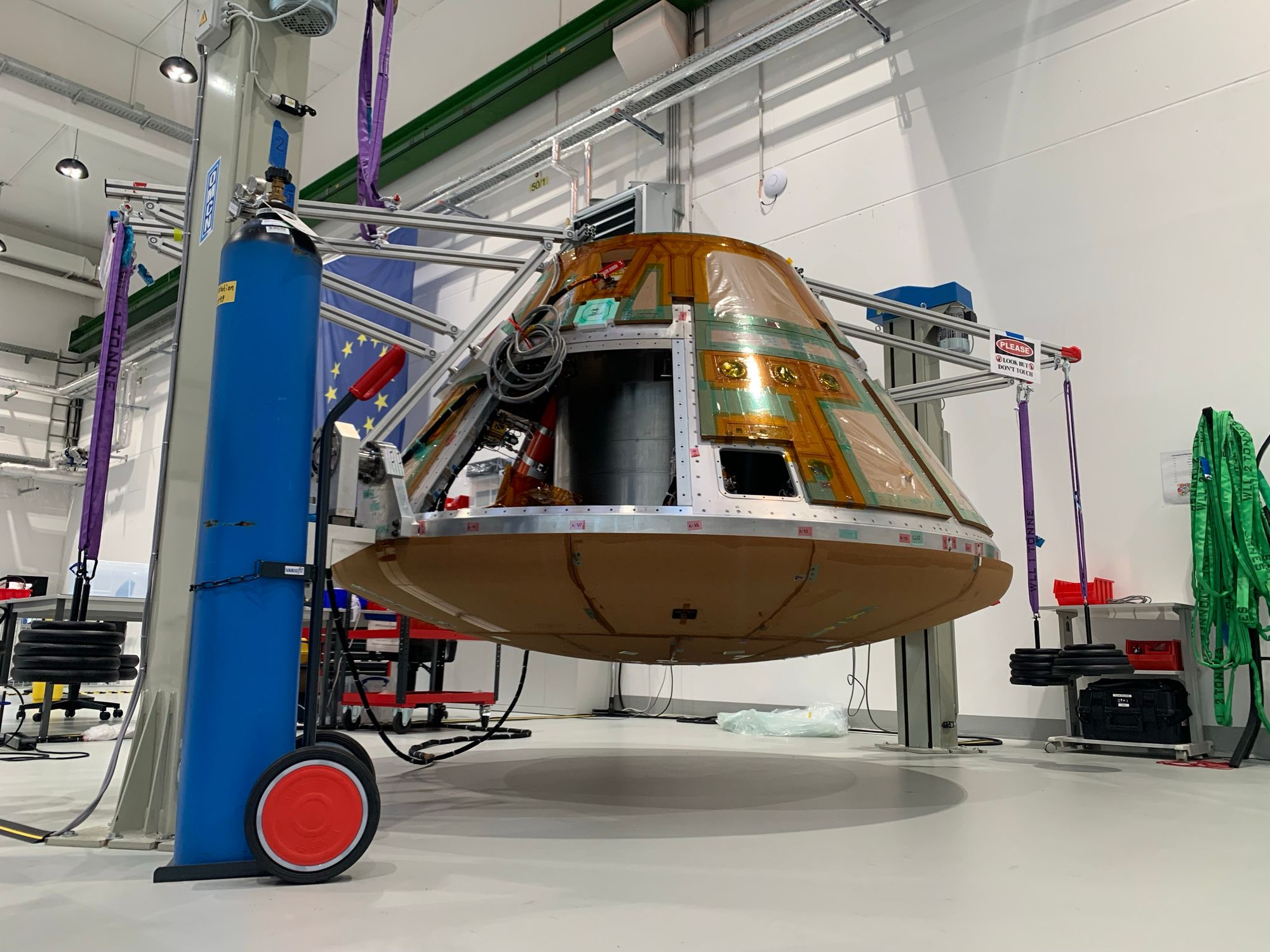
Image (Credit): The Mission Possible vehicle during construction. (The Exploration Company)
A new European space company came close to success with its space capsule early this week until it had problems with reentry. The Exploration Company, discussing its Mission Possible vehicle, had this to say:
The capsule was launched successfully, powered the payloads nominally in-orbit, stabilized itself after separation with the launcher, reentered and reestablished communication after black out…We are still investigating the root causes and will share more information soon. We apologize to all our clients who entrusted us with their payloads.
The Mission Possible capsule was expected to complete the following tasks:
Phase 1: Separation from the Launcher
Phase 2: Stabilizing the Capsule and Putting its Heatshield Forward
Phase 3: Atmospheric Re-entry
Phase 4: Parachute Deployment and Descent
Phase 5: Splashdown and Recovery
The problem appears to be related to the parachute deployment in Phase 4.
Launched into space aboard a SpaceX Falcon 9 rocket, the European company was preparing the way for its planned Nyx capsule. With the Nyx capsule, the company hopes to carve out a place for itself in the space cargo business – first in low-Earth orbit and later between the Earth and the Moon.
In an earlier press release, the company outlined its European roots:
Germany, Munich:Core of spacecraft avionics, power systems, and flight software. Also, a leader in additive manufacturing. France, Bordeaux: Specializing in propulsion systems, reentry phase, thermal engineering, system engineering, and mission safety, also hosts the main control center. Italy, Turin: Home to the babckup control center, docking and other complex mechanisms, life support system and high-thrust engine turbomachinery. Luxembourg, opening in 2025: Dedicated to cryogenic refuelling, a critical development for deep-space missions.
This bold European company’s partial success should pave the way for more attempts and contribute to a greater European presence in the space industry.
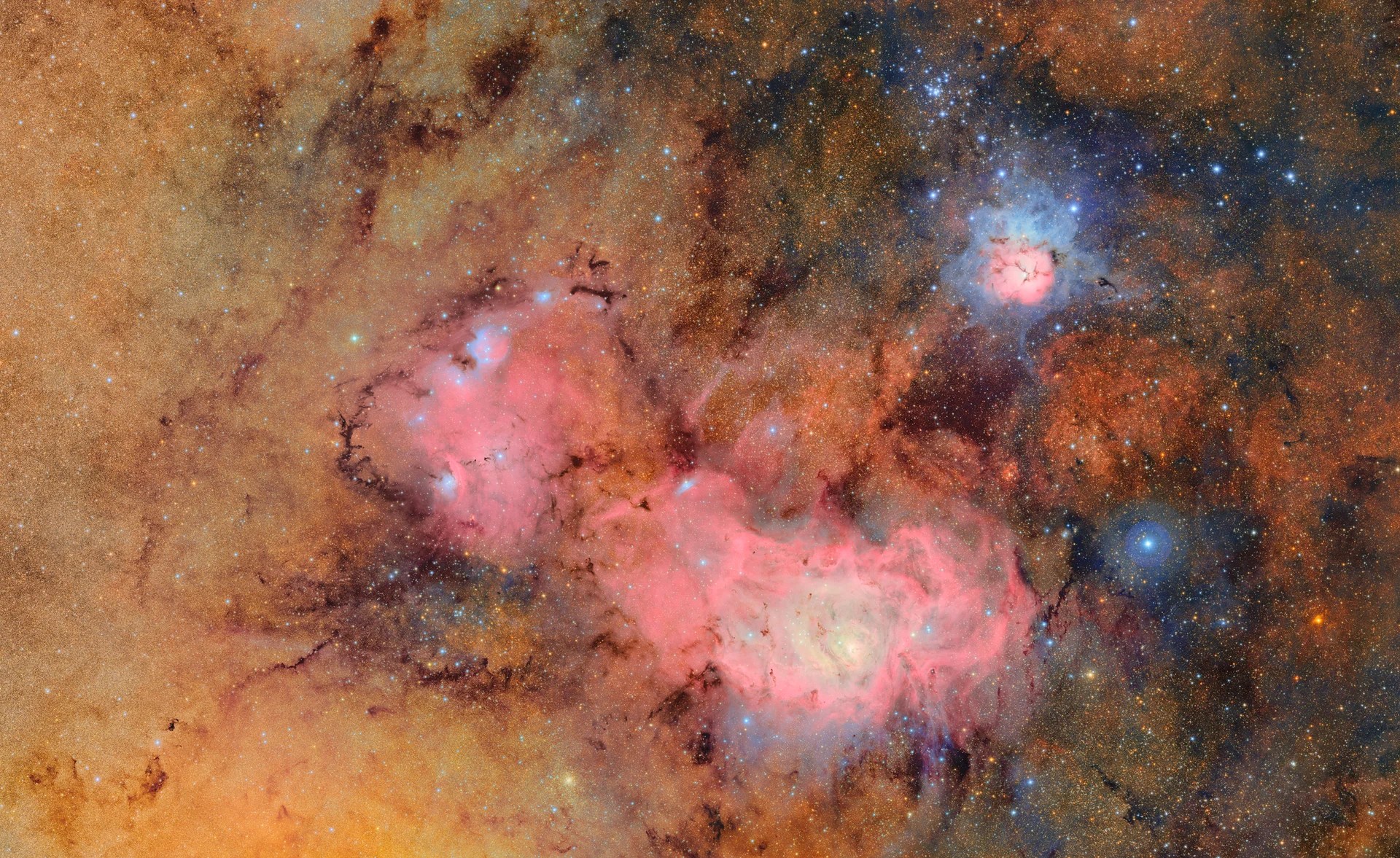
Image (Credit): The Trifid and Lagoon Nebulas as captured by the Vera C. Rubin Observatory. (NSF–DOE Vera C. Rubin Observatory)
This week’s colorful image is from the new Vera C. Rubin Observatory in Chile. It is part of the initial images being released as the observatory comes online. This particular image was created by combining 678 separate images. It shows clouds of gas and dust that comprise the Trifid nebula (top of image) and the Lagoon nebula (middle of image).
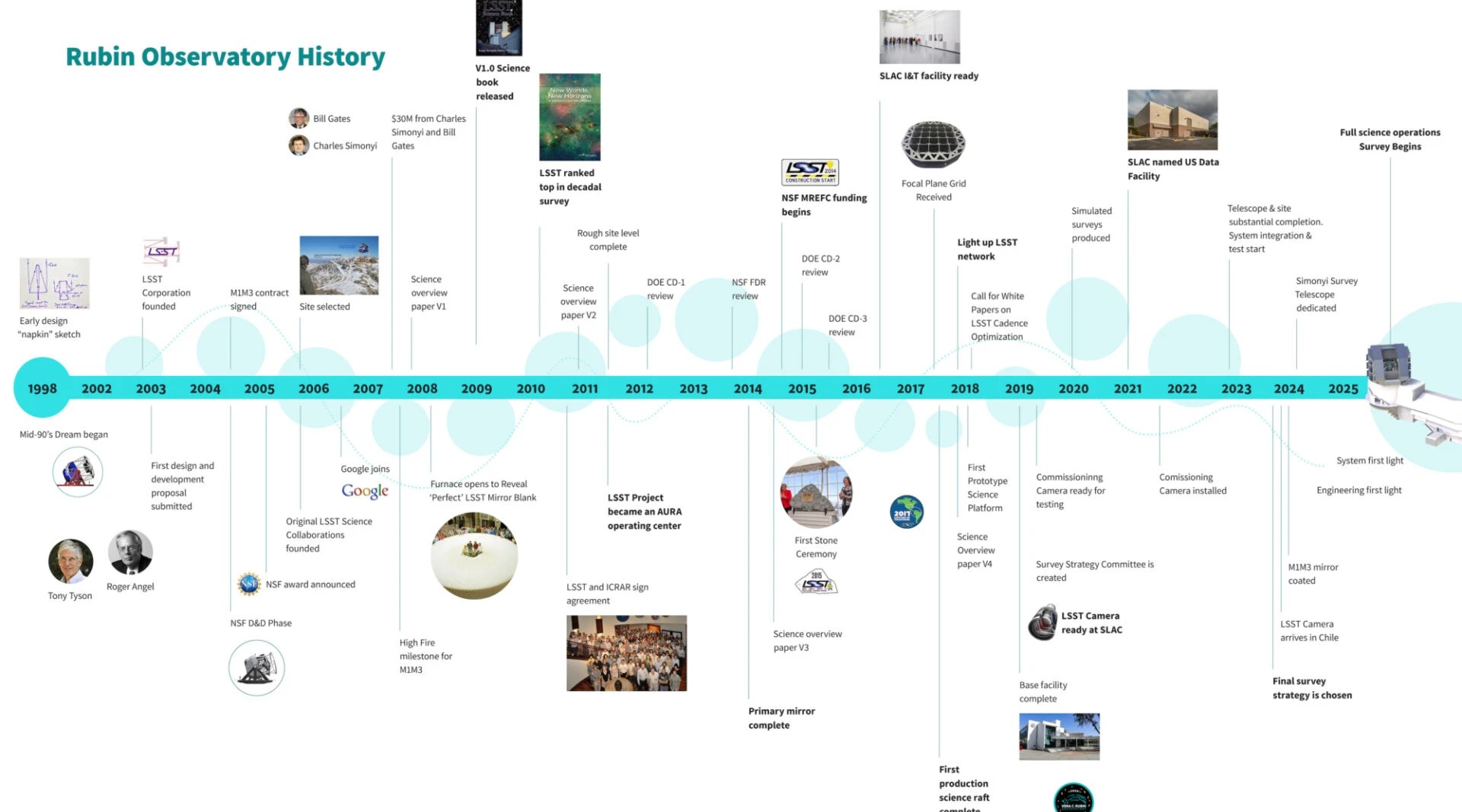
The new observatory is funded by the U.S. National Science Foundation and the U.S. Department of Energy’s Office of Science, and is expected to operate for at least 10 years so it can provide more amazing images and information for astronomers. The timeline related to the creation of the observatory is provided below as well as via this link.
Dr. Vera C. Rubin was an American astronomer known for her work proving the existence “dark matter” in the Universe.
Image (Credit): JWST image subtracting light from the star TWA 7 (marked with a circle and a star symbol) to highlight the exoplanet identified as TWA 7 b. (NASA, ESA, CSA, Anne-Marie Lagrange (CNRS, UGA), Mahdi Zamani (ESA/Webb))
The James Webb Space Telescope (JWST ) continues to amaze us with its discoveries. It has now captured the image of an exoplanet with the mass of Saturn orbiting star TWA 7, representing the first exoplanet captured by JWST in this way. TWA 7 is a young red dwarf star located about 34 light-years away.
JWST used its Mid-Infrared Instrument (MIRI) coronograph to mask the light of the star so that the light from orbiting exoplanets could be detected. Astronomers are pretty confident that what they are seeing is an orbiting planet rather than a star or galaxy in the background. For example, the smaller orange orb on the left represents a background star.
Anne-Marie Lagrange, CNRS researcher at the Observatoire de Paris-PSL and Université Grenoble Alpes in France as well as lead author of the Nature paper, stated.
Our observations reveal a strong candidate for a planet shaping the structure of the TWA 7 debris disk, and its position is exactly where we expected to find a planet of this mass.
NASA’s investments are paying off as we attempt to learn more about this strange universe of ours. Hopefully, members of Congress are paying attention.
A team of astronomers and astrophysicists affiliated with several institutions in Australia has found that a mysterious fast radio burst (FRB) detected last year originated not from a distant source, but from one circling the planet—a long-dead satellite. The team has posted a paper outlining their findings on the arXiv preprint server…The findings could lead to the development of new tools for studying signals coming from space, whether near or far, and possibly new ways to monitor the movement of dead satellites.
A team of astronomers say they’ve gleaned the mysterious traits of our galaxy’s black hole by probing it with an AI model. But a pretty big name on the field is throwing a little bit of cold water on their work. Just a little bit.Reinhard Genzel, a Nobel laureate and an astrophysicist at the Max Planck Institute, expressed some skepticism regarding the team’s use of AI, and the quality of the data they fed into the model.“I’m very sympathetic and interested in what they’re doing,” Genzel told Live Science. “But artificial intelligence is not a miracle cure.”
A space instrument, built by the Swedish Institute of Space Physics (IRF), has for the first time detected negative hydrogen ions on the surface of the Moon – a type of particle never seen there before. The discovery was recently published in the scientific journal Nature Communications Earth and Environment.



 Our Awesome Universe