Study Findings: No Certainty of a Milky Way–Andromeda Collision

Image (Credit): The Andromeda galaxy, or M31, spans 260,000 light-years across. (NASA/JPL-Caltech)

Nature Astronomy abstract of the study findings:

It is commonly believed that our own Milky Way is on a collision course with the neighbouring Andromeda galaxy. As a result of their merger, predicted in around 5 billion years, the two large spiral galaxies that define the present Local Group would form a new elliptical galaxy. Here we consider the latest and most accurate observations by the Gaia and Hubble space telescopes, along with recent consensus mass estimates, to derive possible future scenarios and identify the main sources of uncertainty in the evolution of the Local Group over the next 10 billion years. We found that the next most massive Local Group member galaxies—namely, M33 and the Large Magellanic Cloud—distinctly and radically affect the Milky Way–Andromeda orbit. Although including M33 increases the merger probability, the orbit of the Large Magellanic Cloud runs perpendicular to the Milky Way–Andromeda orbit and makes their merger less probable. In the full system, we found that uncertainties in the present positions, motions and masses of all galaxies leave room for drastically different outcomes and a probability of close to 50% that there will be no Milky Way–Andromeda merger during the next 10 billion years. Based on the best available data, the fate of our Galaxy is still completely open.

Citation: Sawala, T., Delhomelle, J., Deason, A.J. et al. No certainty of a Milky Way–Andromeda collision. Nat Astron (2025).
https://doi.org/10.1038/s41550-025-02563-1

Study-related stories:
PBS

National Geographic

Daily Finland

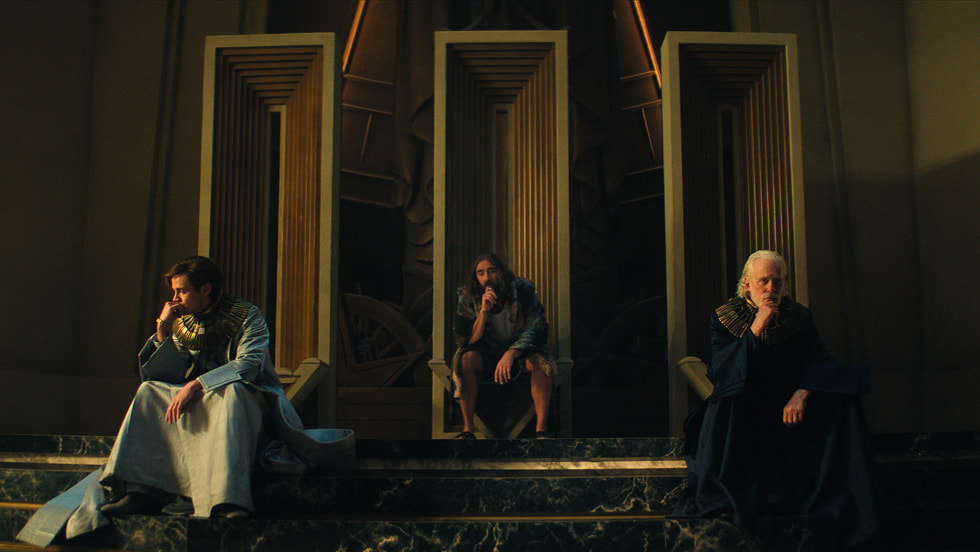
Television: Season Three of Foundation is Coming Soon

Credit: Apple TV+

While our own local empires struggle, we need to turn our eyes to the galactic empire in Foundation, soon to return for a third season on Apple TV+. Mark your calendar for the appearance of the season premiere on July 11.

The trailer for season three indicates there will be no shortage of death-defying adventures. It looks like Mission Impossible in space. The first two seasons did not disappoint, so I am eager to see where this season takes us.

Here is the set up for season three from Apple TV+ Press:

Set 152 years after the events of season two, The Foundation has become increasingly established far beyond its humble beginnings while the Cleonic Dynasty’s Empire has dwindled. As both of these galactic powers forge an uneasy alliance, a threat to the entire galaxy appears in the fearsome form of a warlord known as “The Mule,” whose sights are set on ruling the universe by use of physical and military force as well as mind control. It’s anyone’s guess who will win, who will lose, who will live and who will die as Hari Seldon, Gaal Dornick, the Cleons and Demerzel play a potentially deadly game of intergalactic chess.

This is a show where you do not want to get too attached to the characters. They tend to disappear as often as those in the Game of Thrones.

If you are new to the series, I would not necessarily recommend the season recaps you can find on YouTube. The story line is too disjointed for an easy summary. Also, I do not know why you would want to miss these amazing earlier episodes. This is not Star Trek. Instead, it’s a long movie, where every episode builds on the earlier one.

I recommend you sit through all of the first two seasons to become immersed in this galaxy. You owe it to yourself, and you will not be disappointed.

The Atlantic Council Likes Space Robots

Credit: Image by Christopher White from Pixabay.

If you have not heard of the Atlantic Council you are not alone.

The Atlantic Council defines itself defines itself as a nonpartisan organization that is “…an essential forum for navigating the dramatic economic and political changes defining the twenty-first century by informing and galvanizing its uniquely influential network of global leaders.”

So what does it have to say about the current state of the US space program? It seems to want more robots, artificial intelligence, and virtual reality. It also claims China is moving in this direction.

In a recent article, the Atlantic Council proposed the following to improve the space program for this century:

  • Modernize NASA’s organizational structure by integrating the robotic and human initiatives;
  • Reformulate NASA’s Artemis campaign by changing its plan so that early flights are robotic, with work and preparations being performed by intelligent machines ahead of crewed missions; and
  • Equip lunar robots with virtual reality so intelligent space exploration machines could enable scientists, engineers, and others on Earth to become active participants in the exploration of the Moon, distant planets, and beyond.

Fortunately, the article is not recommending the removal of humans from space flight, but rather the use of technology to enhance these missions, reduce overall costs, and broaden public and scientific support. This would include the expansion of private sector involvement. It’s not a bad idea as NASA struggles with the Artemis mission and potentially other missions due to budget cuts.

Of course, the amazing telescopes that we are trying to maintain and expand upon are already top of the line technology that have expanded public support for astronomy, but this has come at great cost (exceeding cost projections) and has not been protected from budget cuts.

A mix of approaches sounds fine, but a reliable flow of funds with clear expectations also sound nice. We are not going to get that with this White House based upon what we have seen so far. Just finding a leader for NASA that is palatable to the White House is proving impossible.

New ideas should always be welcome, but what is really essential at the moment is stable leadership. Without that all other efforts will go nowhere.

NASA Administrator Nominee To Be Replaced

Credit: Image by succo from Pixabay.

The White House has changed its mind on Jared Isaacman, the nominee for NASA administrator who was ready to be confirmed by the US Senate. A friend of Elon Musk, Mr. Isaacman made the mistake of giving donations to a few Democratic candidates in the past. This is forbidden unless you are Donald Trump, who has made many donations to Democratic candidates over the years, including Hillary Clinton.

NBC News noted that President Trump stated:

After a thorough review of prior associations, I am hereby withdrawing the nomination of Jared Isaacman to head NASA…I will soon announce a new Nominee who will be Mission aligned, and put America First in Space.

It is not clear how political donations has anything to do with putting America first, but this is all we know to date.

Mr. Isaacman has been unceremoniously tossed aside just as Elon Musk is stepping down from his DOGE role after badmouthing the recent Republican House budget bill. Is there a connection?

All we know is that Mr. Musk is losing a friend and customer in the NASA role with Isaacman’s departure. This does not come at a good time as SpaceX struggles with its Starship rocket.

It appears Mr. Musks plans are undergoing a rapid unscheduled disassembly.

Update: Jared Isaacman tweeted about the recent news, stating, in part:

I am incredibly grateful to President Trump @POTUS, the Senate and all those who supported me throughout this journey. The past six months have been enlightening and, honestly, a bit thrilling. I have gained a much deeper appreciation for the complexities of government and the weight our political leaders carry.

Space Quote: US Astronomy Students Are Looking Overseas

Credit: Image by Kamil from Pixabay.

“Historically we’ve been a department that has really tried to make a culture where people minoritized in the field feel like they have a home…The current administration is really driving against that, which has really caused a lot of damage to how people are feeling about their place in astronomy, and whether they feel they have a place here in our country.”

-Statement by University of California Santa Cruz (UCSC) Astronomy & Astrophysics department chair Jonathan Fortney in a Lookout Santa Cruz article. He was discussing recent federal cuts at UCSC as well as NASA. He said his students are looking overseas now for educational and career opportunities given the continuing cuts in US astronomy programs.