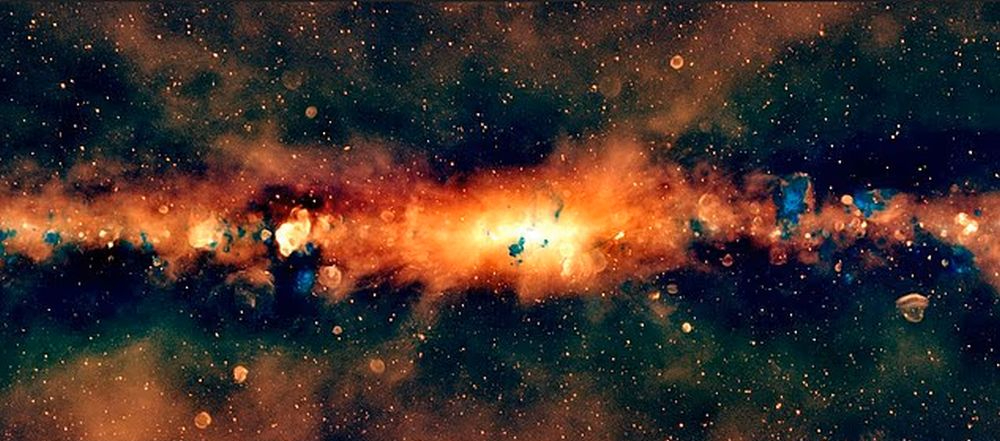
Image (Credit): The Milky Way galaxy in radio waves as seen from the Southern Hemisphere. (Silvia Mantovanini and the GLEAM-X Team)
The image above was released late last year. It shows the Milky Way galaxy in radio-color captured by astronomers from the International Centre of Radio Astronomy Research (ICRAR). All of this was part of the GaLactic and Extragalactic All-sky MWA (GLEAM) and GLEAM-X (GLEAM eXtended) surveys conducted over 28 nights in 2013 and 2014 as well as 113 nights from 2018 to 2020.
In describing the image, Silvia Mantovanini, one of the astronomers analyzing the survey data, noted:
You can clearly identify remnants of exploded stars, represented by large red circles. The smaller blue regions indicate stellar nurseries where new stars are actively forming.
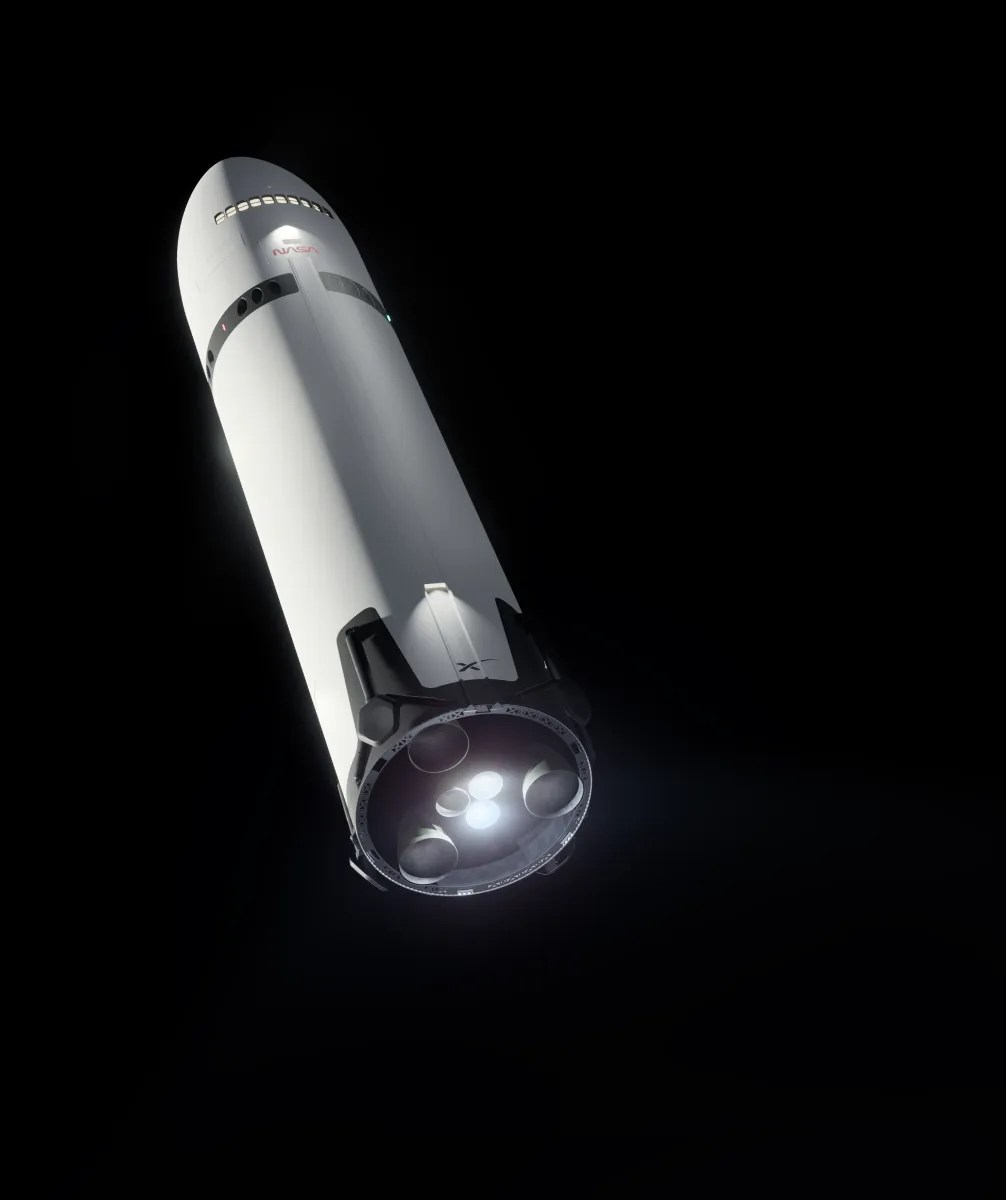
Image (Credit): Artist’s rendering of SpaceX’s Starship HLS preparing for a Moon landing. (SpaceX)
Mr. Musk seems to move like a weather vane regarding where SpaceX is going next, but whether SpaceX is heading for the Moon or Mars it still needs a functioning Starship.
First the confusion. For all of Musk’s ongoing criticism of a Moon mission, it appears he is finally focusing on Artemis III. On Sunday, he tweeted:
For those unaware, SpaceX has already shifted focus to building a self-growing city on the Moon, as we can potentially achieve that in less than 10 years, whereas Mars would take 20+ years.
The mission of SpaceX remains the same: extend consciousness and life as we know it to the stars.
It is only possible to travel to Mars when the planets align every 26 months (six month trip time), whereas we can launch to the Moon every 10 days (2 day trip time). This means we can iterate much faster to complete a Moon city than a Mars city.
That said, SpaceX will also strive to build a Mars city and begin doing so in about 5 to 7 years, but the overriding priority is securing the future of civilization and the Moon is faster.
It seems that someone explained planetary alignment to him over the weekend, but that’s a point for another day.
So the target this week will be the Moon. But a crewed landing on the Moon depends on SpaceX’s Human Landing System (HLS) at the moment, which is where the Starship comes in. Or, more to the point, this is where a multitude of Starships come into play between the refueling in orbit as well and the HLS.
Given that SpaceX planned for 25 Starship launches in 2025 yet achieved only 5, we have an issue Houston (or should I say “Starbase”?).
All indications are that the first launch in 2026 will be early next month (based on one sentence from Musk on January 26th stating “Starship launch in six weeks”), following the last launch of October 13th. Five months between launches is not a very robust schedule given that the Starship not only needs to work but also needs to test the idea of fueling in space before landing a crew on the Moon in 2028.
So far the only parts of Artemis that have proven to work are the Space Launch System and Orion capsule, which are also the two most demonized components said to be substandard based on what the private sector can provide. However, waiting on SpaceX for a workable Moon model is becoming about as logical as waiting for Twitter to become profitable.
Remember, Musk was supposed to have a crew on Mars two years ago. As the Planetary Society noted in 2017:
SpaceX’s previous plan called for landing its first transport ship on Mars in 2022. The timeline Musk gave today was similar; two cargo landers would land on Mars in 2022, with four vehicles launching in 2024. Two of those 2024 ships would be crewed, meaning, in Musk’s timeline, humans could walk on Mars in just seven years.
It now seems like 50/50 that SpaceX can get a crew on the Moon before the Chinese. NASA may need the help of Blue Origin before it has a workable plan.
It may be time to ignore SpaceX’s promises and plan for some new players without tossing out the older technology just yet.
Image (Credit): E.M. Antoniadi’s 1930 book La Planete Mars. (Linda Hall Library)
On this day in 1944, Greek-French astronomer Eugène Michel Antoniadi passed away in Paris, France.
Mr. Antoniadi was one of the astronomers that battled the idea of a civilization creating canals on the surface of Mars, putting him at odds with American astronomer Percival Lowell. While he was initially open to the idea, he later believed the canals to be an optical illusion.
Apple’s iPhone may be one of the most popular phones on Earth, but it’s about to start conquering space as well. According to NASA administrator Jared Isaacman, NASA astronauts are now cleared to take smartphones into space, starting with the SpaceX Crew-12 and Artemis II missions. “We are giving our crews the tools to capture special moments for their families and share inspiring images and video with the world,” he wrote in a tweet.
AES Andes has announced that it will abandon plans to build the INNA industrial complex in Chile’s Atacama Desert. The implementation of this project could jeopardize astronomical observations…On January 23, AES Andes announced that it had decided to discontinue INNA in order to focus on its renewable energy portfolio. “When the cancellation is confirmed, we’ll be relieved that the INNA industrial complex will not be built near Paranal,” said ESO Director General Xavier Barcons. “Due to its planned location, the project would pose a major threat to the darkest and clearest skies on Earth and to the performance of the most advanced astronomical facilities anywhere in the world.”
The current image of Mars as an arid and hostile desert contrasts sharply with the history revealed by its surface. Channels, minerals altered by water, and other geological traces indicate that the Red Planet was, in its early days, a much wetter and more dynamic world. Reconstructing how this water-rich environment disappeared remains one of the great challenges of planetary science. Although several processes are known that can explain some of this loss, the fate of much of Martian water remains a mystery.A new study from an international team of researchers published in Communications: Earth & Environment on February 2, 2026, has brought us a significant step closer to solving this puzzle. For the first time, researchers demonstrated that an anomalous, intense, but localized dust storm was able to drive the transport of water to the upper layers of the Martian atmosphere during the Northern Hemisphere summer – a time when this process was previously considered to be irrelevant.
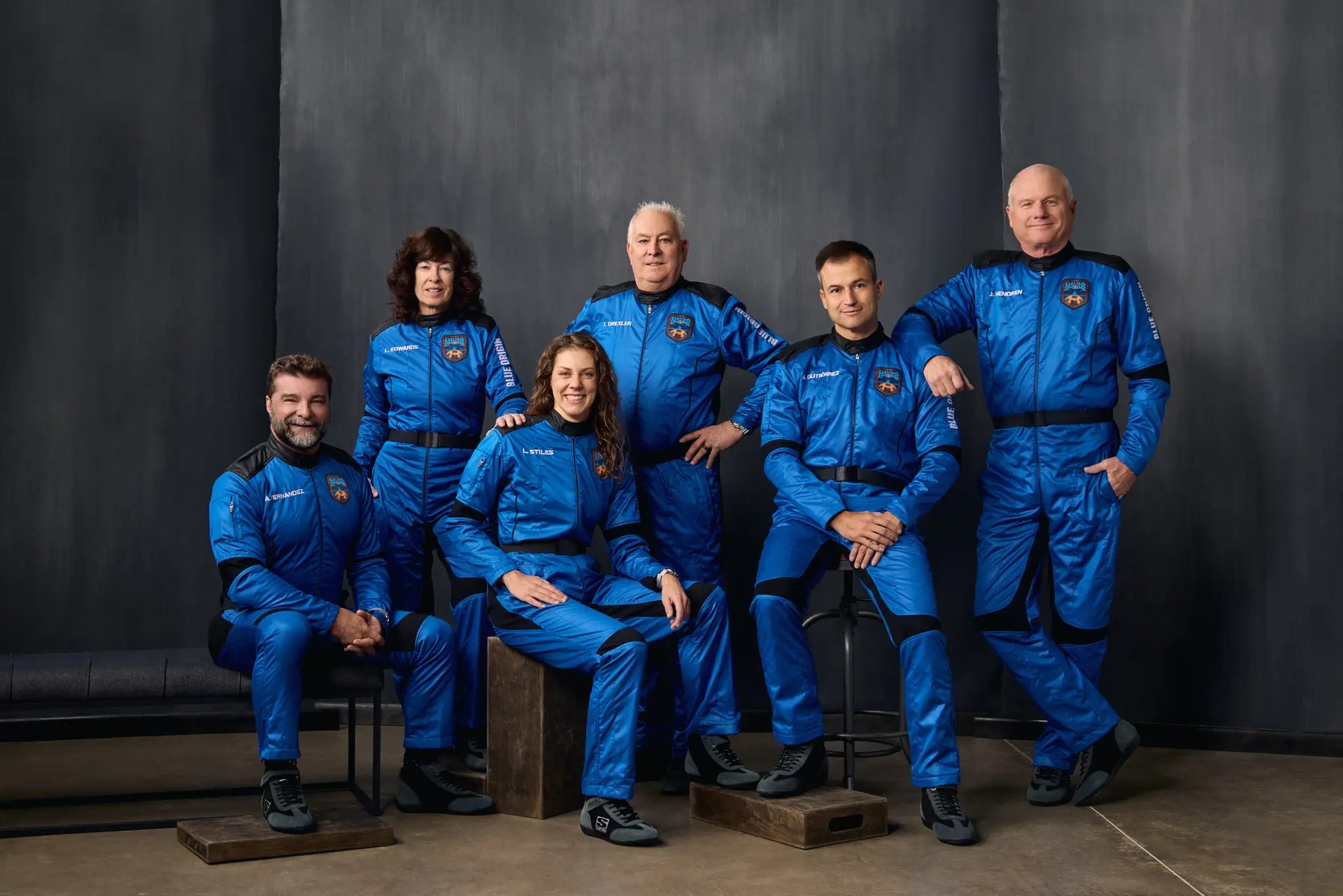
Image (Credit): The 38th and last New Shepard crew for some time. The crew from left to right is Alain Fernandez, Dr. Linda Edwards, Dr. Laura Stiles, Tim Drexler, Alberto Gutiérrez, and Jim Hendren. (Blue Origin)
If you didn’t find your way into orbit yet, your chances to do so in the near future have dropped precipitously.
Blue Origin is ending its New Shepard rocket flights for tourists starting immediately. The pause will last for at least two years while the company focuses on the upcoming Artemis III lunar mission.
Blue Origin today announced it will pause its New Shepard flights and shift resources to further accelerate development of the company’s human lunar capabilities. The decision reflects Blue Origin’s commitment to the nation’s goal of returning to the Moon and establishing a permanent, sustained lunar presence.
New Shepard is the first reusable spaceflight system to vertically land and has flown 38 times and carried 98 humans above the Kármán line to date. New Shepard has launched more than 200 scientific and research payloads from students, academia, research organizations, and NASA. This consistent and reliable performance, combined with an exceptional customer experience, has resulted in a multi-year customer backlog.
Blur Origin is working to be part of the first lunar lander craft on the moon, not just a later one as planned, due to SpaceX’s difficultly meeting its milestones. If only Mr. Musk took the lunar mission as seriously rather than spending his energy on right-wing politics and questionable AI projects.




 Our Awesome Universe