A Very Mixed Week in Space

Image (Credit): One of the last images of the eighth Starship flight on Thursday right before the rocket exploded. (SpaceX)

Let’s start with the good news. This past week two U.S. commercial space companies put landers on the Moon. Both Firefly’s Blue Ghost and Intuitive Machines’ Athena are now residents of the Moon. This is a terrific accomplishment for these relatively new players.

Now the bad news. Athena landed incorrectly and cannot carry out its mission. In fact, it died after only one day on the lunar surface. In addition, the Lunar Trailblazer that accompanied Athena on this mission with plans to orbit and map the Moon also appears to be a lost cause. And finally, SpaceX’s eighth test of its Starship ended with a fiery explosion over the Caribbean, much like its seventh test.

Add to this the potential dismantling of NASA should rumors of a 50 percent cut be true, and you have a very mixed week with too little good news (much like the stock market).

One common element in at least two of the stories – Starship explosion and NASA cuts – relates to Mr. Musk. One wonders whether more attention to SpaceX and less time ransacking the federal government might have led to better outcomes this week. I’m not a rocket scientist, but that seems to make some sense to me.

Big Cuts May be Planned for NASA

Credit: Image by Elle from Pixabay.

If things can get worse for NASA under the current White House, it appears they will.

Both The Planetary Society and The Mars Society are warning their members about a potential 50 percent cut to the NASA program.

In a press release earlier today, The Planetary Society stated:

Should these cuts come to pass, the result would be nothing short of an extinction event for space science and exploration in the United States.

The Mars Society issued a similar warning, stating:

These cuts will almost certainly entail the shutting down of the Mars Curiosity rover, the Hubble Space Telescope, the Voyager and New Horizon interstellar probes, among others, and derail almost all plans for future American planetary exploration and astronomy missions.

The Mars Society President and Founder Dr. Robert Zubrin went further in his condemnation of the proposed cuts to the agency’s Space Science Directorate, stating:

It is not merely the crown jewel of NASA. It is the gothic cathedral of our age, carrying the banner of our society’s highest ideal – the search for truth through science. Destroying it would be wanton crime not only against science, but civilization itself.

We can only hope this is more bluster from the White House similar to tariffs that are immediately pulled back or even NASA personnel cuts that are canceled at the last minute. Bipartisan push back from Congress is also very likely.

During his inauguration, President Trump spoke about a U.S flag on Mars, yet there is little chance of that happening under this administration or anytime soon should these budget cuts occur.

Pic of the Week: Athena Lands on Moon

Image (Credit): Athena approaching the Moon on March 6, 2025. (NASA)

This week’s image is from earlier today when Intuitive Machines’ Athena lunar lander was approaching the Moon’s South Pole. The good news is that the lander made it safely to the surface. However, the lunar lander may have landed in an odd way, creating solar generating issues similar to the company’s first attempt at landing this time last year.

NASA and Intuitive Machines are still trying to determine the status of the lander as well as its exact location. The lander’s goal was to land in Mons Mouton, a lunar plateau near the Moon’s South Pole. NASA’s Lunar Reconnaissance Orbiter should help to pinpoint the lander’s location and orientation in the next few days.

Hopefully, some if not all of the planned experiments are still possible. But for now it’s just a matter of waiting for more news on the mission.

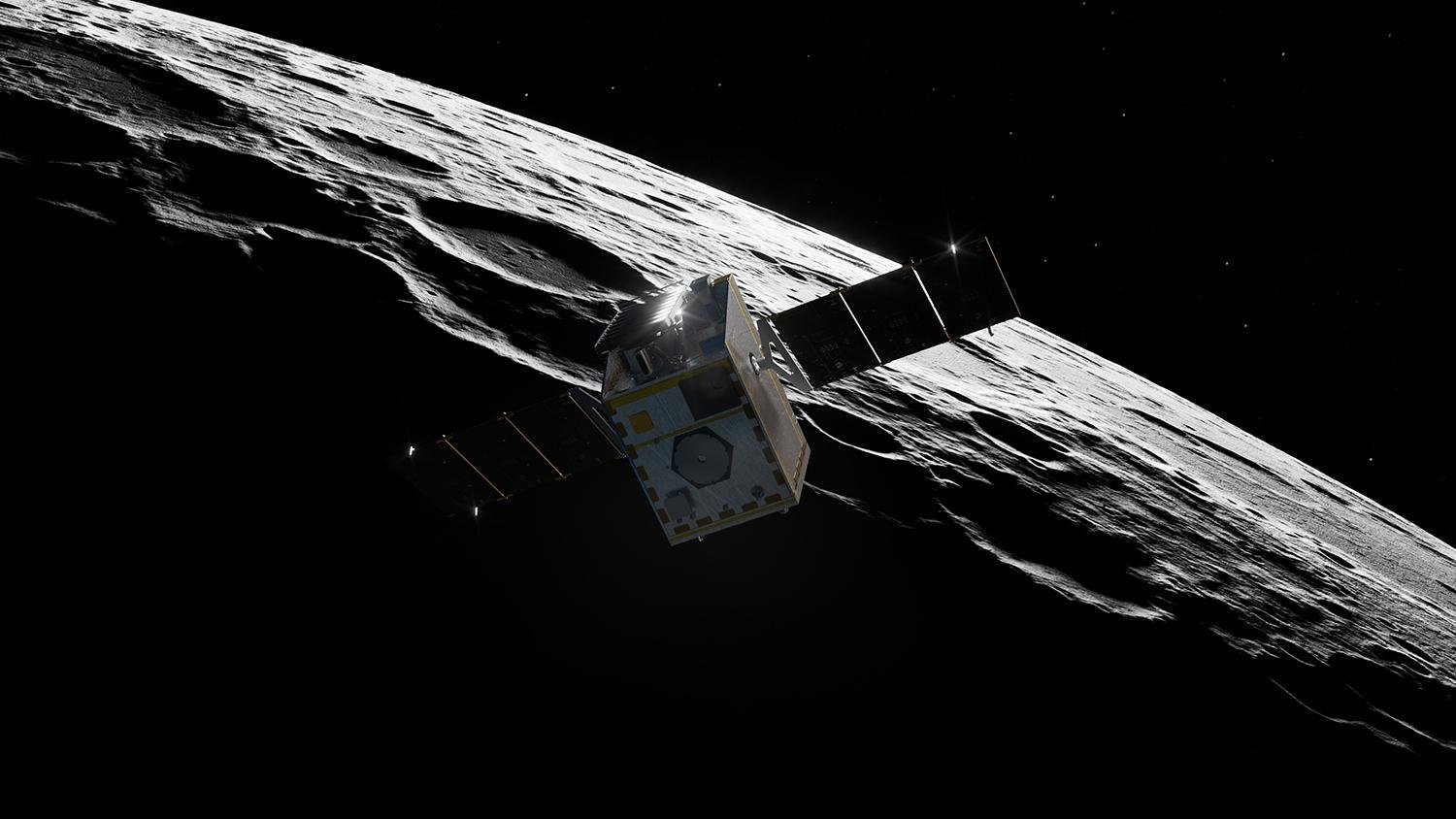
Space Quote: Lunar Trailblazer Mission May be Over Before it Started

Image (Credit): Artist’s rendering of NASA’s Lunar Trailblazer orbiting the Moon. (NASA)

“The Lunar Trailblazer team has been working around the clock to re-establish communications with the spacecraft…NASA sends up high-risk, high-reward missions like Lunar Trailblazer to do incredible science at a lower cost, and the team truly encapsulates the NASA innovative spirit — if anyone can bring Lunar Trailblazer back, it is them.”

-Statement by Nicky Fox, the associate administrator of the NASA Science Mission Directorate, as quoted by CNET. The Lunar Trailblazer was launched with Intuitive Machines’ Athena lunar lander on March 26th. The satellite was designed to orbit about 60 miles above the Moon’s surface as it mapped potential water on the lunar surface.

Space Stories: Upcoming ESA Exoplanet Mission, Evidence of Early Water in the Universe, and a New Nearby Dwarf Galaxy

Here are some recent stories of interest.

German Aerospace Center: PLATO Mission to Launch in Late 2026 Onboard Ariane 6

On 29 January 2025, the European Space Agency (ESA)’s Director of Science, Carole Mundell; ESA’s Director of Space Transportation, Toni Tolker-Nielsen; and Arianespace’s Chief Commercial Officer, Steven Rutgers, signed the launch contract for the ESA PLATO science mission...PLATO stands for PLAnetary Transits and Oscillations of stars…PLATO’s goal is to detect Earth-like planets that orbit Sun-like stars in the Milky Way and may even have conditions suitable for life.

ScienceNews: The Universe’s First Supernovas Probably Produced Water

The first generation of stars in the universe could have produced significant amounts of water upon their deaths, just 100 million to 200 million years after the Big Bang. Signatures of water have previously been observed some 780 million years after the Big Bang. But now, computer simulations suggest that this essential condition for life existed far earlier than astronomers thought, researchers report March 3 in Nature Astronomy.

Phys.org: New Dwarf Galaxy Discovered in the Halo of Andromeda Galaxy

An international team of astronomers reports the discovery of a new dwarf galaxy, which they have named Pegasus VII. The newfound galaxy, which lies about 2.4 million light years away, was identified in the Ultraviolet Near-Infrared Optical Northern Survey (UNIONS). The discovery was detailed in a research paper published Feb. 13 on the arXiv preprint server. Dwarf galaxies are low-luminosity and low-mass stellar systems, usually containing a few billion stars. Their formation and activity are thought to be heavily influenced by interactions with larger galaxies.