Movie: Mickey 17 Premieres Next Month

Credit: Warner Bros. Pictures.

Last April I mentioned the pending arrival of the movie Mickey 17, based on Edward Ashton’s book Mickey 7. Well, the movie premieres in theaters on March 7 (even though the poster above has the date 1/31/25). The first trailer was released four months back, while the second trailer came out two weeks ago. Both indicate the movie will be much wilder than the book.

Here are some of the main names associated with the film:

From the Academy Award-winning writer/director of “Parasite,” Bong Joon Ho, comes his next groundbreaking cinematic experience, “Mickey 17.” The unlikely hero, Mickey Barnes (Robert Pattinson) has found himself in the extraordinary circumstance of working for an employer who demands the ultimate commitment to the job… to die, for a living.

Written and directed by Bong Joon Ho, “Mickey 17” stars Robert Pattinson (“The Batman,” “Tenet”), Naomi Ackie (“Star Wars: Episode IX – The Rise of Skywalker”), Academy Award nominee Steven Yeun (“Minari,” “Beef”), with Academy Award nominee Toni Collette (“Hereditary”), and Academy Award nominee Mark Ruffalo (“Poor Things”).

Generally, I prefer a movie to stick closely to the book. In this case, based on what I can see in the trailers, it shows much more of the alien life on the planet, which should make it interesting. The book also had a somewhat unsatisfactory ending, leaving a lot to the imagination. I expect the film makers will want to eliminate some of that uncertainty.

Given the lack of an humor in most of the recent space films, from battles on space stations to more aliens popping out of bodies, Mickey 17 should be a nice change. If not, we will always have the book.
Space Quote: A Close Call in 2032?

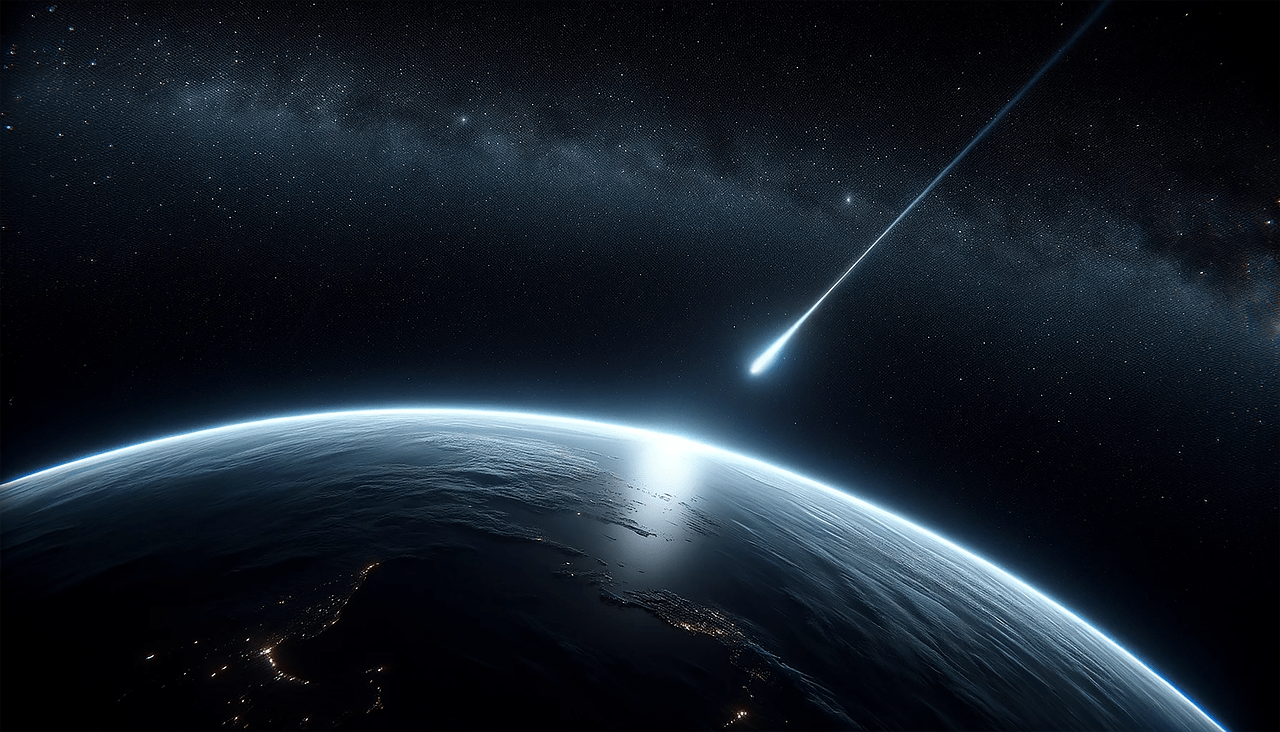
Credit: Image by dlsd cgl from Pixabay.

“We do want to keep an eye on it. We do take it seriously, but we want to put it in perspective … There’s still a very low probability that it would even impact the Earth at all.”

-Statement by Kelly Fast, the acting planetary defense officer for NASA’s Planetary Defense Coordination Office, as quoted by National Pubic Radio. She is referring to asteroid 2024 YR4, which is between 30 feet to about 300 feet in diameter. Scientists believe the asteroid has about a 1.6 percent chance of hitting the Earth in 2032.

Study Findings: An Evaporite Sequence from Ancient Brine Recorded in Bennu Samples

Image (Credit): Up close view of Asteroid Bennu. (NASA)

Nature abstract of the study findings:

Evaporation or freezing of water-rich fluids with dilute concentrations of dissolved salts can produce brines, as observed in closed basins on Earth and detected by remote sensing on icy bodies in the outer Solar System. The mineralogical evolution of these brines is well understood in regard to terrestrial environments, but poorly constrained for extraterrestrial systems owing to a lack of direct sampling. Here we report the occurrence of salt minerals in samples of the asteroid (101955) Bennu returned by the OSIRIS-REx mission. These include sodium-bearing phosphates and sodium-rich carbonates, sulfates, chlorides and fluorides formed during evaporation of a late-stage brine that existed early in the history of Bennu’s parent body. Discovery of diverse salts would not be possible without mission sample return and careful curation and storage, because these decompose with prolonged exposure to Earth’s atmosphere. Similar brines probably still occur in the interior of icy bodies Ceres and Enceladus, as indicated by spectra or measurement of sodium carbonate on the surface or in plumes.

Citation: McCoy, T.J., Russell, S.S., Zega, T.J. et al. An evaporite sequence from ancient brine recorded in Bennu samples. Nature 637, 1072–1077 (2025).
https://doi.org/10.1038/s41586-024-08495-6

Study-related stories:

Smithsonian Magazine

Sci.News

BBC

Pic of the Week: Jupiter’s Swirling Polar Region

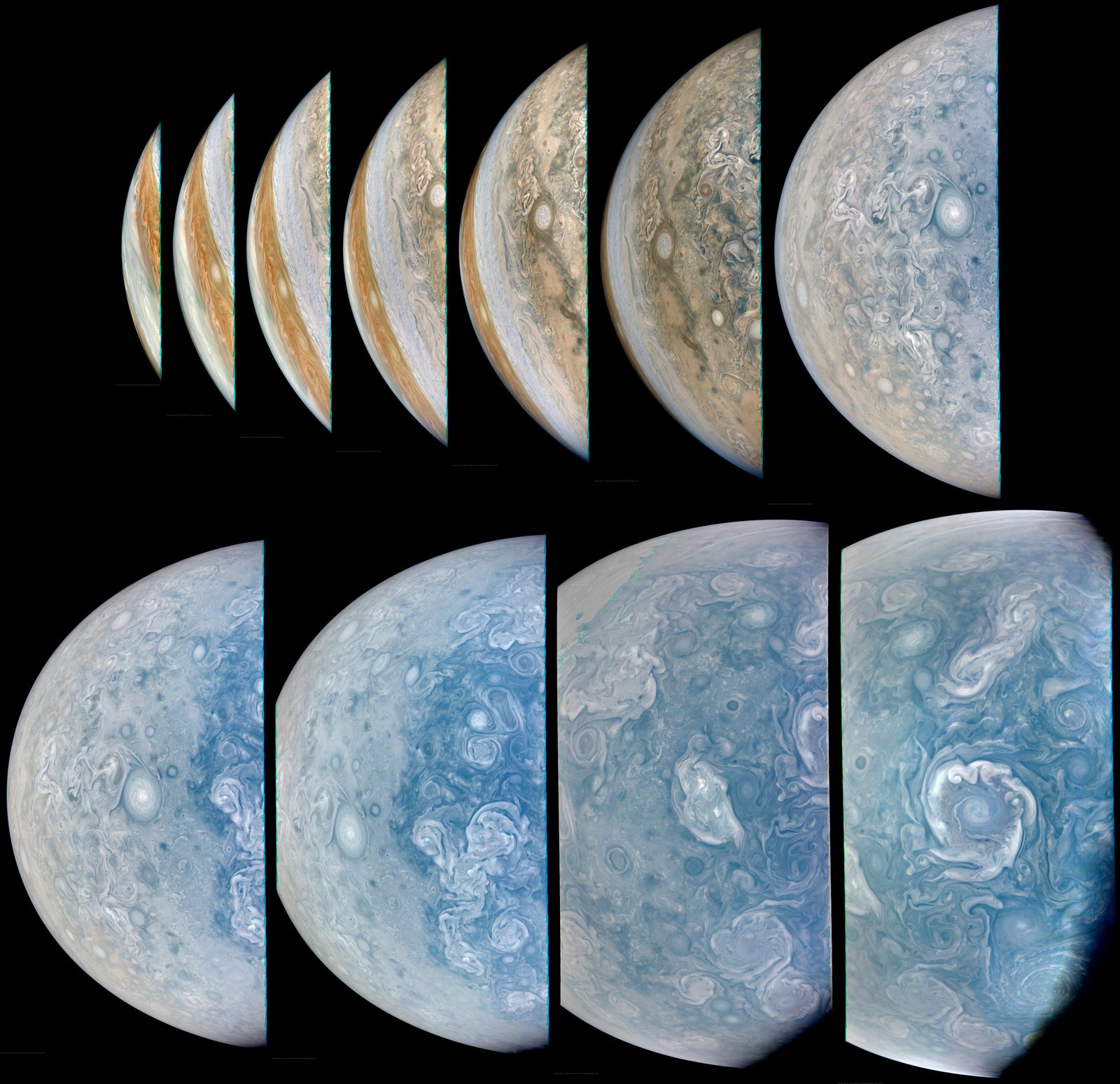
Image (Credit): Jupiter’s north polar region. (Image data: NASA/JPL-Caltech/SwRI/MSSS
Image processing by Brian Swift © CC BY
)

This week’s image comes from NASA’s Juno spacecraft, which captured these images of Jupiter’s north polar region. The spacecraft came within 6,800 miles of the clouds you see.

Launched in August 2011, the Juno spacecraft has been studying Jupiter since 2016 to better understand the origin and evolution of the planet.

You can learn more about the Juno mission here.