Books for NASA Foodies

Credit: Ballast Books

If you are a foodie and still looking for a holiday gift or just a fun gift, you might want to check out these two space-related books.

The first book by Vickie Kloeris, Space Bites: Reflections of a NASA Food Scientist, discusses the thinking that goes into the food prepared for NASA’s astronauts. In this case, Ms. Kloeris worked with the food eaten by astronauts on the space shuttles and the International Space Station.

Former NASA Astronaut Mike Massimino stated:

During her decades-long career at NASA, my friend and colleague Vickie Kloeris made sure my fellow astronauts and I were well-fed and healthy while in space. Space Bites is not only a compilation of stories of her amazing career but also a behind-the-scenes look at the evolution of human space travel. Read this book to be inspired and to learn, and don’t be surprised if it also leaves you hungry for some space food.

It might be the perfect book after holidays if you want some insight into the space program.

However, if you want to sample the astronaut food, you might want to check out this older book by Charles T. Borland and Gregory L. Vogt, The Astronaut’s Cookbook: Tales, Recipes, and More. It contains recipes allowing you to create astronaut-worthy meals without the freeze drying.

The book covers a lot of territory: Appetizers, Beverages, Bread and Tortillas, Cookies, Sandwiches, Desserts, Main Dishes, Soups and Salads, Vegetables, and Future Space Foods.

David W. Hughes from Astronomy Now noted:

Charles Bourland has just retired from his job as NASA’s ‘director of space foods’, and Gregory Vogt was an astronaut trainer. They have provided us with a fascinating insight into the job of the space dietician and nutritionist, as well as a wondrous collection of recipes for the meals that were served on Skylab, Apollo, thespace shuttle and the International Space Station. … This an intriguing book, well written, and colourfully reproduced with a host of appetising pictures.

It may not be fantastic food, yet you can eat like an astronaut (and maybe suffer like an astronaut). When you sit down to dine on this strange fare, you can be pretty certain that no one else in your neighborhood will have such a dinner that evening.

Credit: Springer

Pretty Confusing Security Issues with Musk

Credit: Image by Tayeb MEZAHDIA from Pixabay

I am confused about the role of Mr. Musk at SpaceX.

The news is reporting that Mr. Musk may have trouble accessing some of the SpaceX facilities because he lacks a security clearance due to his questionable behavior with drugs and foreign officials. And yet the same reports note that his upcoming job with the Trump administration’s new Department of Government Efficiency may provide him with those security clearances anyway.

So we are to believe that Mr. Musk is a security risk in the private sector, but his quasi-governmental role will make all of those concerns moot? It sounds like you can buy yourself a security clearance in this country at the right price (in this case, by financing a presidential campaign), national security be damned.

And now we hear that he has been sending tweets supporting Nazi-adjacent parties in Germany. I don’t think this is the best way to gain or maintain a high level security clearance in any democratic nation.

I am hoping someone inside government follows up on these issues. The companies under his control remain deeply embedding in the U.S. Government in highly critical areas.

It does appear the various military branches have concerns about his behavior and have initiated investigations. However, none of this appears to be slowing down his movement into a government position. For all we know, while these reviews are underway Mr. Musk will be given access to even more secrets, including highly-classified military secrets, as part of his role to reduce the size of the government.

And if that is the case, who in the various government agencies will question him when he can recommend the elimination of the party making the complaint? As they say, the caller is in the house.

None of this sounds very good for the space industry or the Nation as a whole.

UFO Panic: Someone Needs a Stargazing Class

Image (Credit): Orion’s Belt. (Davide De Martin & the ESA/ESO/NASA Photoshop FITS Liberator)

The ongoing panic related to drones it getting pretty silly. I am just glad we are not shooting down small airplanes or trying to take out a star system.

For example, Maryland’s former Governor Larry Hogan recently claimed to have “personally witnessed” drones outside his house. However, he was actually looking at Orion’s Belt.

Maybe he should check with employees at the University of Maryland’s observatory to learn about upcoming stargazing events for the public. Oh wait, the observatory is currently closed due to budget cuts.

I wonder who was governor when that happened.

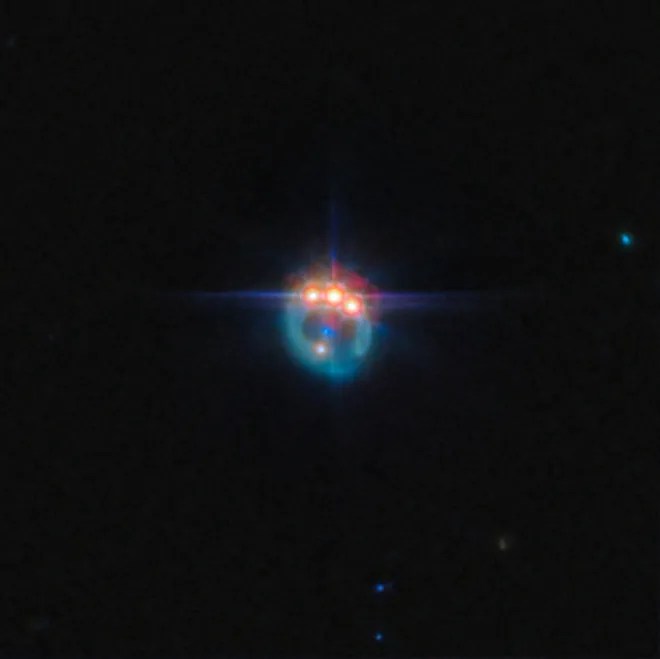
Pic of the Week: Quasar RX J1131-1231

Image (Credit): Quasar known as RX J1131-1231, which is located roughly 6 billion light-years from Earth in the constellation Crater. (ESA/Webb, NASA & CSA, A. Nierenberg)

This week’s image is from the James Webb Space Telescope. It was highlighted in USAToday as one of the best images from 2024. It shows the gravitational lensing of RX J1131-1231, which is a quasar about 6 billion light-years from Earth.

Here is more about the image:

It is considered one of the best lensed quasars discovered to date, as the foreground galaxy smears the image of the background quasar into a bright arc and creates four images of the object. Gravitational lensing, first predicted by Einstein, offers a rare opportunity to study regions close to the black hole in distant quasars, by acting as a natural telescope and magnifying the light from these sources. All matter in the Universe warps the space around itself, with larger masses producing a more pronounced effect. Around very massive objects, such as galaxies, light that passes close by follows this warped space, appearing to bend away from its original path by a clearly visible amount. One of the consequential effects of gravitational lensing is that it can magnify distant astronomical objects, letting astronomers study objects that would otherwise be too faint or far away.

Space Stories: Firefly Wins Another NASA Contract, Commercial Space Station Progress, and Another Starliner Delay

Image (Credit): Firefly’s Blue Ghost lunar lander and a rover on the lunar surface. (Firefly Aerospace)

Here are some recent stories of interest.

Firefly AerospaceFirefly Awarded $179 Million NASA Contract for Moon Delivery to Gruithuisen Domes

Firefly Aerospace, Inc., the leader in end-to-end responsive space services, was awarded an approximately $179.6 million NASA contract to deliver and operate six NASA instruments in the Gruithuisen Domes on the Moon’s near side in 2028. As part of NASA’s Commercial Lunar Payload (CLPS) initiative, the mission will utilize Firefly’s Blue Ghost lunar lander, Elytra Dark orbital vehicle, and a rover from an industry provider to investigate the unique composition of the Gruithuisen Domes – a part of the Moon that has never been explored.

NASANASA Sees Progress on Starlab Commercial Space Station Development

A NASA-funded commercial space station, Starlab, recently completed four key developmental milestones, marking substantial progress in the station’s design and operational readiness. The four milestones are part of a NASA Space Act Agreement awarded in 2021 and focused on reviews of the habitat structural test article preliminary design, systems integration, integrated operations, and a habitat structural test plan. “These milestone achievements are great indicators to reflect Starlab’s commitment to the continued efforts and advancements of their commercial destination,” said Angela Hart, program manager for NASA’s Commercial Low Earth Orbit Development Program. “As we look forward to the future of low Earth orbit, every successful milestone is one step closer to creating a dynamic and robust commercialized low Earth orbit.”

Associated PressNASA’s 2 stuck Astronauts Face More Time in Space with Return Delayed Until at Least Late March

NASA’s two stuck astronauts just got their space mission extended again. That means they won’t be back on Earth until spring, 10 months after rocketing into orbit on Boeing’s Starliner capsule. NASA announced the latest delay in Butch Wilmore and Suni Williams’ homecoming on Tuesday. The two test pilots planned on being away just a week or so when they blasted off June 5 on Boeing’s first astronaut flight to the International Space Station. Their mission grew from eight days to eight months after NASA decided to send the company’s problem-plagued Starliner capsule back empty in September.