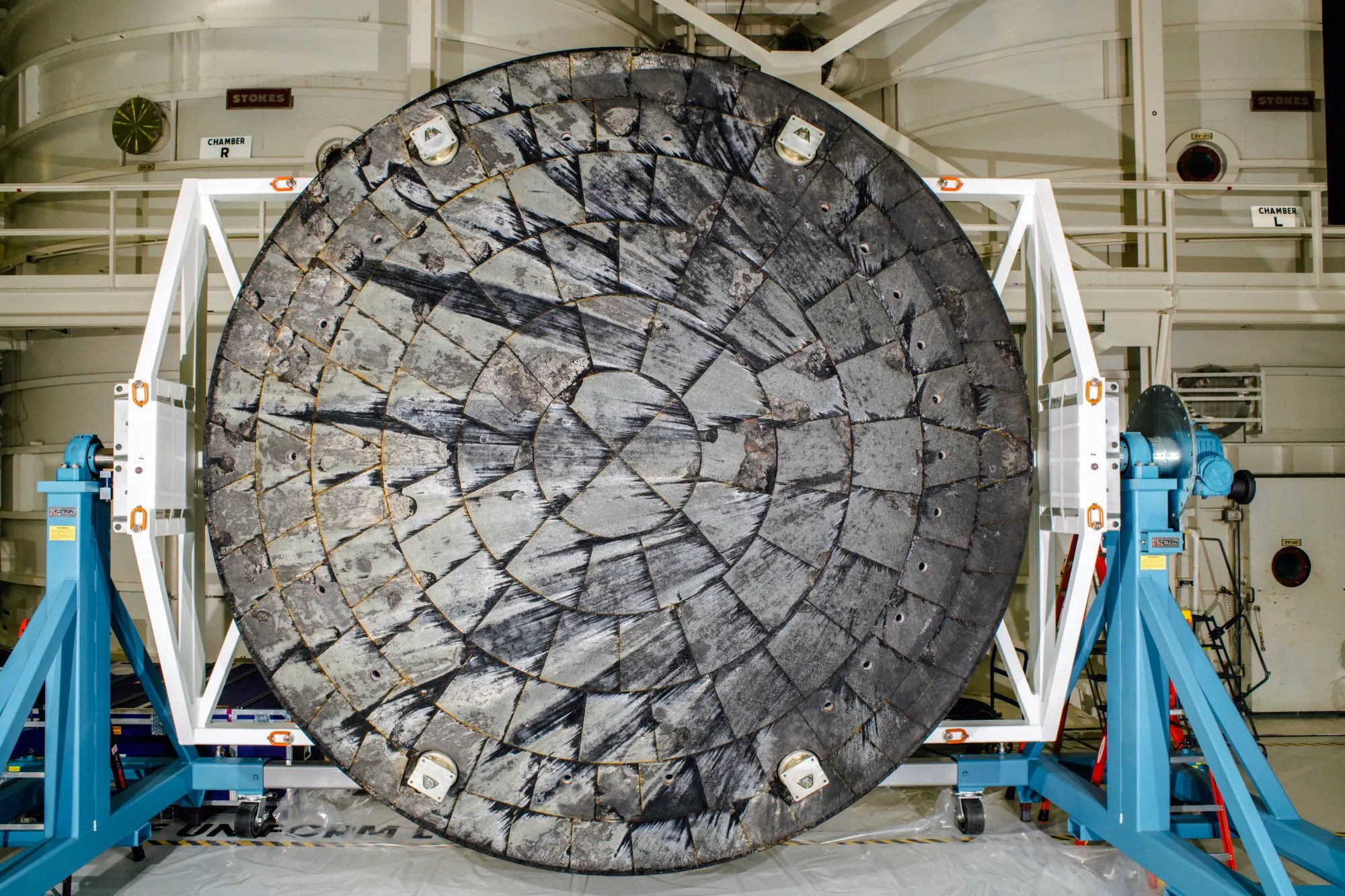
Image (Credit): The recovered Orion heat shield at NASA’s Kennedy Space Center in Florida. (NASA)
Orion heat shield issues have contributed to more delays with the Artemis II (crewed capsule around the Moon) and Artemis III (crewed capsule lands on the Moon) missions. The Artemis II launch has moved from September 2025 to April 2026, while the Artemis III launch has moved from 2026 to mid-2027.
NASA still has plenty of time to beat the China back to the Moon given that China is still aiming for a 2030 human landing on the lunar surface. Even so, this is not a good time to be highlighting the engineering weaknesses in the Artemis program. We know that the incoming administration is likely to ask a lot of questions.
You can watch the entire NASA news conference discussing the delays here.
This is what Mr. Isaacman posted on Twitter/X after being nominated to be the next administrator of NASA:
I am honored to receive President Trump’s…nomination to serve as the next Administrator of NASA. Having been fortunate to see our amazing planet from space, I am passionate about America leading the most incredible adventure in human history.
On my last mission to space, my crew and I traveled farther from Earth than anyone in over half a century. I can confidently say this second space age has only just begun. Space holds unparalleled potential for breakthroughs in manufacturing, biotechnology, mining, and perhaps even pathways to new sources of energy. There will inevitably be a thriving space economy—one that will create opportunities for countless people to live and work in space. At NASA, we will passionately pursue these possibilities and usher in an era where humanity becomes a true spacefaring civilization.
I was born after the Moon landings; my children were born after the final space shuttle launch. With the support of President Trump, I can promise you this: We will never again lose our ability to journey to the stars and never settle for second place. We will inspire children, yours and mine, to look up and dream of what is possible. Americans will walk on the Moon and Mars and in doing so, we will make life better here on Earth.
It is the honor of a lifetime to serve in this role and to work alongside NASA’s extraordinary team to realize our shared dreams of exploration and discovery.
Grateful to serve,
Jared
I find it interesting that his first mention of space accomplishments was his own private flight into orbit rather than the amazing things NASA has already accomplished and plans to do. He also seems to think his space venture brought on the second space age, maybe unaware that the movement towards commercial partnerships started with the Obama administration.
And the statement “Americans will walk on the Moon and Mars” should probably be “Americans will walk on the Moon again and Mars as well.” He admitted that he missed the Moon landing and his kids missed the space shuttle, but let’s treat them like milestones rather than missed opportunities.
I am skeptical that this will be good for NASA, but maybe having a buddy running the agency will give Mr. Musk second thoughts about stripping it down for parts like a Jawa sandcrawler.
This week’s image is the best space exploration image winner in The Planetary Society’s Best of 2024 contest. It shows the Odysseus lunar lander, launched on February 15, leaving the Earth behind as it travels to the Moon. You can read more about the lunar mission to the lunar South Pole by visiting this NASA mission page.
Visit The Planetary Society for more on the Best of 2024 winners, including the most exciting upcoming planetary science mission. I won’t spoil the news. You can read about it yourself.
Image (Credit): Jared Isaacman. (U.S. Air Force photo by Trevor Cokley)
I guess it was too much to pick a former astronaut to lead NASA, so the Trump administration is turning to a wealthy space tourist to lead the agency. Jared Isaacman, the CEO and founder of a credit card-processing company, was nominated to be the next administrator of NASA.
Mr. Isaacman main experience with space has been procuring SpaceX flights to fulfill his hobby of modeling space suits in orbit. His last space jaunt was back in September where he left the capsule while in orbit for what was called the first commercial space walk.
Unlike the Department of Justice and DOD, a nomination at this level is unlikely to be challenged by Congress. So this is most likely a nomination that will move through the system without interruption.
What this means for NASA is unclear at the moment, but it appears the private contractors and tourists will be in charge for a while. Will this lead to the continuation of serious space endeavors or simply space stunts and contacted boondoggles?
We can only hope that the overall mission of NASA is respected and advanced by whoever ultimately leads the agency in the the years to come. Many missions, including the Artemis mission, need the full focus of management as well as support from the Congress.
The story of the inner early Solar System goes something like this: Billions of years ago, there were three rocky worlds with oceans of liquid water. Perhaps all three could have been primed for life. But as Mars lost its atmosphere and Venus’ atmosphere experienced a runaway greenhouse effect, only Earth could support life by the end. But a trio of researchers at the University of Cambridge, U.K., have a different view — that all those billions of years ago, Venus was already too hot to support oceans. There was water vapor (we still see evidence of this today), but it never had the chance to condense into oceans. Instead, Venus was a steam world, one that could reach surface temperatures as high as 1,340 degrees Fahrenheit (727 degrees Celsius). By most metrics, this means the surface of Venus was already a hellish, inhospitable world — and it never got much better.
Imagine the formation of a black hole and you’ll probably envision a massive star running out of fuel and collapsing in on itself. Yet the chaotic conditions of the early universe may have also allowed many small black holes to form long before the first stars. These primordial black holes have been theorized for decades and could even be ever-elusive dark matter, the invisible matter that accounts for 85% of the universe’s total mass. Still, no primordial black hole has ever been observed. New research co-led by the University at Buffalo proposes thinking both big and small to confirm their existence, suggesting that their signatures could range from very large — hollow planetoids in space — to minute — microscopic tunnels in everyday materials found on Earth, like rocks, metal and glass.
Six years ago, NASA’s Dawn mission communicated with Earth for the last time, ending its exploration of Ceres and Vesta, the two largest bodies in the asteroid belt. Since then, Ceres —a water-rich dwarf planet showing signs of geological activity— has been at the center of intense debates about its origin and evolution. Now, a study led by IAA-CSIC, using Dawn data and an innovative methodology, has identified eleven new regions suggesting the existence of an internal reservoir of organic materials in the dwarf planet. The results, published in The Planetary Science Journal, provide critical insights into the potential nature of this celestial body.




 Our Awesome Universe