Chinese Martian Rover Images

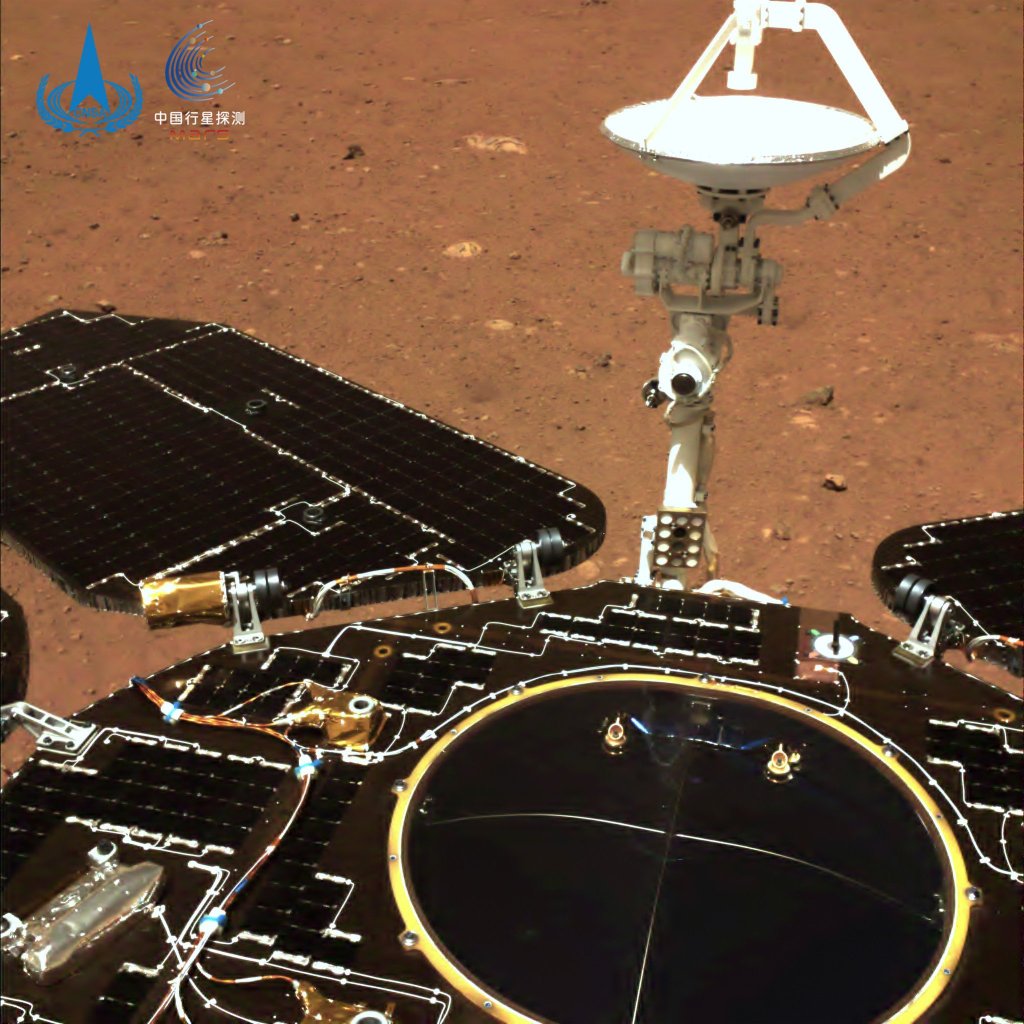
Image (Credit): Two images from China’s Martian Rover Zhurong. (CNCA)

The China National Space Administration (CNSA) Watcher site posted the above before and after selfies taken by the Zhurong Mars Rover. The top shot was taken on May 19, 2021 and the bottom shot on January 22, 2022. You can see the dust that has accumulated in less than a year on the rover’s panels. The site notes that the rover has the ability to vibrate and loosen the accumulated dust.

China launched Tianwen-1, which carried the rover, on July 23, 2020. It went into orbit around Mars in February 2021, with the Zhurong Rover landing on the Martian surface on May 14, 2021. China sent the rover to the Red Planet to find evidence of water. If all goes well, China hopes to bring a Martian samples back to Earth in a subsequent mission. The Planetary Society has some helpful information here on the Chinese mission.

Image (Credit): China’s Mars Rover Zhurong next to its landing platform on the surface of the red planet. (CNSA)

Movies: A Romance Set on Mars

Image (Credit): Upcoming HBO movie Moonshot. (HBO)

On March 31st you can can watch another space-related movie, though this one has a misleading name. Called Moonshot, the setting is actually a space colony on Mars. You can watch a trailer of the HBO Max movie here.

While its just a platform for a young adult romantic comedy, it will be fun to see how the film portrays life on the Red Planet. Given that it includes a stowaway on the trip to Mars, you have to wonder what kind of space program these people are running when every pound of extra weight is critical.

Of course, Netflix already did the Mars mission stowaway story in last year’s film Stowaway.

So don’t think too hard. Just enjoy the spacecraft and scenery.

Pic of the Week: Space Triangle

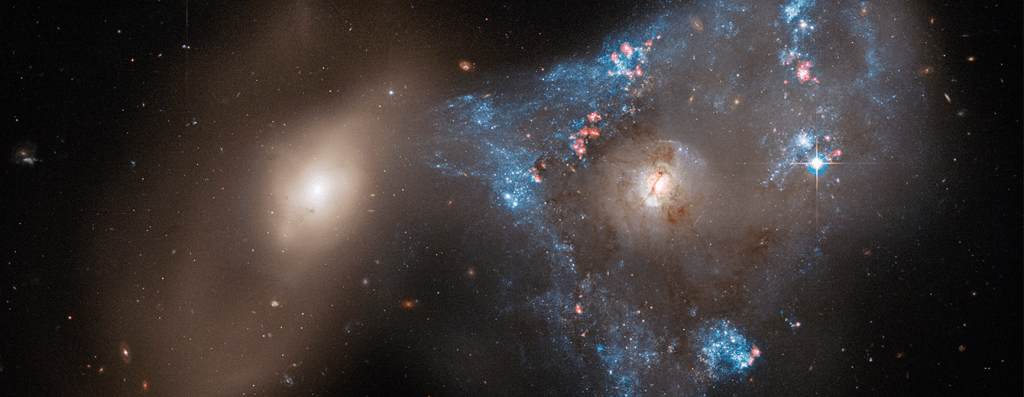
Image (Credit): Space Triangle image from the Hubble Space Telescope. (NASA, ESA, STScI, Julianne Dalcanton with the Center for Computational Astrophysics/Flatiron Inst., UWashington)

This week’s image is from the Hubble Space Telescope. It shows the collision of spiral galaxy NGC 2445 on the right and NGC 2444 on the left, creating what appears to be a triangle of new stars. Here is a little more on the pair from NASA’s Hubblesite:

A spectacular head-on collision between two galaxies fueled the unusual triangular-shaped star-birthing frenzy, as captured in a new image from NASA’s Hubble Space Telescope…

Astronomers suggest that the galaxies passed through each other, igniting the uniquely shaped star-formation firestorm in NGC 2445, where thousands of stars are bursting to life on the right-hand side of the image. This galaxy is awash in starbirth because it is rich in gas, the fuel that makes stars. However, it hasn’t yet escaped the gravitational clutches of its partner NGC 2444, shown on the left side of the image. The pair is waging a cosmic tug-of-war, which NGC 2444 appears to be winning. The galaxy has pulled gas from NGC 2445, forming the oddball triangle of newly minted stars.

The Future of Mauna Kea and its Telescopes

Image (Credit): Observatories on Mauna Kea in Hawaii. (EastVillage Images/Shutterstock)

Finding the right place to build a telescope is crucial in a time of growing cities and brighter skies, which is why the telescopes atop of Mauna Kean in Hawaii are a great resource. Is that about to change? It is not clear, but a Hawaiian State bill is attempting to transfer ownership of the site. Here is a summary of House Bill 2400:

Establishes the Mauna a Wakea stewardship authority as the sole authority for management of state-managed lands on Mauna a Wakea. Requires the authority to develop a single plan that dictates the management of land uses; human activities, uses, and access; stewardship; education; research; disposition; and overall operations. Requires the authority to develop a framework to limit astronomy development on Mauna a Wakea. Allows the authority to prohibit certain commercial use and activities on Mauna a Wakea. Requires an application and fee for all recreational users of Mauna a Wakea. Establishes the Mauna a Wakea management special fund. Repeals the Mauna Kea lands management special fund. Appropriates funds.

The telescopes have been the subject of debate among Native Hawaiians who do not want to see more construction on the mountain, nor like what is already there. The land beneath the multiple observatories is under lease from the state of Hawaii’s Board of Land and Natural Resources (BLNR) and administered by the University of Hawaii. In 1968, BLRN provided a 65-year lease to the University of Hawaii. The bill is looking to change this arrangement by creating a new authority to oversee the use of the land. The astronomy community is generally against this bill as it would add to restrictions on the use of the land and put control of the site primarily into the hands of parties opposed to the telescopes.

The bill follows the completion of a working group study on the matter. The expectation among many in the community has been that the mountain would eventually be returned to its natural state. The working group study makes this clear: “All observatories on Mauna a Wākea shall plan for and finance their decommissioning process as a condition for any lease on Mauna a Wākea.”

Will the approved House bill pass the full Senate? That’s a whole other matter, though it has been approved by a number of committees. Only time will tell if astronomy will die a slow death on a mountain top.

What is the Galileo Project?

After mentioning this organization in a previous post, I thought I would look a little further at its work. The Galileo Project was set up for one purpose:

…to bring the search for extraterrestrial technological signatures of Extraterrestrial Technological Civilizations (ETCs) from accidental or anecdotal observations and legends to the mainstream of transparent, validated and systematic scientific research. This project is complementary to traditional SETI, in that it searches for physical objects, and not electromagnetic signals, associated with extraterrestrial technological equipment.

I do not see the acronym ETC very often, but maybe like SETI it will become commonly known someday. It certainly sounds more sophisticated than terms such as UFO or Unidentified Aerial Phenomena (UAP) as it looks for “technological equipment,” aka spacecraft. The ‘Oumuamua interstellar object is the first potential ETC that helped to stimulate this group.

The Project’s three areas of activity are:

  1. Obtain High-resolution, Multi-detector UAP Images, Discover their Nature;
  2. Search for and In-Depth Research on ‘Oumuamua-like Interstellar Objects; and
  3.  Search for Potential ETC Satellites.

For instance, the third area of activity discusses using telescopes to discover “…potential 1 meter-scale or smaller satellites that may be exploring Earth, e.g., in polar orbits a few hundred km above Earth…”

We are no longer talking about listening for signals from another planet or monitoring distant objects rolling through our solar system, but instead searching for Earth-focused intelligence gathering by a distant civilization. Where is the Jodie Foster movie for this one?