A Space Telescope Goes Dark

Image (Credit): Picture of the completely integrated mirrors and detectors before final packaging. (Max Planck Institute for Extraterrestrial Physics)

You may have heard of Germany’s black hole-hunting telescope called the extended ROentgen Survey with an Imaging Telescope Arraye (eROSITA). It was launched in 2019 as part of a larger Russian-German mission called the “Spectrum-Roentgen-Gamma” (SRG) observatory and placed in the L2 Lagrange Point.

The eROSITA has three primary goals:

  • to detect the hot intergalactic medium of 50-100 thousand galaxy clusters and groups and hot gas in filaments between clusters to map out the large scale structure in the Universe for the study of cosmic structure evolution,
  • to detect systematically all obscured accreting Black Holes in nearby galaxies and many (up to 3 Million) new, distant active galactic nuclei and
  • to study in detail the physics of galactic X-ray source populations, like pre-main sequence stars, supernova remnants and X-ray binaries.

Well, similar to other joint Russian space missions, the telescope’s work was put on hold because of continuing events in Ukraine. The German government had this to say:

[Deutsches Zentrum für Luft- und Raumfahrt (DLR)] and the German Space Agency at DLR have been cooperating with Russian institutions on a number of research projects, in some cases with the participation of other German research organisations and universities, and international partners.

Against the backdrop of the aggressive attack on Ukraine, the DLR Executive Board is taking the following measures:

  • All collaboration activities with Russian institutions on current projects or projects in the planning stage will be terminated.
  • There will be no new projects or initiatives with institutions in Russia.

Where necessary, DLR will enter into coordination with other national and international partners.

We are slowly blocking our view of the bigger universe because of the reckless actions of a few. Hopefully, we can open up our eyes again shortly.
Exoplanet or Star?

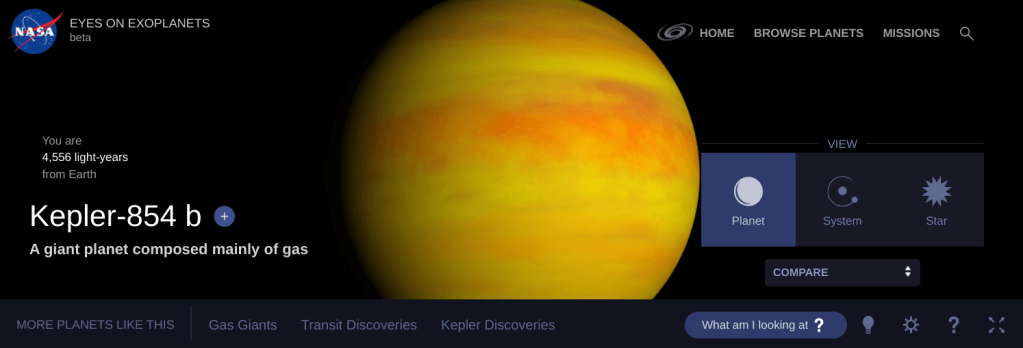
Image(Credit): Kepler-854b (NASA Exoplanet Exploration).

Phys.org had a good story on the reclassification of objects captured by the NASA’s Kepler Space Telescope once believed to be exoplanets. New evidence indicates three “exoplanets” – Kepler-854b, Kepler-840b, and Kepler-699b – are actually stars (hence, the NASA image above will need to be modified).

The article notes that the three objects are too large to be considered planets, being between two and four times the size of Jupiter. The results were part of a study from the Astronomical Journal. A fourth exoplanet, Kepler-747 b, might also be a star.

After updated information indicated Kepler-854b was about three times the size of Jupiter, one of the study authors said, “There’s no way the universe can make a planet of that size…It just doesn’t exist.”

While the team reviewed about 2,000 Kepler exoplanets to find these four questionable items, it is likely that more will be found in the future among other reported exoplanets. Fortunately, that still leaves us with plenty of real exoplanets to study.

The Future of the International Space Station

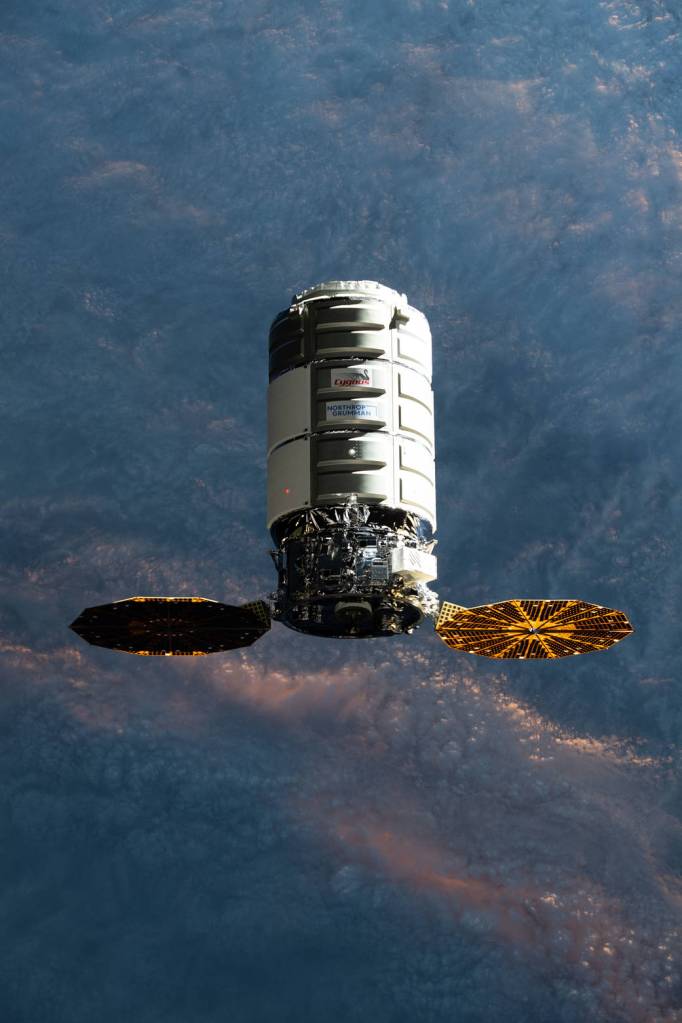
Image(Credit): Northrop Grumman’s Cygnus space freighter approaching the International Space Station (NASA).

Over the weekend, the Washington Post published an editorial by Homer Hickam, former NASA engineer and advisor to the National Space Council, titled, “Our space partnership with Russia can’t go on.” In the piece, Mr. Hickam argues that the International Space Station (ISS) has accomplished its goals and the US can now move onto other projects without the Russians:

With our flourishing commercial space companies, who are already cutting metal on their own future space stations, plus our federal government’s Artemis moon program, the United States is entering a new golden age of space exploration. The Russians, meanwhile, are stuck in the past with antiquated spacecraft and nowhere to go except the ISS.

Mr. Hickam appears to believe pushing out the Russians may mean the end of the ISS. Of course, this is just one man’s view, and whatever we do we need to do it in conjunction with our other ISS partners.

We could continue to maintain the ISS through 2030, as planned, and schedule more useful science even without the Russians as partners. This may make sense until we have another viable station that we can use, such as NASA’s planned lunar Gateway. Russia will not be part of the Gateway given that it is working with China on other lunar plans, so we do not need to worry about another breakup.

It would be better if Russia had focused on its space accomplishments rather than territorial ambitions as it prepares for the future. Joint space programs are a great way to use rockets for peaceful missions. I am not against a space race that pushes us even farther into space, yet I would prefer it be fueled by scientific achievement rather than nationalist angst.

Image(Credit): Artist rendering of the Artemis lunar Gateway (NASA).

A Day in Astronomy: The Discovery of Uranus

Source/Credit: Image of Uranus taken by Voyager 2 in 1986 (NASA).

On this day in 1781, astronomer Frederick William Herschel noticed a new object in the constellation of Gemini. With further study, he found he had discovered a new planet in our solar system – Uranus. Following his discovery, King George III appointed him Court Astronomer (yes, that King George who did not get many kind words from the embattled colonists on the other side of the pond).

While Frederick William Herschel is credited with numerous astronomical findings (including finding a number of moons, such as Saturn’s Enceladus, and discovering infrared radiation), he was also an accomplished musician. He played the oboe, violin, harpsichord and organ, and composed 24 symphonies as well as concertos, sonatas, and more. You can hear one of his symphonies here.

He was also a man with strong views about life beyond the Earth, including believing the Moon and the planets were populated with intelligent life (stating the surface of the Moon was similar to the English countryside) and speculating that the interior of the sun was heavy populated. Of course, he was a bit off the mark, but I expect he would be fascinated with the discovery of other planets and moons around the galaxy.

Extra: Frederick William Herschel’s sister Caroline assisted him with his work and also became an astronomer herself. For instance, she discovered a companion galaxy to the Andromeda Galaxy, M110 (NGC 205). She also discovered 14 nebulae and 8 comets. For her work cataloging stars, she was awarded the Gold Medal of the Royal Astronomical Society. She also became an Honorary Member of the Royal Astronomical Society in 1835.

Space Trips: Getting Too Costly?

Source/Credit: Star Wars: Galactic Starcruiser room from Disney World.

I thought we were trying to bring down the cost of space travel. Someone may need to inform Disney. It was already expensive enough for visit Disney World under normal circumstances, but now it is crazy if you want to be part of the new Star Wars adventure. Would you like to spend up to $20,000 for a two night stay in its Star Wars’ themed luxury suite? It is less than a spaceflight on Blue Origin, but at least you leave the ground with Blue Origin.

The new Star Wars immersive experience hotel opened March 1st, and I am sure plenty of people in this economy will plop down the money given that TSA will not be asking for the Covid test results before letting them return to Earth (unlike a trip to Earth-bound France).

Here is how Disney World sells it:

Star Wars: Galactic Starcruiser is a revolutionary new 2-night experience where you are the hero. You and your group will embark on a first-of-its-kind Star Wars adventure that’s your own. It’s the most immersive Star Wars story ever created—one where you live a bespoke experience and journey further into a Star Wars adventure than you ever dreamed possible.

Looking at the website, you should plan to spend about $4,800 for a two night stay for two, and about $6,000 if you are a group of four. I would expect each room to come with massage droids, but I did not see that on the list of services. However, you do get a hair dryer with your room. Even with these prices, I found only six available nights over the next three months.

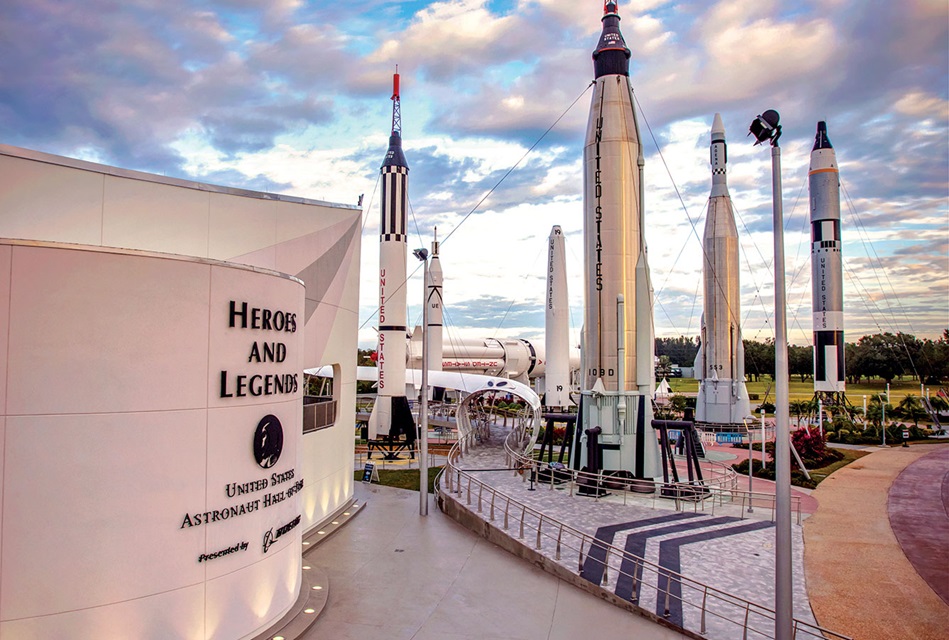
The Washington Post just had a piece about the high prices at the Disney parks, wondering whether the magic is gone. I am not sure about finding magic in a hotel room with no real windows, but I want to point out that Florida has other less expensive ways to get into the space spirit, from the Kennedy Space Center to the US Air Force Space and Missile Museum. Spend what you want, but I think you can keep the dream alive without giving the t-shirt off your back.

Source/Credit: Kennedy Space Center.