Does Musk Still Want Mars?

Image (Credit): Twitter icon and Mars. (icon-library.com)

It was Stephen R. Covey who said, “When you have too many top priorities, you effectively have no top priorities.” Is that where we are today with Elon Musk as he buys Twitter and puts his fortune and name on the line?

I thought he was the man with ideas for transforming our auto industry while also building the first Martian colony. Now I am not so sure. Maybe that is what too much money will do to a person – cause them to think that they have a solution for everything rather than simply some good, focused ideas.

Will Mr. Musk have enough attention and energy to oversee SpaceX, Tesla, and Twitter? Will he combine them into one big company? Will he sell off something to fund his other adventures?

Clearly his priorities have expanded from building better rockets and cars, though these improved rockets and cars really what this country needs more than one more person playing with Twitter. We don’t need Mr. Musk to save democracy from itself, which is what he seems to think he is doing. No, we need to build new and better things to get us into a better future. Let someone else worry about a company of 280 characters.

Twitter could disappear tomorrow and life will be just fine. And maybe Tesla could disappear tomorrow now that everyone else got the point about electric vehicles. But the space program? We need ever more innovative ideas to get us to the Moon, Mars, and elsewhere. That is where Mr. Musk helped us to dream and see a new future. No one dreams about improved edit capabilities at Twitter, except maybe Mr. Musk.

It is time to focus on the prize and not the prattle. Mr. Musk will not be remembered for “saving” Twitter from itself. He will be remembered if he can get us to Mars. It is time to grow up, ignore the noisy crowd, and start building rockets again. Let’s keep the dream alive.

The Latest on Exocomets

Image (Credit): Artist’s drawing of exocomets around the young Beta Pictoris. (NASA/FUSE/Lynette Cook)

We have all heard about exoplanets and exomoons, but what about exocomets? It appears the bodies we can observe outside of our solar system are getting even smaller. In a Scientific American article, “Ukrainian Astronomers Discover ‘Exocomets’ around Another Star,” we learn about Ukrainian astronomers who found five such comets using data from NASA’s Transiting Exoplanet Survey Satellite (TESS).

The comets in question orbit the young star Beta Pictoris, which is about 65 light-years from Earth. This is not the first time comments were detected in this distant solar system’s debris disk. The researchers confirmed those earlier sighting as well. The planet-forming debris surrounding the star presents plenty of opportunities for comet sightings.

Such findings, using information from both the Kepler Space Telescope and TESS, continue to expand our understanding of these objects. Once we focus the James Webb Space Telescope on these little bodies, it should get even more interesting.

Extra: You can find the 2019 Astronomy article on the exocomets around Beta Pictoris here.

Bernie Sanders Has Questions About Private Space Companies

Image (Credit): Senator Bernie Sanders. (Rollcall)

In a recent The Guardian newspaper editorial, Bernie Sanders had some questions about the role of private companies, such as Blue Origin and SpaceX, in the future of space exploration or, as he sees it, space profiteering. In his editorial, “Jeff Bezos is worth $160bn – yet Congress might bail out his space company,” he noted the following:

At this moment, if you can believe it, Congress is considering legislation to provide a $10bn bailout to Jeff Bezos’s Blue Origin space company for a contract to build a lunar lander. This legislation is taking place after Blue Origin lost a competitive bid to SpaceX, Musk’s company. Bezos is worth some $180bn.

He then cites the costs of Jeff Bezos’ yacht and homes while pointing out the plight of those living paycheck to paycheck. Of course, the same could be said about Elon Musk, rumored to be the wealthiest man in the world and now in the papers for buying another company unrelated to space (or the car industry).

First, this battle between Bernie and Bezos has been going on for some time, but the “bailout” in question was debunked by Verifythis.com last year, which stated:

Although NASA recently chose SpaceX over Blue Origin and one other company to receive funding for development of a human lunar lander, NASA stated in its decision that it wanted to fund two companies but lacked the budget to even fund one without negotiating the price down. The Senate bill is in response to that, allocating NASA enough funding to award a second contract. Blue Origin is the likely frontrunner for that contract, but it’s not guaranteed. Even if Blue Origin does win the contract, the allocated $10 billion to NASA isn’t just for this contract and therefore wouldn’t all go to Blue Origin.

Of course, the editorial is really a lead in to the real issue – who owes the minerals in space? Mr. Sanders highlights the worth of a single asteroid, stating “Just a single 3,000ft asteroid may contain platinum worth over $5tn.” It is a good point as we consider the next great race for minerals. Of course, maybe Uncle Sam can get some of it back via taxes, but it is not hard to believe space companies would incorporate in the Bahamas or somewhere similar to avoid such taxation.

Mr. Sanders is calling for a “rational space policy,” and wants Congress to be part of the process. Given the number of nations heading to the Moon and Mars, it is much bigger than the U.S. Congress. The United Nations will need to play a role here via the Outer Space Treaty, which NASA is attempting to update via the Artemis Accords. In addition, maybe Congress needs to update the rescind the 2015 U.S. Commercial Space Launch Competitiveness Act, which states in § 51303:

A United States citizen engaged in commercial recovery of an asteroid resource or a space resource under this chapter shall be entitled to any asteroid resource or space resource obtained, including to possess, own, transport, use, and sell the asteroid resource or space resource obtained in accordance with applicable law, including the international obligations of the United States.

By the way, NASA has already issued a press release regarding more lunar lander opportunities. You can find the press release here.

Earth Day: Let’s Cut Back on Satellites

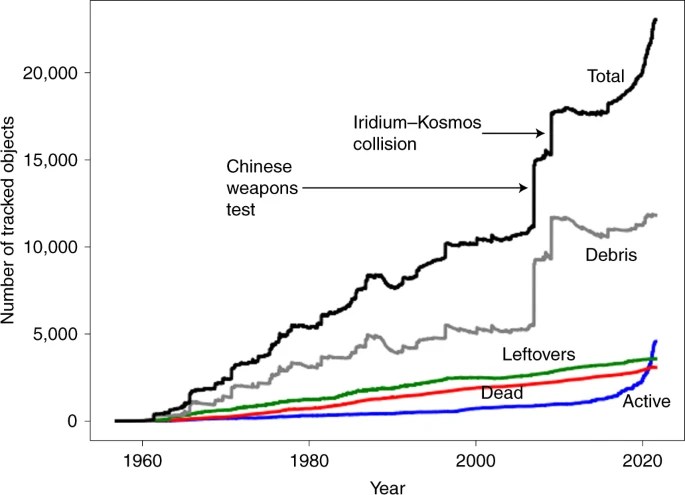
Image (Credit): The growth of all tracked objects in space over time. (‘The Case for Space Environmentalism,” Nature, April 22, 2022)

An article in Nature is encouraging a new approach to satellites as we recognize Earth Day. The article, “The Case for Space Environmentalism,” highlights the growth of satellites (estimated to reach more than 100,000 by the end of the decade) and related debris as well as its impact on professional astronomy, public stargazing, and the sustainability of commercial, civic, and military activity in space. The paper states:

We have laid out the argument for the urgent need for orbital space to be considered part of the human environment. Adequately addressing the problems detailed above will require a holistic approach that treats orbital space as part of the environment, and worthy of environmental protection through existing and new policies, rules and regulations at national and international levels. We urge decision makers and policymakers to consider the environmental impacts of all aspects of satellite constellations, including launch, operation and de-orbit, and to work with all stakeholders to co-create a shared, ethical, sustainable approach to space.

This is the perfect day to consider the need to protect the environment on the ground and in the heavens. Happy Earth Day!

Pic of the Week: Stars and Planets over Portugal

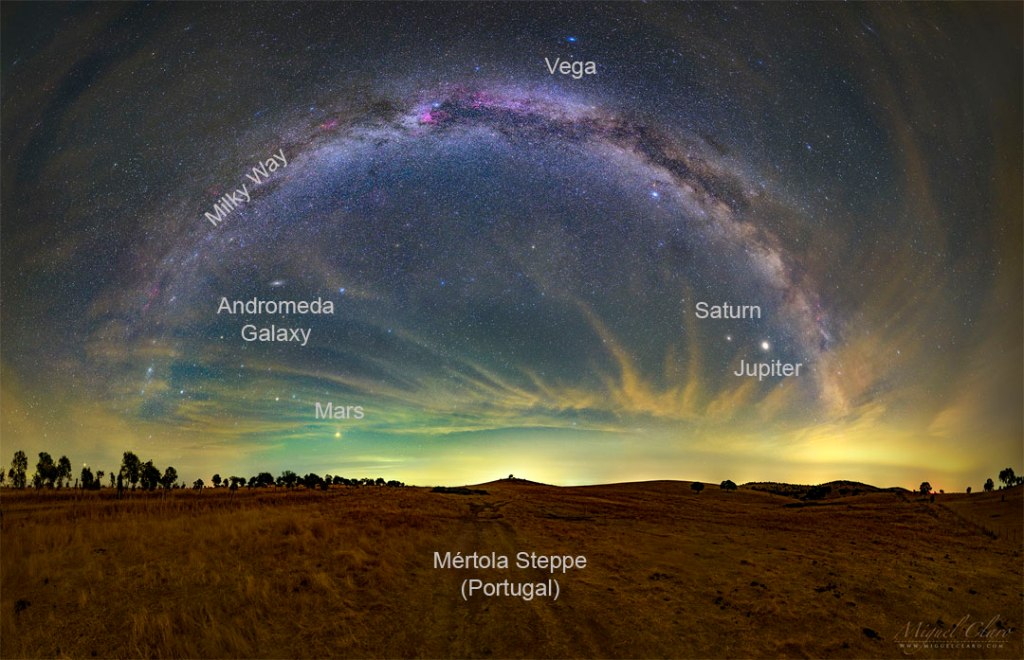
Image (Credit): Night sky in Portugal. (Miguel Claro, The World at Night, Dark Sky Alqueva)

This week’s photo is an amazing night shot in Portugal showing planets, stars, and galaxies. Here is the full description from NASA’s Astronomy Picture of the Day:

The mission was to document night-flying birds — but it ended up also documenting a beautiful sky. The featured wide-angle mosaic was taken over the steppe golden fields in Mértola, Portugal in 2020. From such a dark location, an immediately-evident breathtaking glow arched over the night sky: the central band of our Milky Way galaxy. But this sky had much more. Thin clouds crossed the sky like golden ribbons. The planet Mars appeared on the far left, while the planets Saturn and Jupiter were also simultaneously visible — but on the opposite side of the sky, here seen on the far right. Near the top of the image the bright star Vega can be found, while the far-distant and faint Andromeda Galaxy can be seen toward the left, just below Milky Way’s arch. As the current month progresses, several planets are lining up in the pre-dawn sky: Jupiter, Venus, Mars, and Saturn.