White House: U.S. Anti-Satellite Testing to End

Image (Credit): The White House. (Whitehouse.gov)

Earlier this week, Vice President Harris announced that the United States will no longer conduct anti-satellite missile testing in space. In her statement, she highlighted the dangers caused by the related satellite debris.

From Vandenberg Air Force Base in California, she stated:

I am pleased to announce that as of today, the United States commits not to conduct destructive direct-ascent anti-satellite missile testing.

Simply put: These tests are dangerous, and we will not conduct them.

We are the first nation to make such a commitment.  And today, on behalf of the United States of America, I call on all nations to join us.

Whether a nation is spacefaring or not, we believe this will benefit everyone, just as space benefits everyone.

In the days and months ahead, we will work with other nations to establish this as a new international norm for responsible behavior in space.  And there is a direct connection between such a norm and the daily life of the American people. 

If a satellite was taken out by debris, it could affect the daily weather forecast, GPS driving directions, and even your favorite TV station.

Critical infrastructure, like wind turbines that power our homes, well, they rely on satellites for connectivity.

Satellites help us track the climate crisis.  They enable our commercial activities.  And they help us protect our troops and our people.

All of this is threatened by the debris created by these reckless tests.

These tests also threaten the lives of astronauts in the International Space Station.

In fact, I spoke earlier this month with Mark Vande Hei who just returned from 355 days in space on the Space Station.  An American record.

While he was in space, Russia conducted its anti-satellite missile test.  He had to shelter in an escape capsule in case the Space Station was hit by debris.

Russia’s action was a threat not just to his life, but also to those of Russian cosmonauts.

Let’s hope other nations are quick to follow. Further discussions and decisions on limiting the number of satellites in low-Earth orbit would also be helpful. That said, it’s a start.

A Day in Astronomy: The Launch of Salyut 1

Image (Credit): Artist’s drawing of the Soviet Union’s Salyut 1 with a Soyuz spacecraft (upper left) approaching it. (NASA)

On this day in 1971, the Soviet Union launched Salyut 1, mankind’s first space station. The station was visited only once by a Soyuz 11 crew for 24 days, who had to cut their mission short do to technical problems, including an electrical fire. The crew died of asphyxia on the trip back to Earth.

While an earlier Soyuz 10 crew had attempted to dock with the Salyut 1, they were unsuccessful. This unsuccessful docking, followed by the death of the Soyuz 11 crew, led to a redesign of the Soyuz spacecraft. Unfortunately, the new spacecraft could not be launched in time to save the Salyut 1. The station burned up in the Earth’s atmosphere in October 1971.

The Salyut 1 was followed by the successful launch of five more stations, the last one being the Zvezda Service Module, launched in 2000. This module is still in orbit and part of the International Space Station.

Even with all of the issues, it was a great accomplishment for the Soviet Union. The United States did not have its own space station in orbit until the launch of Skylab 1 on May 14, 1973.

No one said space missions were easy or safe, as NASA has also learned over the years.

You can read more about the Soviet and Russian space stations at this NASA site.

Podcast: More on the James Webb Space Telescope

Image (Credit): Alan Alda’s podcast Clear & Vivid (Amazon)

I wanted to highlight another astronomy interview from Alan Alda’s Clear+Vivid podcast, in this case involving a mother and daughter team. Astronomers Natalie and Natasha Batalha discuss “Looking for Life on Alien Worlds” using the new James Webb Space Telescope. The two guests discuss upcoming efforts to better understand the 5,000+ planets that have already been discovered. One of their favorites among the exoplanet systems is the TRAPPIST-1 system, noting the parent red star is about the size of Jupiter. This small star has seven exoplanets, with the “Goldilocks zone” being much closer in than is the case in our system.

NASA describes one of the exoplanets in the “Goldilocks zone,” TRAPPIST-1d, in this way:

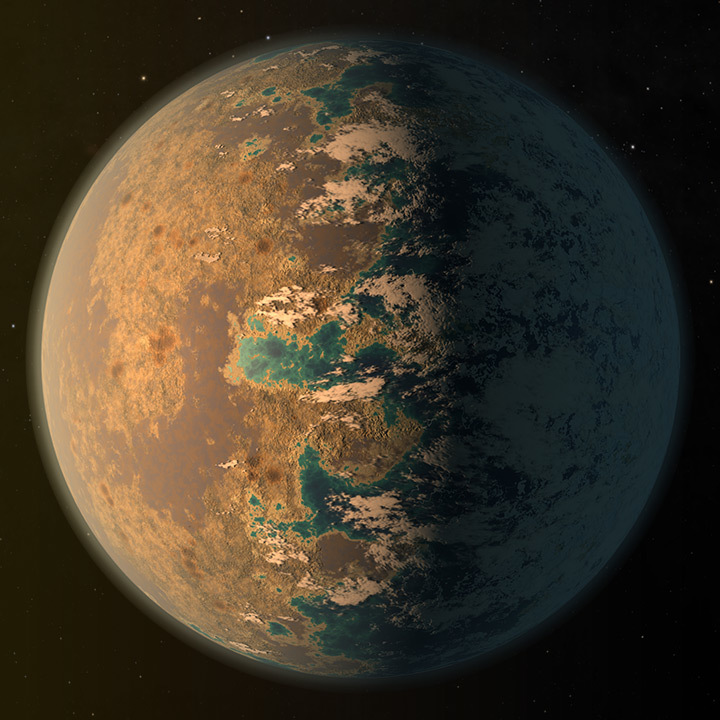
TRAPPIST-1d is one of seven Earth-sized planets in the TRAPPIST-1 system. About 40 light-years from Earth, TRAPPIST-1 is unusual both for its number of small rocky planets and the number in the habitable zone. Several of the artist’s illustrationsportray possible water or ice in the system– the proximity of the planets to their red dwarf star may indicate that any of them could have water on their surface. This artist’s concept shows TRAPPIST-1d with a narrow band of water near the terminator, the divide between a hot, dry day and an ice-covered night side.

You can read more about the TRAPPIST-1 system here.

Image (Credit): Artist’s image of exoplanet TRAPPIST-1d. (NASA)

Space Quote: Not a Hopeful Message

Image (Credit): The Very Large Array located at the National Radio Astronomy Observatory (NROA) site in Socorro, New Mexico, which is used by the Search for Extraterrestrial Intelligence Institute. (Alex Savello/NROA)

“There is a real possibility that humans will not exist as a species thousands of years from now, and thus a ‘message in a bottle’ about the very basic details would at least serve as a small reminder that we existed.”

Statement by Kristen Fahy, a NASA Jet Propulsion Laboratory scientist and co-author on a paper about a message of friendship to alien beings. The paper, A Beacon in the Galaxy: Updated Arecibo Message for Potential FAST and SETI Projects, calls for:

An updated, binary-coded message has been developed for transmission to extraterrestrial intelligences in the Milky Way galaxy. The proposed message includes basic mathematical and physical concepts to establish a universal means of communication followed by information on the biochemical composition of life on Earth, the Solar System’s time-stamped position in the Milky Way relative to known globular clusters, as well as digitized depictions of the Solar System, and Earth’s surface. The message concludes with digitized images of the human form, along with an invitation for any receiving intelligences to respond. 

I am not what the value of a ‘message in a bottle’ would be from a dead civilization. I was hoping for a more hopeful spin about why we want to send a message. Of course, many do not want to send a message at all because the alien response may not be what we want.

Similar Sentiments About Our Place in the Universe

Image (Credit): Book cover of Olaf Staledon’s Star Maker. (Wesleyan University Press)

I was reading the 1937 science fiction classic Star Maker by British writer Olaf Stapledon when I came across this statement:

I perceived that I was on a little round grain or rock and metal, filmed with water and with air, whirling in sunlight and darkness. And on the skin of that little grain all the swarms of men, generation by generation, had lived in labor and blindness, with intermittent joy and intermittent lucidity of spirit. And all their history, with its folk-wanderings, its empires, its philosophies, its proud sciences, its social revolutions, its increasing hunger for community, was but a flicker in one day of the lives of stars.

It reminded me of Carl Sagan’s famous statement from his book Pale Blue Dot:

From this distant vantage point, the Earth might not seem of any particular interest. But for us, it’s different. Consider again that dot. That’s here. That’s home. That’s us. On it everyone you love, everyone you know, everyone you ever heard of, every human being who ever was, lived out their lives. The aggregate of our joy and suffering, thousands of confident religions, ideologies, and economic doctrines, every hunter and forager, every hero and coward, every creator and destroyer of civilization, every king and peasant, every young couple in love, every mother and father, hopeful child, inventor and explorer, every teacher of morals, every corrupt politician, every “superstar,” every “supreme leader,” every saint and sinner in the history of our species lived there–on a mote of dust suspended in a sunbeam.

Mr. Stapledon had only his imagination at hand when he pondered the role of humans. His book has been praised by numerous science fiction writers, including H. G. Wells, Stanisław Lem, and Arthur C. Clarke.

Mr. Sagan was fortunate to have an image from Voyager I that clearly made this same point. We need the combined powers of dreamers and scientists as we face this awesome universe.

Image (Credit): This narrow-angle color image of the Earth, dubbed ‘Pale Blue Dot’, is a part of the first ever ‘portrait’ of the solar system taken by Voyager 1. (NASA JP)

Extra: For more background on the image above, visit NASA’s site 10 Things You Might Not Know About Voyager’s Famous ‘Pale Blue Dot’ Photo.